Glenn Greenwald
Politics • Culture • Writing
The Histrionics and Melodrama Around 1/6 Are Laughable, but They Serve Several Key Purposes
As Kamala Harris compares 1/6 to 9/11 and Nancy Pelosi introduces the cast of Hamilton to sing about democracy, today's inanity should not obscure its dangers.
October 31, 2022
post photo preview
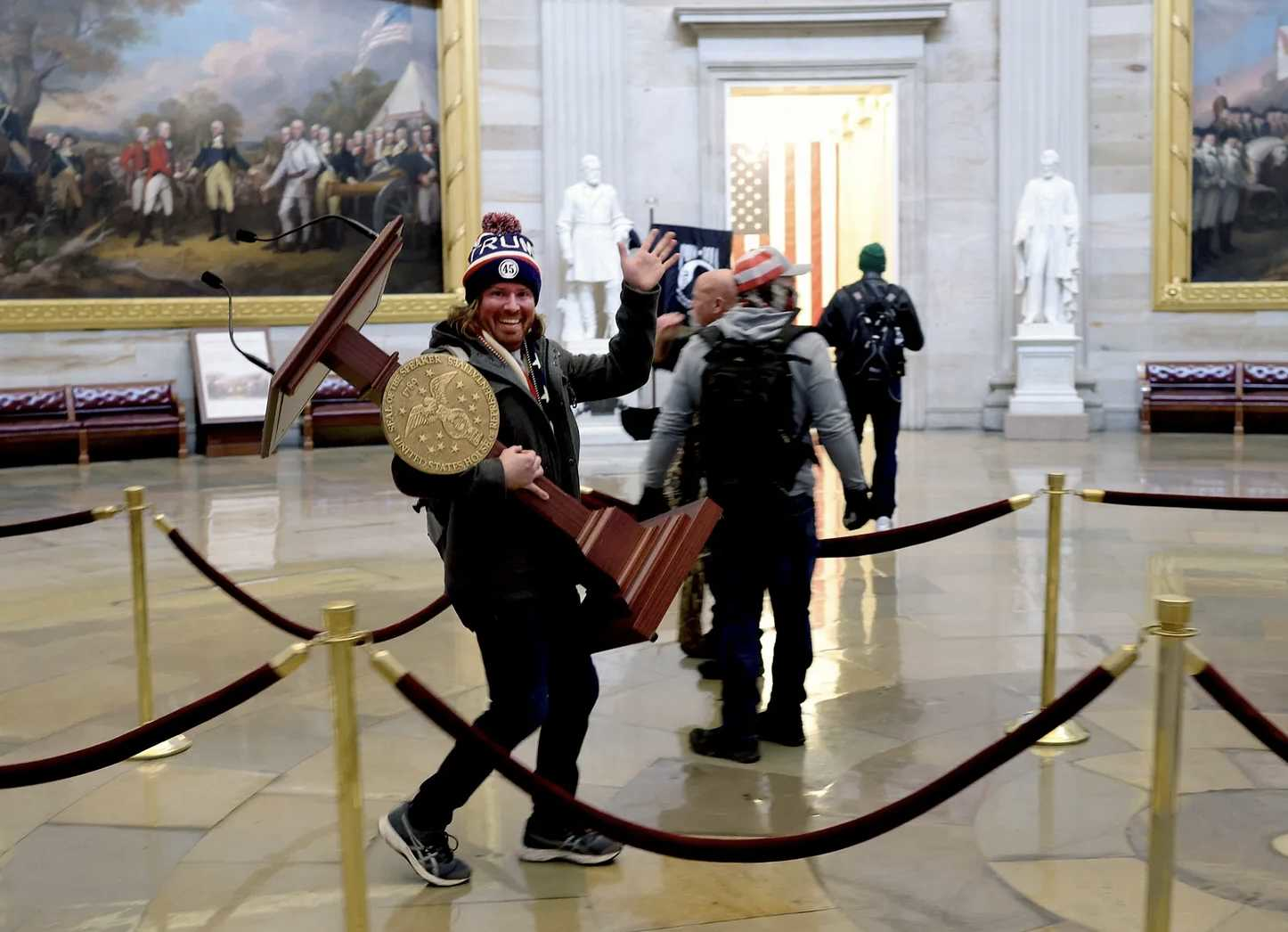
A pro-Trump protester carries the lectern of U.S. Speaker of the House Nancy Pelosi through the Rotunda of the U.S. Capitol Building (Photo by Win McNamee/Getty Images)

This article was originally publised on Substack on Jan. 6, 2022

The number of people killed by pro-Trump supporters at the January 6 Capitol riot is equal to the number of pro-Trump supporters who brandished guns or knives inside the Capitol. That is the same number as the total of Americans who — after a full year of a Democrat-led DOJ conducting what is heralded as “the most expansive federal law enforcement investigation in US history” — have been charged with inciting insurrection, sedition, treason or conspiracy to overthrow the government as a result of that riot one year ago. Coincidentally, it is the same number as Americans who ended up being criminally charged by the Mueller probe of conspiring with Russia over the 2016 election, and the number of wounds — grave or light — which AOC, who finally emerged at night to assure an on-edge nation that she was “okay" while waiting in an office building away from the riot at the rotunda, sustained on that solemn day.

That number is zero. But just as these rather crucial facts do not prevent the dominant wing of the U.S. corporate media and Democratic Party leaders from continuing to insist that Donald Trump's 2016 election victory was illegitimate due to his collusion with the Kremlin, it also does not prevent January 6 from being widely described in those same circles as an Insurrection, an attempted coup, an event as traumatizing as Pearl Harbor (2,403 dead) or the 9/11 attack (2,977 dead), and as the gravest attack on American democracy since the mid-19th Century Civil War (750,000 dead). The Huffington Post's White House reporter S.V. Date said that it was wrong to compare 1/6 to 9/11, because the former — the three-hour riot at the Capitol — was “1,000 percent worse.”

Indeed, when it comes to melodrama, histrionics, and exploitation of fear levels from the 1/6 riot, there has never been any apparent limit. And today — the one-year anniversary of that three-hour riot — there is no apparent end in sight. Too many political and media elites are far too vested in this maximalist narrative for them to relinquish it voluntarily.

The orgy of psychodrama today was so much worse and more pathetic than I expected — and I expected it to be extremely bad and pathetic. “House Democrats [waited] their turn on the House floor to talk to Dick Cheney as a beacon for American democracy,” reported CNN's Edward-Isaac Dovere; “One by one, Democrats are coming over to introduce themselves to former VP Dick Cheney and shake his hand,” added ABC News’ Ben Siegel. Nancy Pelosi gravely introduced Lin-Manuel Miranda and the cast of Hamilton to sermonize and sing about the importance of American democracy. The Huffington Post's senior politics reporter Igor Bobic unironically expressed gratitudefor “the four legged emotional support professionals roaming the Capitol this week, helping officers, staffers, and reporters alike” — meaning therapy dogs. Yesterday, CNN's Kaise Hunt announced: "Tomorrow is going to be a tough one for those of us who were there or had loved ones in the building. Thinking of all of you and finding strength knowing I’m not alone in this." Unsurprisingly but still repellently: Kamala Harris today compared 1/6 to 9/11.

That the January 6 riot was some sort of serious attempted insurrection or "coup” was laughable from the start, and has become even more preposterous with the passage of time and the emergence of more facts. The United States is the most armed, militarized and powerful regime in the history of humanity. The idea that a thousand or so Trump supporters, largely composed of Gen X and Boomers, who had been locked in their homes during a pandemic — three of whom were so physically infirm that they dropped dead from the stress — posed anything approaching a serious threat to “overthrow” the federal government of the United States of America is such a self-evidently ludicrous assertion that any healthy political culture would instantly expel someone suggesting it with a straight face.

Putting the events of January 6 into their proper perspective is not to dismiss the fact that it was a lamentable event — any more than opposing the exploitation of 9/11 and exaggeration of the domestic threat of Muslim extremism, which I spent a full decade doing, meant that one was denying the heinousness of that attack. The day after the 1/6 riot, I wrote in this space that “the introduction of physical force into political protest is always lamentable, usually dangerous, and, except in the rarest of circumstances that are plainly inapplicable here, unjustifiable.” I still believe that to be the case. There was nothing virtuous about the 1/6 riot.

But it is typically the case that fear-mongering and deliberate exaggeration of threats has an element of truth to them. Al Qaeda and ISIS really did want to carry out mass-casualty events on U.S. soil. COVID is a fatal virus that can kill people and has done so around the world. There are right-wing extremists in the U.S. bent on using violence to advance their political agenda, just as there are left-wing extremists and anarchist insurrectionary movements and many other types eager to do the same (more destruction was caused by the latter than the former over the last two years, to say nothing of the dozens of journalists physically assaulted by individuals participating in Antifa protests).

Far too many centers of political and economic power benefit from an exaggerated and even false narrative about January 6 to expect it ever to end.

The Democratic Party, eager to cling to their majoritarian control of the White House and both houses of Congress, knows it has no political program that is appealing and thus hopes that this concocted drama will help them win — just as they foolishly believed about Russiagate. With the threat of Al Qaeda and ISIS faded if not gone, and the attempt to scare Americans over Putin a failure, the U.S. security state, always in need of a scary enemy, has settled on the claim that right-wing “domestic extremists" are the greatest threat to U.S national security; though they claimed this before 1/6, casting 1/6 as an insurrection allows them to classify an entire domestic political movement as an insurrectionary criminal group and thus justify greater spying powers and budgetary authorities.

CNN proudly announced that the most-watched day in the history of their network was 1/6. The dirty little secret of the liberal wing of the corporate media is that nobody benefited more from the Trump campaign, his presidency and its aftermath than they, and they are desperate to rejuvenate it and re-discover that glory. Meanwhile, coddled journalists who have never broken meaningful stories have finally found a way to claim that they stared down dangerous and risky situations — as if they spent years in the middle of an active war zone or were persecuted and prosecuted by a corrupt and authoritarian state for their intrepid reporting — and have converted Brian Stelter's CNN show into a virtual therapists's couch where they all get to go and talk about how they are still coping with the deep trauma of spending a few hours in the Capitol last year.

The pettiness and absurdity of this Democrat/media narrative, laughable as it often is, does not mean it is free of danger. Asserting that the U.S. suffered an attempted coup by a still-vibrant armed faction of insurrectionists is a self-evidently inflammatory claim. It has been used to allocate billions more to the Capitol Police and to radically expand their powers; justify the increased domestic use of FBI tactics including monitoring and infiltration; and agitate for the mass imprisonment of political adversaries, including elected members of Congress. Hapless defendants who are not even accused of using violence have been held in harsh solitary confinement for close to a year, then sentenced to years in prison — while self-styled criminal justice reform advocates say nothing or, even worse, cheer. If one genuinely believes that the U.S. came close to a violent overthrow of American democracy and still faces the risk of an insurrection, then it is rational to sanction radical acts by the U.S. security state that, in more peaceful and normal times, would be unthinkable.

Where is this “insurrection"? What happened to it? Where did it go? The January 6 protest barely lasted four hours until it was easily subdued. Copying the Bush/Cheney model of keeping fear levels high by constantly issuing vague warnings of looming violence and doom, the Department of Homeland Security issued at least six separate "heightened threat” warnings last year, not a single one of which materialized. There were no violent protests in Washington, D.C. or in state capitols on Inauguration Day; no violent protests materialized the week after Biden's inauguration; no violent protest erupted once COVID lockdowns were eased due to social media provocations; none happened on the 20th anniversary of the 9/11 attack; there was no right-wing violence perpetrated in connection with the commemoration of the 100th year anniversary of the Tulsa massacre. Each time such a warning was issued, cable outlets and liberal newspapers breathlessly reported them, ensuring fear levels remained high.

What is really going on here is as tawdry as it is obvious. Democrats have no governing program on which they can run and win. The complete collapse of the party was temporarily obscured by the once-in-a-generation talent in Barack Obama and the very narrow win in 2020 of a banal, empty septuagenarian, thanks to the incumbent-killing double crisis of a devastating pandemic and economic shutdown. But the edifice of this party collapsed under Obama — “the Whole Democratic Party is Now a Smoking Pile of Rubble,” warned supreme Democratic partisan Matt Yglesias at Vox in 2016 — and it is collapsing once again under Biden. Its only ideologies — neoliberalism, corporatism, militarism — are widely despised failures, but they are imprisoned by their donor base from offering anything else.

A party that does not believe it can win politically often tries to criminalize its adversaries. That is what Democrats did during the Trump years: focused not on defeating his legislative agenda but obsessing on the fantasy that FBI Superman Robert Mueller was going to come and round up Trump and his family members and associates and haul them off to prison. The Democrats’ beloved former CIA Director, NBC News star John Brennan, all but promised that was going to happen two weeks before Robert Mueller closed his investigation by announcing he found no evidence to establish the core crime of conspiring with Russia.

When that four-year-long prison fantasy collapsed, they quickly switched to a new one: Merrick Garland was going to come and round up Trump and his allies in Congress like Josh Hawley and Matt Gaetz and haul them off to prison as traitors and seditionists. After a full year of producing nothing but banal trespassing and assault charges — no sexy allegations of insurrection or sedition let alone the arrest of Trump and his relatives — Democrats, who spent four years pretending to revere an apolitical DOJ, are now intensifying their political pressure on Garland to deliver. In a press conference on Wednesday, the beleaguered Attorney General addressed those political attacks directly and urged Democrats to have patience, implying that people not present at the Capitol on 1/6 could and would be criminally charged. Fantasies of Trump in handcuffs once again danced in the heads of Adam Schiff, Laurence Tribe, and Eric Swalwell.

As demonstrated by the glee universally expressed by Democrats over Twitter's banning this week of Rep. Marjorie Taylor Greene (R-GA), it is not an exaggeration to say the top priority for Democrats is to turn their opponents into criminals who are silenced, censored, rounded up by prosecutors and then imprisoned. That is why they are so content to see Julian Assange (an actually persecuted and traumatized journalist) rotting in prison: to them, his real crime is that he helped elect Donald Trump and, for that, he deserves prison. That is why this Insurrection narrative surrounding 1/6 is so vital to Democrats: it ensures that they are not facing a different ideological camp but rather a band of criminals and domestic terrorists who deserve not a defeat at the ballot box but censorship by a union of state and corporate power, followed by a prison cell.

Democrats’ media allies — the axis of the The New York Times, NBC News, CNN, The Atlantic, The New Yorker, and the undifferentiated and rapidly disappearing mass of Brooklyn-based digital outlets (HuffPostGizmodoBuzzFeedDailyBeastIntercept MotherJonesViceVultureVox, who churn out the same content with just a few more curse words and radical poses) — now speak only to and for one another when they are not failing completely. Keeping Americans hooked on fear — of Putin's takeover of the U.S., of COVID, of an imminent fascist coup — is their only hope for relevance, profit, and purpose. They can shower themselves with as many Pulitzers as they want for fake Russiagate stories and spend all day applauding one another on social media, but they know they are widely despised and distrusted. Posturing as the bulwark against Fascism and Defenders of Democracy — which in turn depends on the existence of an insurrectionary movement — is their only hope for finding meaning. But cowards and propagandists who weep and engage in public therapy when confronting the slightest discomfort do not make for convincing super heroes. Nobody is inspired, but merely irritated, by the Princess whining about the pea buried under her seventeenth mattress.

As usual, the prime beneficiaries of all of this, and the most dangerous one, is the U.S. security state. They need, above all else, an existential threat to justify their endless growth and unchecked power. All of the old villains are largely vanquished and stale (Communism, Al Qaeda, ISIS), while the proposed stand-ins never really panned out (Americans never woke up thinking about Putin). That is when they began claiming that the most serious threat was a domestic one: fellow American citizens who harbor “extremist” ideologies. Though they claim that it is right-wing extremists who pose the greatest threat — white supremacist extremists to be exact — the lists they disseminate of who falls under this rubric encompass essentially anyoneleft, right or in between — who sees the world differently than Wolf Blitzer, Joe Scarborough and Chris Hayes see it: meaning dissidents, those who distrust the decrees of authority and wish to subvert rather than submit to establishment power. Claiming that the U.S. is facing an Insurrection and barely survived a "coup” is a script that could not be better suited to their interests.

There are unresolved questions surrounding the 1/6 riot that are genuinely important and merit scrutiny. It is, for instance, confirmed that the FBI had at least two informants on the ground with whom it was communicating as the protest unfolded, but the full extent of the FBI's role — whether it replicated what it repeatedly did during the first War on Terror and then again in engineering the attempted kidnapping of Michigan Gov. Gretchen Whitmer — remains unknown. That is because the only bodies capable of discovering the answers — the DOJ and the Congressional 1/6 Committee — have no interest in finding out. The contrary is true: they have a strong interest in suppressing those facts because it undermines rather than advances their fear narrative.

Fear is a powerful human drive — arguably the most powerful one. Humans need it to survive; without it, they would have died off thousands of years ago. It is embedded in our psyches. And any demagogue worth their salt knows how to stimulate and manipulate it. Fear — as we have seen throughout the last two years of the COVID pandemic — breeds acquiescence, subservience and conformity. It fosters not just a willingness, but an eagerness to submit to any authority promising to keep you safe from the threat and to banish and silence anyone dissenting from their decrees, on the ground that dissent is not just wrong but dangerous.

What happened on January 6 was ugly and disturbing. But it was nowhere near an insurrection, a coup, or anything threatening American democracy (to the extent it can be said to exist) in a fundamental or sustained way. That core truth — that it was merely an angry protest that, like so many of its kind, organically turned into a three-hour riot killing nobody except four of the protesters — destroys its value. Only the false narrative that has been constructed over the last year and consecrated by today's inane festivities can convert this banal episode into some world-historic event that at once makes heroes out of those who were there to oppose it and justifies everything and anything done in the name of preventing its repetition.

Correction, Jan. 8, 2021, 5:47 a.m. ET: This article was edited to reflect that Marjorie Taylor Greene is the Republican, not Democratic, Congressional representative from Georgia.

 

community logo
Join the Glenn Greenwald Community
To read more articles like this, sign up and join my community today
0
What else you may like…
Videos
Podcasts
Posts
Articles
Lindsey Graham: Senator from Tel Aviv

New video: Glenn discusses Sen. Lindsey Graham's (R-SC) extreme devotion to Israel.

00:18:06
The NYT Performs Loyal Stenography—Masquerading as Journalism—to Protect AOC

The New York Times dutifully protected AOC after her disastrous interview flop at the Munich Security Conference, watch Glenn's reaction here:

00:31:25
AOC Makes Her Big Foreign Policy Debut, Falls Flat on Her Face
00:23:22
Listen to this Article: Reflecting New U.S. Control of TikTok's Censorship, Our Report Criticizing Zelensky Was Deleted

For years, U.S. officials and their media allies accused Russia, China and Iran of tyranny for demanding censorship as a condition for Big Tech access. Now, the U.S. is doing the same to TikTok. Listen below.

Listen to this Article: Reflecting New U.S. Control of TikTok's Censorship, Our Report Criticizing Zelensky Was Deleted
Good news about your Locals membership and our move to Substack

Dear Locals members:

We have good and exciting news about your Locals membership. It concerns your ability to easily convert your Locals membership to SYSTEM UPDATE into a Substack subscription for our new page, with no additional cost or work required.

As most of you know, on February 6, we announced the end of our SYSTEM UPDATE program on Rumble, or at least an end to the format we’ve used for the last 3 years: as a live, nightly news program aired exclusively on Rumble.

With the end of our show, we also announced that we were very excited to be moving back to Substack as the base for our journalism. Such a move, we explained, would enable us not only to continue to produce the kind of in-depth video segments, interviews, and reports you’ve grown accustomed to on SYSTEM UPDATE, but would also far better enable me to devote substantial time to long-form investigations and written articles. Our ability at Subtack to combine all those forms of journalism will enable (indeed, already is enabling) us to ...

Super article, one of his best. Excellently persuasive. Thanks Glenn!

I am going to pick a quotation that has a pivotal focus for the reading:

”(oil is often cited as the reason, but the U.S. is a net exporter of oil, and multiple oil-rich countries in that region are perfectly eager to sell the U.S. as much oil as it wants to buy)”

There is another argument that states that it is to prevent Iran from selling oil to China. So then there is the question, that if Iran only agreed to not sell oil to China, would we still be on the brink of a new war with Iran?

There is also the question of how much money does it cost simply to transport all that military hardware to that region in order to “persuade” Iran and then if Trump decides to return all that military hardware back to home base how much is that cost in addition to the departure journey?

https://open.substack.com/pub/greenwald/p/the-us-is-on-the-brink-of-a-major?r=onv0m&utm_medium=ios

NEW: Message from Glenn to Locals Members About Substack, System Update, and Subscriptions

Hello Locals members:

I wanted to make sure you are updated on what I regard as the exciting changes we announced on Friday night’s program, as well as the status of your current membership.

As most of you likely know, we announced on our Friday night show that that SYSTEM UPDATE episode would be the last one under the show’s current format (if you would like to watch it, you can do so here). As I explained when announcing these changes, producing and hosting a nightly video-based show has been exhilarating and fulfilling, but it also at times has been a bit draining and, most importantly, an impediment to doing other types of work that have always formed the core of my journalism: namely, longer-form written articles and deep investigations.

We have produced three full years of SYSTEM UPDATE episodes on Rumble (our premiere show was December 10, 2022). And while we will continue to produce video content similar to the kinds of segments that composed the show, they won’t be airing live every night at 7:00 p.m. Eastern, but instead will be posted periodically throughout the week (as we have been doing over the last couple of months both on Rumble and on our YouTube channel here).

To enlarge the scope of my work, I am returning to Substack as the central hub for my journalism, which is where I was prior to launching SYSTEM UPDATE on Rumble. In addition to long-form articles, Substack enables a wide array of community-based features, including shorter-form written items that can be posted throughout the day to stimulate conversation among members, a page for guest writers, and new podcast and video features. You can find our redesigned Substack here; it is launching with new content on Monday.

For our current Locals subscribers, you can continue to stay at Locals or move to Substack, whichever you prefer. For any video content and long-form articles that we publish for paying Substack members, we will cross-post them here on Locals (for members only), meaning that your Locals subscription will continue to give you full access to our journalism. 

When I was last at Substack, we published some articles without a paywall in order to ensure the widest possible reach. My expectation is that we will do something similar, though there will be a substantial amount of exclusive content solely for our subscribers. 

We are working on other options to convert your Locals membership into a Substack membership, depending on your preference. But either way, your Locals membership will continue to provide full access to the articles and videos we will publish on both platforms.

Although I will miss producing SYSTEM UPDATE on a (more or less) nightly basis, I really believe that these changes will enable the expansion of my journalism, both in terms of quality and reach. We are very grateful to our Locals members who have played such a vital role over the last three years in supporting our work, and we hope to continue to provide you with true independent journalism into the future.

— Glenn Greenwald   

Read full Article
post photo preview
The Epstein Files: The Blackmail of Billionaire Leon Black and Epstein's Role in It
Black's downfall — despite paying tens of millions in extortion demands — illustrates how potent and valuable intimate secrets are in Epstein's world of oligarchs and billionaires.

One of the towering questions hovering over the Epstein saga was whether the illicit sexual activities of the world’s most powerful people were used as blackmail by Epstein or by intelligence agencies with whom (or for whom) he worked. The Trump administration now insists that no such blackmail occurred.


Top law enforcement officials in the Trump administration — such as Attorney General Pam Bondi, FBI Director Kash Patel, and former FBI Deputy Director Dan Bongino — spent years vehemently denouncing the Biden administration for hiding Epstein’s “client list,” as well as concealing details about Epstein’s global blackmail operations. Yet last June, these exact same officials suddenly announced, in the words of their joint DOJ-FBI statement, that their “exhaustive review” found no “client list” nor any “credible evidence … that Epstein blackmailed prominent individuals as part of his actions.” They also assured the public that they were certain, beyond any doubt, that Epstein killed himself.


There are still many files that remain heavily and inexplicably redacted. But, from the files that have been made public, we know one thing for certain. One of Epstein’s two key benefactors — the hedge fund billionaire Leon Black, who paid Epstein at least $158 million from 2012 through 2017 — was aggressively blackmailed over his sexual conduct. (Epstein’s second most-important benefactor was the billionaire Les Wexner, a major pro-Israel donor who cut off ties in 2008 after Epstein repaid Wexner $100 million for money Wexner alleged Epstein had stolen from him.)


Despite that $100 million repayment in 2008 to Wexner, Epstein had accumulated so much wealth through his involvement with Wexner that it barely made a dent. He was able to successfully “pilfer” such a mind-boggling amount of money because he had been given virtually unconstrained access to, and power over, every aspect of Wexner’s life. Wexner even gave Epstein power of attorney and had him oversee his children’s trusts. And Epstein, several years later, created a similar role with Leon Black, one of the richest hedge fund billionaires of his generation.


Epstein’s 2008 conviction and imprisonment due to his guilty plea on a charge of “soliciting a minor for prostitution” began mildly hindering his access to the world’s billionaires. It was at this time that he lost Wexner as his font of wealth due to Wexner’s belief that Epstein stole from him.


But Epstein’s world was salvaged, and ultimately thrived more than ever, as a result of the seemingly full-scale dependence that Leon Black developed on Epstein. As he did with Wexner, Epstein insinuated himself into every aspect of the billionaire’s life — financial, political, and personal — and, in doing so, obtained innate, immense power over Black.


The recently released Epstein files depict the blackmail and extortion schemes to which Black was subjected. One of the most vicious and protracted arose out of a six-year affair he carried on with a young Russian model, who then threatened in 2015 to expose everything to Black’s wife and family, and “ruin his life,” unless he paid her $100 million. But Epstein himself also implicitly, if not overtly, threatened Black in order to extract millions more in payments after Black, in 2016, sought to terminate their relationship.


While the sordid matter of Black’s affair has been previously reported — essentially because the woman, Guzel Ganieva, went public and sued Black, accusing him of “rape and assault,” even after he paid her more than $9 million out of a $21 million deal he made with her to stay silent — the newly released emails provide very vivid and invasive details about how desperately Black worked to avoid public disclosure of his sex life. The broad outlines of these events were laid out in a Bloomberg report on Sunday, but the text of emails provide a crucial look into how these blackmail schemes in Epstein World operated.


Epstein was central to all of this. That is why the emails describing all of this in detail are now publicly available: because they were all sent by Black or his lawyers to Epstein, and are thus now part of the Epstein Files.


Once Ganieva began blackmailing and extorting Black with her demands for $100 million — which she repeatedly said was her final, non-negotiable offer — Black turned to Epstein to tell him how to navigate this. (Black’s other key advisor was Brad Karp, who was forced to resign last week as head of the powerful Paul, Weiss law firm due to his extensive involvement with Epstein).


From the start of Ganieva’s increasingly unhinged threats against Black, Epstein became a vital advisor. In 2015, Epstein drafted a script for what he thought Black should tell his mistress, and emailed that script to himself.


Epstein included an explicit threat that Black would have Russian intelligence — the Federal Security Service (FSB) — murder Ganieva, because, Epstein argued, failure to resolve this matter with an American businessman important to the Russian economy would make her an “enemy of the state” in the eyes of the Russian government. Part of Epstein’s suggested script for Black is as follows (spelling and grammatical errors maintained from the original correspondents):


you should also know that I felt it necessary to contact some friends in FSB, and I though did not give them your name. They explained to me in no uncertain terms that especially now , when Russia is trying to bring in outside investors , as you know the economy sucks, and desperately investment that a person that would attempt to blackmail a us businessman would immeditaly become in the 21 century, what they terms . vrag naroda meant in the 20th they translated it for me as the enemy of the people, and would e dealt with extremely harshly , as it threatened the economies of teh country. So i expect never ever to hear a threat from you again.


In a separate email to Karp, Black’s lawyer, Epstein instructs him to order surveillance on the woman’s whereabouts by using the services of Nardello & Co., a private spy and intelligence agency used by the world’s richest people.


Black’s utter desperation for Ganieva not to reveal their affair is viscerally apparent from the transcripts of multiple lunches he had with her throughout 2015, which he secretly tape-recorded. His law firm, Paul, Weiss, had those recordings transcribed, and those were sent to Epstein.


To describe these negotiations as torturous would be an understatement. But it is worth taking a glimpse to see how easily and casually blackmail and extortion were used in this world.


Leon Black is a man worth $13 billion, yet his life appears utterly consumed by having to deal constantly with all sorts of people (including Epstein) demanding huge sums of money from him, accompanied by threats of various kinds. Epstein was central to helping him navigate through all of this blackmail and extortion, and thus, he was obviously fully privy to all of Black’s darkest secrets.


At their first taped meeting on August 14, 2015, Black repeatedly offered his mistress a payment package of $1 million per year for the next 12 years, plus an up-front investment fund of £2 million for her to obtain a visa to live with her minor son in the UK. But Ganieva repeatedly rejected those offers, instead demanding a lump sum of no less than $100 million, threatening him over and over that she would destroy his life if he did not pay all of it.


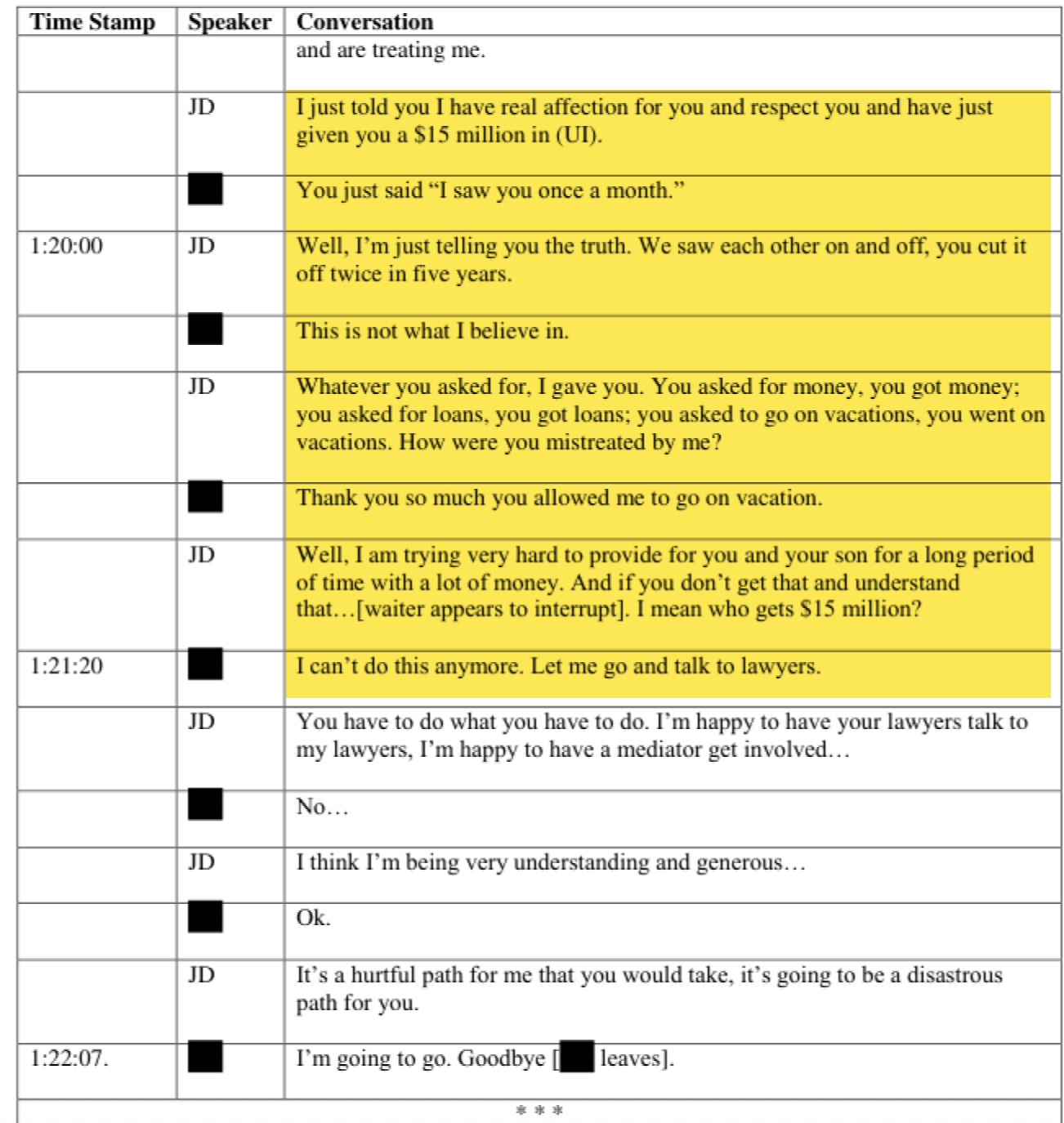
Black was both astounded and irritated that she thought a payment package of $15 million was somehow abusive and insulting. He emphasized that he was willing to negotiate it upward, but she was adamant that it had to be $100 million or nothing, an amount Black insisted he could not and would not pay.


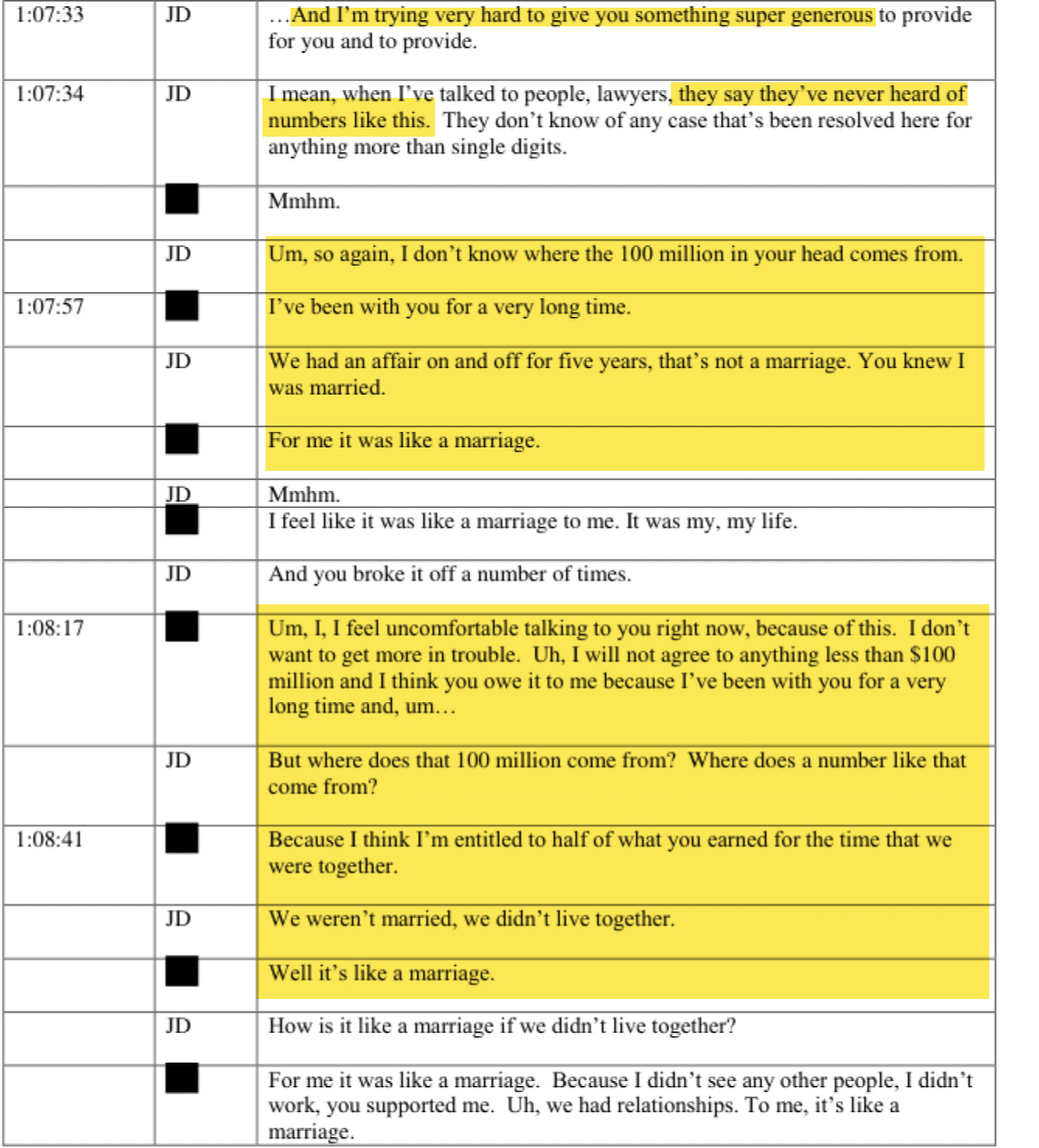
When pressed to explain where she derived that number, Ganieva argued that she considered the two to be married (even though Black was long married to another woman), thereby entitling her to half of what he earned during those years. Whenever Black pointed out that they only had sex once a month or so for five or six years in an apartment he rented for her, and that they never even lived together, she became offended and enraged and repeatedly hardened her stance.


Over and over, they went in circles for hours across multiple meetings. Many times, Black tried flattery: telling her how much he cared for her and assuring her that he considered her brilliant and beautiful. Everything he tried seemed to backfire and to solidify her $100 million blackmail price tag. (In the transcripts, “JD” refers to “John Doe,” the name the law firm used for Black; the redacted initials are for Ganieva):


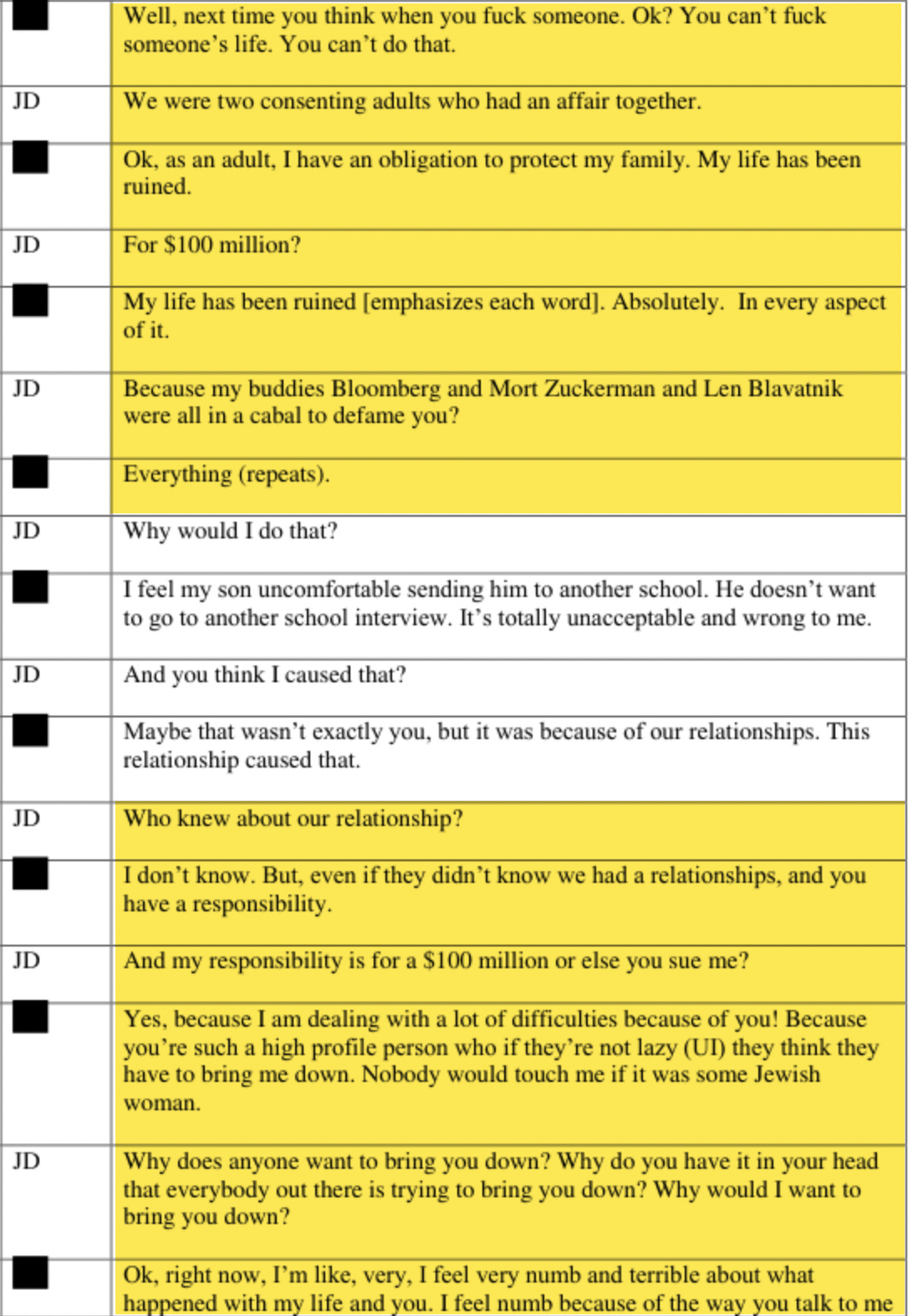
On other occasions during their meetings, Ganieva insisted that she was entitled to $100 million because Black had “ruined” her life. He invariably pointed out how much money he had given her over the years, to say nothing of the $15 million he was now offering her, and expressed bafflement at how she could see it that way.


In response, Ganieva would insist that a “cabal” of Black’s billionaire friends — led by Michael Bloomberg, Mort Zuckerman, and Len Blavatnik — had conspired with Black to ruin her reputation. Other times, she blamed Black for speaking disparagingly of her to destroy her life. Other times, she claimed that people in multiple cities — New York, London, Moscow — were monitoring and following her and trying to kill her. This is but a fraction of the exchanges they had, as he alternated between threatening her with prison and flattering her with praise, while she kept saying she did not care about the consequences and would ruin his life unless she was paid the full amount:


By their last taped meeting in October, Ganieva appeared more willing to negotiate the amount of the payment. The duo agreed to a payment package in return for her silence; it included Black’s payments to her of $100,000 per month for the next 12 years (or $1.2 million per year for 12 years), as well as other benefits that exceeded a value of $5 million. They signed a contract formalizing what they called a “non-disclosure agreement,” and he made the payments to her for several years on time. The ultimate total value to be paid was $21 million.


Unfortunately for Black, these hours of misery, and the many millions paid to her, were all for naught. In March, 2021, Ganieva — despite Black’s paying the required amounts — took to Twitter to publicly accuse Black of “raping and assaulting” her, and further claimed that he “trafficked” her to Epstein in Miami without her consent, to force her to have sex with Epstein.


As part of these public accusations, Ganieva spilled all the beans on the years-long affair the two had: exactly what Black had paid her millions of dollars to keep quiet. When Black denied her accusations, she sued him for both defamation and assault. Her case was ultimately dismissed, and she sacrificed all the remaining millions she was to receive in an attempt to destroy his life.


Meanwhile, in 2021, Black was forced out of the hedge fund that made him a billionaire and which he had co-founded, Apollo Global Management, as a result of extensive public disclosures about his close ties to Epstein, who, two years earlier, had been arrested, became a notorious household name, and then died in prison. As a result of all that, and the disclosures from his mistress, Black — just like his ex-mistress — came to believe he was the victim of a “cabal.” He sued his co-founder at Apollo, the billionaire Josh Harris, as well as Ganieva and a leading P.R. firm on RICO charges, alleging that they all conspired to destroy his reputation and drive him out of Apollo. Black’s RICO case was dismissed.


Black’s fear that these disclosures would permanently destroy his reputation and standing in society proved to be prescient. An independent law firm was retained by Apollo to investigate his relationship with Epstein. Despite the report’s conclusion that Black had done nothing illegal, he has been forced off multiple boards that he spent tens of millions of dollars to obtain, including the highly prestigious post of Chair of the Museum of Modern Art, which he received after compiling one of the world’s largest and most expensive collections, only to lose that position due to Epstein associations.


So destroyed is Leon Black’s reputation from these disclosures that a business relationship between Apollo and the company Lifetouch — an 80-year-old company that captures photos of young school children — resulted in many school districts this week cancelling photo shoots involving this company, even though the company never appeared once in the Epstein files. But any remote association with Black — once a pillar of global high society — is now deemed so toxic that it can contaminate anything, no matter how removed from Epstein.


None of this definitively proves anything like a global blackmail ring overseen by Epstein and/or intelligence agencies. But it does leave little doubt that Epstein was not only very aware of the valuable leverage such sexual secrets gave him, but also that he used it when he needed to, including with Leon Black. Epstein witnessed up close how many millions Black was willing to pay to prevent public disclosure in a desperate attempt to preserve his reputation and marriage.


In October, The New York Times published a long examination of what was known at the time about the years-long relationship between Black and Epstein. In 2016, Black seemingly wanted to stop paying Epstein the tens of millions each year he had been paying him. But Epstein was having none of it.


Far from speaking to Black as if Epstein were an employee or paid advisor, he spoke to the billionaire in threatening, menacing, highly demanding, and insulting terms:


Jeffrey Epstein was furious. For years, he had relied on the billionaire Leon Black as his primary source of income, advising him on everything from taxes to his world-class art collection. But by 2016, Mr. Black seemed to be reluctant to keep paying him tens of millions of dollars a year.

So Mr. Epstein threw a tantrum.

One of Mr. Black’s other financial advisers had created “a really dangerous mess,” Mr. Epstein wrote in an email to Mr. Black. Another was “a waste of money and space.” He even attacked Mr. Black’s children as “retarded” for supposedly making a mess of his estate.

The typo-strewn tirade was one of dozens of previously unreported emails reviewed by The New York Times in which Mr. Epstein hectored Mr. Black, at times demanding tens of millions of dollars beyond the $150 million he had already been paid.

The pressure campaign appeared to work. Mr. Black, who for decades was one of the richest and highest-profile figures on Wall Street, continued to fork over tens of millions of dollars in fees and loans, albeit less than Mr. Epstein had been seeking.


The mind-bogglingly massive size of Black’s payments to Epstein over the years for “tax advice” made no rational sense. Billionaires like Black are not exactly known for easily or willingly parting with money that they do not have to pay. They cling to money, which is how many become billionaires in the first place.


As the Times article put it, Black’s explanation for these payments to Epstein “puzzled many on Wall Street, who have asked why one of the country’s richest men would pay Mr. Epstein, a college dropout, so much more than what prestigious law firms would charge for similar services.”


Beyond Black’s payments to Epstein himself, he also “wired hundreds of thousands of dollars to at least three women who were associated with Mr. Epstein.” And all of this led to Epstein speaking to Black not the way one would speak to one’s most valuable client or to one’s boss, but rather spoke to him in terms of non-negotiable ultimatums, notably similar to the tone used by Black’s mistress-turned-blackmailer:


Email from Jeffrey Epstein to Leon Black, dated November 2, 2015.


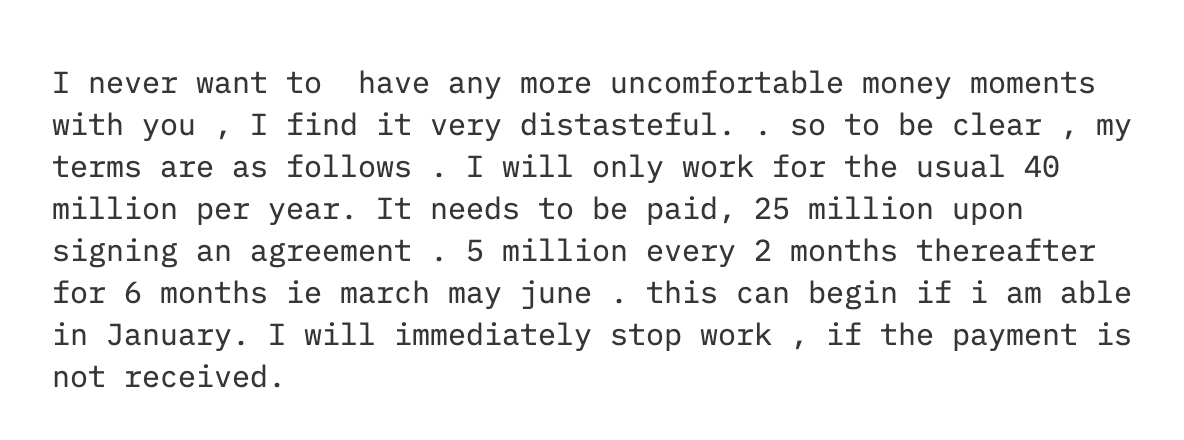
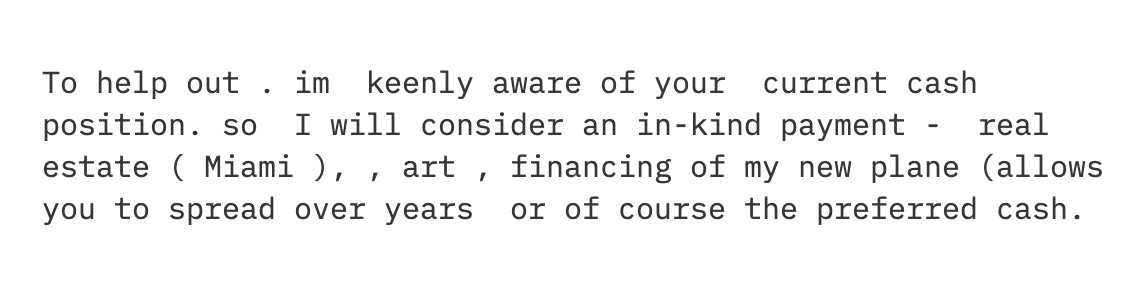
When Black did not relent, Epstein’s demands only grew more aggressive. In one email, he told Black: “I think you should pay the 25 [million] that you did not for this year. For next year it's the same 40 [million] as always, paid 20 [million] in jan and 20 [million] in july, and then we are done.” At one point, Epstein responded to Black’s complaints about a cash crunch (a grievance Black also tried using with his mistress) with offers to take payment from Black in the form of real estate, art, or financing for Epstein’s plane:


Email from Jeffrey Epstein to Leon Black, dated March 16, 2016.


With whatever motives, Black succumbed to Epstein’s pressure and kept paying him massive sums, including $20 million at the start of 2017, and then another $8 million just a few months later, in April.


Epstein had access to virtually every part of Black’s life, as he had with Wexner before that. He was in possession of all sorts of private information about their intimate lives, which would and could have destroyed them if he disclosed it, as evidenced by the reputational destruction each has suffered just from the limited disclosures about their relationship with Epstein, to say nothing of whatever else Epstein knew.


Leon Black was most definitely the target of extreme and aggressive blackmail and extortion over his sex life in at least one instance we know of, and Epstein was at the center of that, directing him. While Wall Street may have been baffled that Wexner and Black paid such sums to Epstein over the years, including after Black wanted to cut him off, it is quite easy to understand why they did so. That is particularly so as Epstein became angrier and more threatening, and as he began reminding Black of all the threats from which Epstein had long protected him. Epstein watched those exact tactics work for Black’s mistress.


The DOJ continues to insist it has no evidence of Epstein using his access to the most embarrassing parts of the private and sexual lives of the world’s richest and most powerful people for blackmail purposes. But we know for certain that blackmail was used in this world, and that Epstein was not only well aware of highly valuable secrets but was also paid enormous, seemingly irrational sums by billionaires whose lives he knew intimately.

Read full Article
post photo preview
Amazon's Ring and Google's Nest Unwittingly Reveal the Severity of the U.S. Surveillance State
Just a decade after a global backlash was triggered by Snowden reporting on mass domestic surveillance, the state-corporate dragnet is stronger and more invasive than ever.

That the U.S. Surveillance State is rapidly growing to the point of ubiquity has been demonstrated over the past week by seemingly benign events. While the picture that emerges is grim, to put it mildly, at least Americans are again confronted with crystal clarity over how severe this has become.


The latest round of valid panic over privacy began during the Super Bowl held on Sunday. During the game, Amazon ran a commercial for its Ring camera security system. The ad manipulatively exploited people’s love of dogs to induce them to ignore the consequences of what Amazon was touting. It seems that trick did not work.


The ad highlighted what the company calls its “Search Party” feature, whereby one can upload a picture, for example, of a lost dog. Doing so will activate multiple other Amazon Ring cameras in the neighborhood, which will, in turn, use AI programs to scan all dogs, it seems, and identify the one that is lost. The 30-second commercial was full of heart-tugging scenes of young children and elderly people being reunited with their lost dogs.


But the graphic Amazon used seems to have unwittingly depicted how invasive this technology can be. That this capability now exists in a product that has long been pitched as nothing more than a simple tool for homeowners to monitor their own homes created, it seems, an unavoidable contract between public understanding of Ring and what Amazon was now boasting it could do.


Amazon’s Super Bowl ad for Ring and its “Search Party” feature.


Many people were not just surprised but quite shocked and alarmed to learn that what they thought was merely their own personal security system now has the ability to link with countless other Ring cameras to form a neighborhood-wide (or city-wide, or state-wide) surveillance dragnet. That Amazon emphasized that this feature is available (for now) only to those who “opt-in” did not assuage concerns.


Numerous media outlets sounded the alarm. The online privacy group Electronic Frontier Foundation (EFF) condemned Ring’s program as previewing “a world where biometric identification could be unleashed from consumer devices to identify, track, and locate anything — human, pet, and otherwise.”


Many private citizens who previously used Ring also reacted negatively. “Viral videos online show people removing or destroying their cameras over privacy concerns,” reported USA Today. The backlash became so severe that, just days later, Amazon — seeking to assuage public anger — announced the termination of a partnership between Ring and Flock Safety, a police surveillance tech company (while Flock is unrelated to Search Party, public backlash made it impossible, at least for now, for Amazon to send Ring’s user data to a police surveillance firm).


The Amazon ad seems to have triggered a long-overdue spotlight on how the combination of ubiquitous cameras, AI, and rapidly advancing facial recognition software will render the term “privacy” little more than a quaint concept from the past. As EFF put it, Ring’s program “could already run afoul of biometric privacy laws in some states, which require explicit, informed consent from individuals before a company can just run face recognition on someone.”


Those concerns escalated just a few days later in the context of the Tucson disappearance of Nancy Guthrie, mother of long-time TODAY Show host Savannah Guthrie. At the home where she lives, Nancy Guthrie used Google’s Nest camera for security, a product similar to Amazon’s Ring.


Guthrie, however, did not pay Google for a subscription for those cameras, instead solely using the cameras for real-time monitoring. As CBS News explained, “with a free Google Nest plan, the video should have been deleted within 3 to 6 hours — long after Guthrie was reported missing.” Even professional privacy advocates have understood that customers who use Nest without a subscription will not have their cameras connected to Google’s data servers, meaning that no recordings will be stored or available for any period beyond a few hours.


For that reason, Pima County Sheriff Chris Nanos announced early on “that there was no video available in part because Guthrie didn’t have an active subscription to the company.” Many people, for obvious reasons, prefer to avoid permanently storing comprehensive daily video reports with Google of when they leave and return to their own home, or who visits them at their home, when, and for how long.


Despite all this, FBI investigators on the case were somehow magically able to “recover” this video from Guthrie’s camera many days later. FBI Director Kash Patel was essentially forced to admit this when he released still images of what appears to be the masked perpetrator who broke into Guthrie’s home. (The Google user agreement, which few users read, does protect the company by stating that images may be stored even in the absence of a subscription.)


While the “discovery” of footage from this home camera by Google engineers is obviously of great value to the Guthrie family and law enforcement agents searching for Guthrie, it raises obvious yet serious questions about why Google, contrary to common understanding, was storing the video footage of unsubscribed users. A former NSA data researcher and CEO of a cybersecurity firm, Patrick Johnson, told CBS: “There's kind of this old saying that data is never deleted, it's just renamed.” 


Image obtained through Nancy Guthrie’s unsubscribed Google Nest camera and released by the FBI.


It is rather remarkable that Americans are being led, more or less willingly, into a state-corporate, Panopticon-like domestic surveillance state with relatively little resistance, though the widespread reaction to Amazon’s Ring ad is encouraging. Much of that muted reaction may be due to a lack of realization about the severity of the evolving privacy threat. Beyond that, privacy and other core rights can seem abstract and less of a priority than more material concerns, at least until they are gone.


It is always the case that there are benefits available from relinquishing core civil liberties: allowing infringements on free speech may reduce false claims and hateful ideas; allowing searches and seizures without warrants will likely help the police catch more criminals, and do so more quickly; giving up privacy may, in fact, enhance security.


But the core premise of the West generally, and the U.S. in particular, is that those trade-offs are never worthwhile. Americans still all learn and are taught to admire the iconic (if not apocryphal) 1775 words of Patrick Henry, which came to define the core ethos of the Revolutionary War and American Founding: “Give me liberty or give me death.” It is hard to express in more definitive terms on which side of that liberty-versus-security trade-off the U.S. was intended to fall.


These recent events emerge in a broader context of this new Silicon Valley-driven destruction of individual privacy. Palantir’s federal contracts for domestic surveillance and domestic data management continue to expand rapidly, with more and more intrusive data about Americans consolidated under the control of this one sinister corporation.


Facial recognition technology — now fully in use for an array of purposes from Customs and Border Protection at airports to ICE’s patrolling of American streets — means that fully tracking one’s movements in public spaces is easier than ever, and is becoming easier by the day. It was only three years ago that we interviewed New York Timesreporter Kashmir Hill about her new book, “Your Face Belongs to Us.” The warnings she issued about the dangers of this proliferating technology have not only come true with startling speed but also appear already beyond what even she envisioned.


On top of all this are advances in AI. Its effects on privacy cannot yet be quantified, but they will not be good. I have tried most AI programs simply to remain abreast of how they function.


After just a few weeks, I had to stop my use of Google’s Gemini because it was compiling not just segregated data about me, but also a wide array of information to form what could reasonably be described as a dossier on my life, including information I had not wittingly provided it. It would answer questions I asked it with creepy, unrelated references to the far-too-complete picture it had managed to create of many aspects of my life (at one point, it commented, somewhat judgmentally or out of feigned “concern,” about the late hours I was keeping while working, a topic I never raised).


Many of these unnerving developments have happened without much public notice because we are often distracted by what appear to be more immediate and proximate events in the news cycle. The lack of sufficient attention to these privacy dangers over the last couple of years, including at times from me, should not obscure how consequential they are.


All of this is particularly remarkable, and particularly disconcerting, since we are barely more than a decade removed from the disclosures about mass domestic surveillance enabled by the courageous whistleblower Edward Snowden. Although most of our reporting focused on state surveillance, one of the first stories featured the joint state-corporate spying framework built in conjunction with the U.S. security state and Silicon Valley giants.


The Snowden stories sparked years of anger, attempts at reform, changes in diplomatic relations, and even genuine (albeit forced) improvements in Big Tech’s user privacy. But the calculation of the U.S. security state and Big Tech was that at some point, attention to privacy concerns would disperse and then virtually evaporate, enabling the state-corporate surveillance state to march on without much notice or resistance. At least as of now, the calculation seems to have been vindicated.

Read full Article
See More
Available on mobile and TV devices
google store google store app store app store
google store google store app tv store app tv store amazon store amazon store roku store roku store
Powered by Locals