Glenn Greenwald
Politics • Culture • Writing
Biden Wanted $33B More For Ukraine. Congress Quickly Raised it to $40B. Who Benefits?
Tens of billions, soon to be much more, are flying out of U.S. coffers to Ukraine as Americans suffer, showing who runs the U.S. Government, and for whose benefit.
November 01, 2022
post photo preview
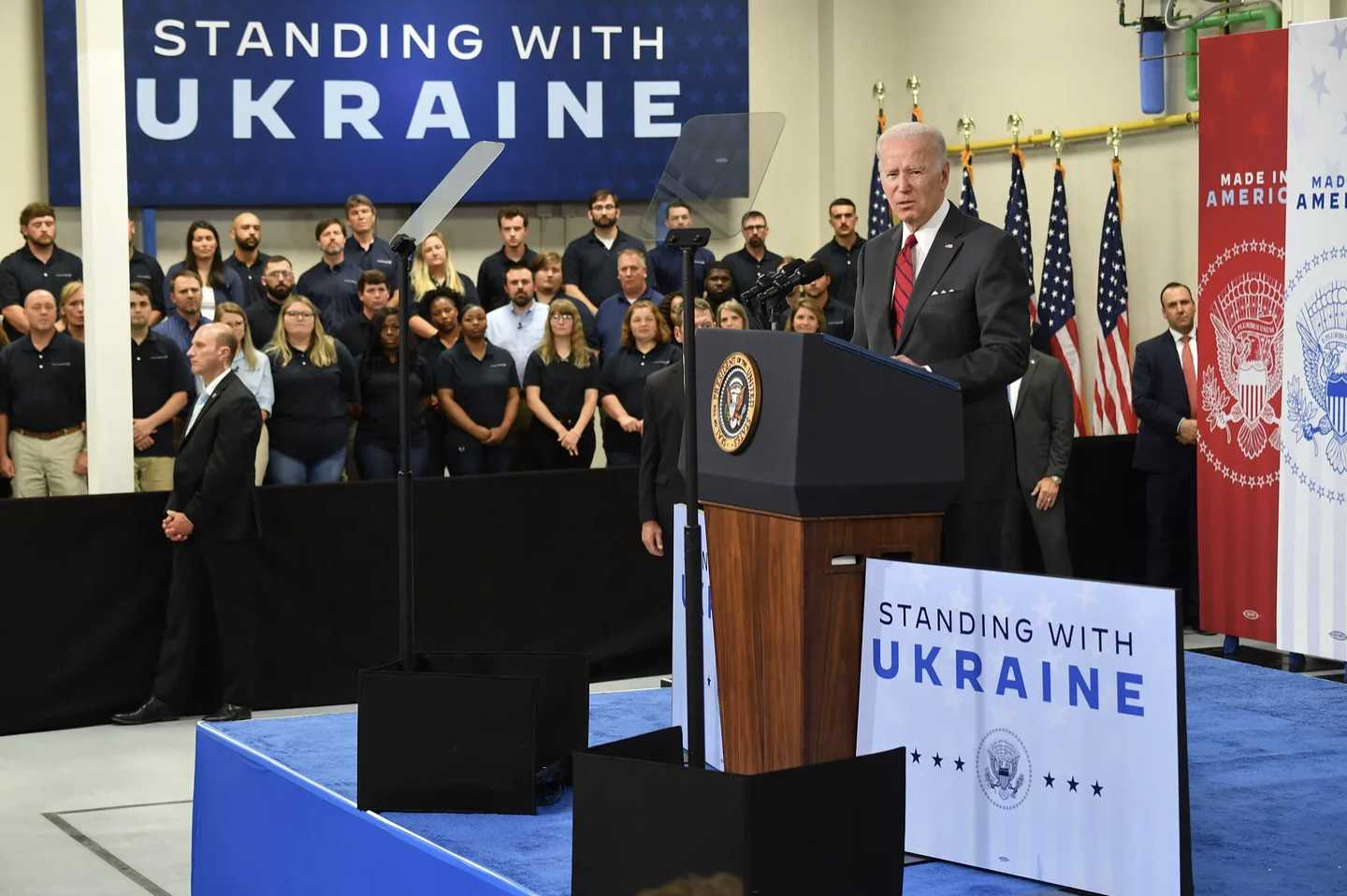
US President Joe Biden speaks about the conflict in Ukraine during a visit to the Lockheed Martins Pike County Operations facility on May 3, 2022 (Photo by Nicholas Kamm/AFP via Getty Images)

This article was originally published on Substack on May 10, 2022

From the start of the Russian invasion of Ukraine on February 24, the Biden White House has repeatedly announced large and seemingly random amounts of money that it intends to send to fuel the war in Ukraine. The latest such dispatch, pursuant to an initial $3.5 billion fund authorized by Congress early on, was announced on Friday; “Biden says U.S. will send $1.3 billion in additional military and economic support to Ukraine,” read the CNBC headline. This was preceded by a series of new lavish spending packages for the war, unveiled every two to three weeks, starting on the third day of the war:

  • Feb. 26: “Biden approves $350 million in military aid for Ukraine": Reuters;

  • Mar. 16: “Biden announces $800 million in military aid for Ukraine”: The New York Times;

  • Mar. 30: “Ukraine to receive additional $500 million in aid from U.S., Biden announces”: NBC News;

  • Apr. 12: “U.S. to announce $750 million more in weapons for Ukraine, officials say": Reuters;

  • May 6: “Biden announces new $150 million weapons package for Ukraine”: Reuters.

Those amounts by themselves are in excess of $3 billion; by the end of April, the total U.S. expenditure on the war in Ukraine was close to $14 billion, drawn from the additional $13.5 billion Congress authorized in mid-March. While some of that is earmarked for economic and humanitarian assistance for Ukraine, most of it will go into the coffers of the weapons industry — including Raytheon, on whose Board of Directors the current Secretary of Defense, Lloyd Austin, sat immediately before being chosen by Biden to run the Pentagon. As CNN put it: “about $6.5 billion, roughly half of the aid package, will go to the US Department of Defense so it can deploy troops to the region and send defense equipment to Ukraine.”

As enormous as those sums already are, they were dwarfed by the Biden administration's announcement on April 28 that it “is asking Congress for $33 billion in funding to respond to the Russian invasion of Ukraine, more than double the $14 billion in support authorized so far.” The White House itself acknowledges that the vast majority of that new spending package will go to the purchase of weaponry and other military assets: “$20.4 billion in additional security and military assistance for Ukraine and for U.S. efforts to strengthen European security in cooperation with our NATO allies and other partners in the region.”

It is difficult to put into context how enormous these expenditures are — particularly since the war is only ten weeks old, and U.S. officials predict/hope that this war will last not months but years. That ensures that the ultimate amounts will be significantly higher still.

The amounts allocated thus far — the new Biden request of $33 billion combined with the $14 billion already spent — already exceed the average annual amount the U.S. spent for its own war in Afghanistan ($46 billion). In the twenty-year U.S. war in Afghanistan which ended just eight months ago, there was at least some pretense of a self-defense rationale given the claim that the Taliban had harbored Osama bin Laden and Al Qaeda at the time of the 9/11 attack. Now the U.S. will spend more than that annual average after just ten weeks of a war in Ukraine that nobody claims has any remote connection to American self-defense.

Even more amazingly, the total amount spent by the U.S. on the Russia/Ukraine war in less than three months is close to Russia's total military budget for the entire year ($65.9 billion). While Washington depicts Russia as some sort of grave and existential menace to the U.S., the reality is that the U.S. spends more than ten times on its military what Russia spends on its military each year; indeed, the U.S. spends three times more than the second-highest military spender, China, and more than the next twelve countries combined.

But as gargantuan as Biden's already-spent and newly requested sums are — for a ten-week war in which the U.S. claims not to be a belligerent — it was apparently woefully inadequate in the eyes of the bipartisan establishment in Congress, who is ostensibly elected to serve the needs and interests of American citizens, not Ukrainians. Leaders of both parties instantly decreed that Biden's $33 billion request was not enough. They thus raised it to $40 billion — a more than 20% increase over the White House's request — and are now working together to create an accelerated procedure to ensure immediate passage and disbursement of these weapons and funds to the war zone in Ukraine. "Time is of the essence – and we cannot afford to wait,” House Speaker Nancy Pelosi said in a letter to House members, adding: "This package, which builds on the robust support already secured by Congress, will be pivotal in helping Ukraine defend not only its nation but democracy for the world." (See update below).

We have long ago left the realm of debating why it is in the interest of American citizens to pour our country's resources into this war, to say nothing of risking a direct war and possibly catastrophic nuclear escalation with Russia, the country with the largest nuclear stockpile, with the US close behind. Indeed, one could argue that the U.S. government entered this war and rapidly escalated its involvement without this critical question — which should be fundamental to any policy decision of the U.S. government — being asked at all.

This omission — a failure to address how the interests of ordinary Americans are served by the U.S. government's escalating role in this conflict — is particularly glaring given the steadfast and oft-stated view of former President Barack Obama that Ukraine is and always will be of vital interest to Russia, but is not of vital interest to the U.S. For that reason, Obama repeatedly resisted bipartisan demands that he send lethal arms to Ukraine, a step he was deeply reluctant to take due to his belief that the U.S. should not provoke Moscow over an interest as remote as Ukraine (ironically, Trump — who was accused by the U.S. media for years of being a Kremlin asset, controlled by Putin through blackmail — did send lethal arms to Ukraine despite how provocative doing so was to Russia).

While it is extremely difficult to isolate any benefit to ordinary American citizens from all of this, it requires no effort to see that there is a tiny group of Americans who do benefit greatly from this massive expenditure of funds. That is the industry of weapons manufacturers. So fortunate are they that the White House has met with them on several occasions to urge them to expand their capacity to produce sophisticated weapons so that the U.S. government can buy them in massive quantities:

Top U.S. defense officials will meet with the chief executives of the eight largest U.S. defense contractors to discuss industry’s capacity to meet Ukraine’s weapons needs if the war with Russia continues for years.


Deputy Defense Secretary Kathleen Hicks told reporters Tuesday she plans to participate in a classified roundtable with defense CEOs on Wednesday to discuss “what can we do to help them, what do they need to generate supply"….


“We will discuss industry proposals to accelerate production of existing systems and develop new, modernized capabilities critical to the Department’s ongoing security assistance to Ukraine and long-term readiness of U.S. and ally/partner forces,” the official added.

On May 3, Biden visited a Lockheed Martin facility (see lead photo) and “praised the… plant that manufactures Javelin anti-tank missiles, saying their work was critical to the Ukrainian war effort and to the defense of democracy itself.”

Indeed, by transferring so much military equipment to Ukraine, the U.S. has depleted its own stockpiles, necessitating their replenishment with mass government purchases. One need not be a conspiracy theorist to marvel at the great fortune of this industry, having lost their primary weapons market just eight months ago when the U.S. war in Afghanistan finally ended, only to now be gifted with an even greater and more lucrative opportunity to sell their weapons by virtue of the protracted and always-escalating U.S. role in Ukraine. Raytheon, the primary manufacturer of Javelins along with Lockheed, has been particularly fortunate that its large stockpile, no longer needed for Afghanistan, is now being ordered in larger-than-ever quantities by its former Board member, now running the Pentagon, for shipment to Ukraine. Their stock prices have bulged nicely since the start of the war:

But how does any of this benefit the vast majority of Americans? Does that even matter? As of 2020, almost 30 million Americans are without any health insurance. Over the weekend, USA Today warned of “the ongoing infant formula shortage,” in which “nearly 40% of popular baby formula brands were sold out at retailers across the U.S. during the week starting April 24.” So many Americans are unable to afford college for their children that close to a majority are delaying plans or eliminating them all together. Meanwhile, “monthly poverty remained elevated in February 2022, with a 14.4 percent poverty rate for the total US population….Overall, 6 million more individuals were in poverty in February relative to December.” The latest data from the U.S. Census Bureau found that “approximately 42.5 million Americans [are] living below the poverty line.” Americans with diabetes often struggle to buy life-saving insulin. And on and on and on.

Now, if the U.S. were invaded or otherwise attacked by another country, or its vital interests were directly threatened, one would of course expect the U.S. government to expend large sums in order to protect and defend the national security of the country and its citizens. But can anyone advance a cogent argument, let alone a persuasive one, that Americans are somehow endangered by the war in Ukraine? Clearly, they are far more endangered by the U.S. response to the war in Ukraine than the war itself; after all, a nuclear confrontation between the U.S. and Russia has long been ranked by the Bulletin of Atomic Scientists as one of the two greatest threats facing humanity.


One would usually expect the American left, or whatever passes it for these days, to be indignant about the expenditure of tens of billions of dollars for weapons while ordinary Americans suffer. But the American left, such that it exists, is barely visible when it comes to debates over the war in Ukraine, while American liberals stand in virtual unity with the establishment wing of the Republican Party behind the Biden administration in support for the escalating U.S. role in the war in Ukraine. A few stray voices (such as Noam Chomsky) have joined large parts of the international leftin urging a diplomatic solution in lieu of war and criticizing Biden for insufficient efforts to forge one, but the U.S. left and American liberals are almost entirely silent if not supportive.

That has left the traditionally left-wing argument about war opposition to the populist right. “You can’t find baby formula in the United States right now but Congress is voting today to send $40 billion to Ukraine," said Donald Trump, Jr. on Tuesday, echoing what one would expect to hear from the 2016 version of Bernie Sanders or the pre-victory AOC. “In the America LAST $40 BILLION Ukraine FIRST bill that we are voting on tonight, there is authorization for funds to be given to the CIA for who knows what and who knows how much? But NO BABY FORMULA for American mothers!” explained Rep. Marjorie Taylor Greene (R-GA). Christian Walker, the conservative influencer and son of GOP Senate candidate Herschel Walker in Georgia, today observed: “Biden should go apply to be the President of Ukraine since he clearly cares more about them than the U.S.” Chomsky himself caused controversy last week when he said that there is only one statesman of any stature in the West urging a diplomatic solution “and his name is Donald J. Trump.”

https://twitter.com/ggreenwald/status/1520752370472341504?s=20&t=FDDjsg_7HVGTA1pMmt7vTQ

Meanwhile, the only place where dissent is heard over the Biden administration's war policy is on the 8:00 p.m. and 10:00 p.m. programs on Fox News, hosted, respectively, by Tucker Carlson and Laura Ingraham, who routinely demand to know how ordinary Americans are benefiting from this increasing U.S. involvement. On CNN, NBC, and in the op-ed pages of The New York Times and The Washington Post, there is virtually lockstep unity in favor of the U.S. role in this war; the only question that is permitted, as usual, is whether the U.S. is doing enough or whether it should do more.

That the U.S. has no legitimate role to play in this war, or that its escalating involvement comes at the expense of American citizens, the people they are supposed to be serving, provokes immediate accusations that one is spreading Russian propaganda and is a Kremlin agent. That is therefore an anti-war view that is all but prohibited in those corporate liberal media venues. Meanwhile, mainstream Democratic House members, such as Rep. Jason Crow (D-CO), are now openly talking about the war in Ukraine as if it is the U.S.'s own:

Whatever else is true, the claim with which we are bombarded by the corporate press — the two parties agree on nothing; they are constantly at each other's throats; they have radically different views of the world — is patently untrue, at least when it comes time for the U.S. to join in new wars. Typically, what we see in such situations is what we are seeing now: the establishment wings of both parties are in complete lockstep unity, always breathlessly supporting the new proposed U.S. role in any new war, eager to empty the coffers of the U.S. Treasury and transfer it to the weapons industry while their constituents suffer.

One can believe that Russia's invasion of Ukraine is profoundly unjust and has produced horrific outcomes while still questioning what legitimate interests the U.S. has in participating in this war to this extent. Even if one fervently believes that helping Ukrainians fight Russia is a moral good, surely the U.S. government should be prioritizing the ability of its own citizens to live above the poverty line, have health insurance, send their kids to college, and buy insulin and baby formula.

There are always horrific wars raging, typically with a clear aggressor, but that does not mean that the U.S. can or should assume responsibility for the war absent its own vital interests and the interests of its citizens being directly at stake. In what conceivable sense are American citizens benefiting from this enormous expenditure of their resources and the increasing energy and attention being devoted by their leaders to Ukraine rather than to their lives and the multi-pronged deprivations that define them?

CORRECTION (May 10, 2022, 20:47 pm ET): This article was edited shortly after publication to reflect that Russia's total annual military budget is $65.9 billion, not $65.9 million.

UPDATE (May 10, 2022, 22:39 pm ET): Shortly after publication of this article, the $40 billion package for the war in Ukraine passed in the House of Representatives by a vote of 368-57. According to CNN: “All 57 votes in opposition were from Republicans.”


community logo
Join the Glenn Greenwald Community
To read more articles like this, sign up and join my community today
3
What else you may like…
Videos
Podcasts
Posts
Articles
Howard Lutnick's Blatant Lies About Epstein Ties
00:22:04
System Update's schedule: and my life as a "farmer"

As we have the last couple of years, we are going to take the break from Christmas until New Year off from the show, returning on Monday, January 5. We very well may have individual video segments we post to Rumble and YouTube until then, but the full show at its regular hour will resume on January 6.

In the meantime, enjoy this video we produced of my fulfillment this year of a childhood dream: to have a (very) small farm where my family can go to make communion and connection with every type of animal possible.

00:05:18
SPECIAL AFTERSHOW - SYSTEM UPDATE 500
01:07:46
Listen to this Article: Reflecting New U.S. Control of TikTok's Censorship, Our Report Criticizing Zelensky Was Deleted

For years, U.S. officials and their media allies accused Russia, China and Iran of tyranny for demanding censorship as a condition for Big Tech access. Now, the U.S. is doing the same to TikTok. Listen below.

Listen to this Article: Reflecting New U.S. Control of TikTok's Censorship, Our Report Criticizing Zelensky Was Deleted

On Noam Chomsky & Jeffrey Epstein

For people like me who spend a lot of time on Twitter/X, it can appear as though Aaron Maté is currently the only prominent leftist who hasn't jumped on the anti-Chomsky bandwagon, where everyone embraces the darkest interpretation possible of every photo and email fragment.

People in this camp include Vijay Prashad, Chris Hedges, Alan MacCleod, Aaron's colleague Max Blumenthal, and Briahna Joy Gray, who titled an interview with MacCleod with this salacious headline on YouTube: "Chomsky FANTASIZED About Epstein's Island."

But not all leftist writers and intellectuals utilize social media to promote their work; a mistake in my opinion, as it means they have less visibility. So far, I have found 3 essays by such writers/thinkers, which I find highly worthwhile in their good-faith, nuanced approach to the story, and deserving of wider circulation. I strongly recommend reading/listening to each one:

1 - "Chomsky and Epstein: What the Evidence Shows," by Tim Hjersted:
This ...

post photo preview

Yes, I’ve been trying to figure out how to cancel the subscription. Please cancel mine, @ggreenwald_ and confirm it’s been cancelled. Thanks. ([email protected])

February 10, 2026

Jimmy Dore Starts a book club on Friday the 13th, if anyone is interested? First book is 'Memories, Dreams, Reflections' by 'Carl Jung',
Sign up at .... jimmydore.com

Here is a fun fact from the Friday 13th Superstition!
It was the beginning of the 'fall' of the 'Knights's Templar' by Mass Arrests, perpetrated by the soon to be pennyless through debt, King Philip of France, on 'Friday October 13, 1307'.......

Looking forward to the book club! 👍💯🙏🕉️

NEW: Message from Glenn to Locals Members About Substack, System Update, and Subscriptions

Hello Locals members:

I wanted to make sure you are updated on what I regard as the exciting changes we announced on Friday night’s program, as well as the status of your current membership.

As most of you likely know, we announced on our Friday night show that that SYSTEM UPDATE episode would be the last one under the show’s current format (if you would like to watch it, you can do so here). As I explained when announcing these changes, producing and hosting a nightly video-based show has been exhilarating and fulfilling, but it also at times has been a bit draining and, most importantly, an impediment to doing other types of work that have always formed the core of my journalism: namely, longer-form written articles and deep investigations.

We have produced three full years of SYSTEM UPDATE episodes on Rumble (our premiere show was December 10, 2022). And while we will continue to produce video content similar to the kinds of segments that composed the show, they won’t be airing live every night at 7:00 p.m. Eastern, but instead will be posted periodically throughout the week (as we have been doing over the last couple of months both on Rumble and on our YouTube channel here).

To enlarge the scope of my work, I am returning to Substack as the central hub for my journalism, which is where I was prior to launching SYSTEM UPDATE on Rumble. In addition to long-form articles, Substack enables a wide array of community-based features, including shorter-form written items that can be posted throughout the day to stimulate conversation among members, a page for guest writers, and new podcast and video features. You can find our redesigned Substack here; it is launching with new content on Monday.

For our current Locals subscribers, you can continue to stay at Locals or move to Substack, whichever you prefer. For any video content and long-form articles that we publish for paying Substack members, we will cross-post them here on Locals (for members only), meaning that your Locals subscription will continue to give you full access to our journalism. 

When I was last at Substack, we published some articles without a paywall in order to ensure the widest possible reach. My expectation is that we will do something similar, though there will be a substantial amount of exclusive content solely for our subscribers. 

We are working on other options to convert your Locals membership into a Substack membership, depending on your preference. But either way, your Locals membership will continue to provide full access to the articles and videos we will publish on both platforms.

Although I will miss producing SYSTEM UPDATE on a (more or less) nightly basis, I really believe that these changes will enable the expansion of my journalism, both in terms of quality and reach. We are very grateful to our Locals members who have played such a vital role over the last three years in supporting our work, and we hope to continue to provide you with true independent journalism into the future.

— Glenn Greenwald   

Read full Article
Netanyahu Visits Trump for the Seventh Time Amid More Threats of a U.S. Attack on Iran
Will the U.S. Government base its policies toward Iran on its own interests, or fight a pointless but costly war against Israel's prime enemy in the Middle East?

Israeli Prime Minister Benjamin Netanyahu has by far spent more time with President Trump than with any other world leader. Netanyahu, on Wednesday, will make his seventh visit to the U.S. since Trump’s second term began a little over a year ago, on top of the visit to Israel made by Trump in October. No other leader has visited the White House during Trump’s second term more than twice. The duo will once again meet at the White House.

The Israeli leader is traveling to Washington this time in order to impose as onerous conditions as possible on Trump’s desire to sign a deal with Iran that would avert a second U.S. attack on that country in the last eight months. “I will present to the President our positions regarding the principles of the negotiations,” Netanyahu saidbefore boarding his presidential plane this morning.

In June, Trump ordered the U.S. military to bomb several of Iran’s underground enrichment facilities in the midst of Israel’s 12-day bombing campaign. After those strikes, Trump pronounced Iran’s nuclear facilities “completely and totally obliterated.”

Yet over the past two months, Trump has ordered the deployment of what he called a “massive armada,” led by the aircraft carrier USS Abraham Lincoln, headed to Iran. On Truth Social, Trump emphasized that the deployment of military assets to Iran is larger than what he sent to Venezuela prior to the removal of that country’s president by the U.S. military. Trump added: “Like with Venezuela, [the U.S. armada] is ready, willing, and able to rapidly fulfill its mission, with speed and violence, if necessary.”

Indeed, Trump has explicitly and repeatedly threatened Tehran with “violence” and “very steep” consequences in the event that the two countries fail to reach a long-term agreement governing Iran’s nuclear program — the same one that Trump insisted had been “obliterated” last June.


Trump stated over the weekend that he believes negotiations with Iran are going “very well,” arguing that “they want a deal very badly.” Numerous reports have suggested that Trump’s strong desire for an agreement instead of war has put him at odds not only with many of his most hawkish pro-Israel advisers, but also with Netanyahu. Today’s trip is thus being depicted as one between two leaders who have very different views of how Iran should be dealt with, thus implying that Netanyahu’s trip is an act of desperation to prevent Trump from reaching peace with Israel’s arch-nemesis.

All of that might be encouraging if not for the fact that this was the exact playbook run by Israel and the U.S. prior to their last joint bombing campaign on Iran. In the weeks leading up to Israel’s surprise attack, Trump had repeatedly assured the public, and Iran, that he believed negotiations were rapidly progressing to a deal that would render unnecessary military conflict with Iran.

And, just as now, coordinated leaks — typically laundered through Axios’ always-helpful Barak Ravid, the former IDF soldier who served in Israel’s notorious intelligence Unit 8200 — depicted a major rift between the two leaders as a result of Trump’s refusal to sanction a war with Iran. It seems clear that last year’s reports of a major “rift” were designed to lower Iran’s guard against what Trump ultimately acknowledged was a jointly planned U.S./Israel attack.


The supposed “dispute” between Washington and Tel Aviv this time rests on the scope of the deal with Iran. Israel’s fiercest loyalists in the U.S. have been demanding that Trump send the U.S. military to achieve Netanyahu’s longest and most supreme goal: having the U.S. military impose regime change on Israel’s most formidable regional enemy and replace it with a pliable puppet.

The sudden outbreak of deep concern over the human rights of Iranian protesters, from the same crowd that has cheered on every U.S. and Israeli war for decades, was quite obviously intended to provoke and even force a U.S. war to dislodge the Iranian government from power. This ritual is depressingly familiar to anyone paying even minimal attention to U.S. wars over the last several decades.

As I have long documented, feigned concern for oppressed peoples is always the tactic of choice for Washington’s neocons and warmongers. When they were trying in 2005 to force former President George W. Bush to go “from Baghdad to Tehran” on what was intended to be his regime-change crusade against Israel’s enemies, Americans were suddenly subjected to stories about the cruel and abusive treatment of Iranian gay men, as if that were a motivating factor in agitating for regime change there. (Similar concerns are rarely, if ever, expressed about the at least equally repressive behavior of friendly governments in Saudi Arabia, UAE, Egypt, Uganda — all governments which the U.S. actively supports.)

What Israel and its American supporters most fear is a U.S. deal with Iran that will only resolve the question of Iran’s nuclear program, while leaving the current government in place. But the position of the U.S. government and of President Trump has long been that the threat posed to the U.S. by Iran comes from the development of an Iranian nuclear weapon. By Trump’s own repeatedly stated views, that is the only legitimate concern of the U.S. when it comes to Iran.

But Israel has a far more ambitious agenda when it comes to that country. For that reason, Israel — as it did last June — is demanding the imposition of pre-conditions on Iran to which Israel knows Iran would and could never agree.

As the Israeli journalist Guy Azriel reported this week: “Despite the apparent lack of tangible progress in the Iran talks over the weekend and the unresolved gaps between Washington and Tehran, concern is growing in Jerusalem over the trajectory of the U.S.-led negotiations[.] … In Israel, there is mounting fear that any emerging deal could fall short of addressing the country’s core demands, not only regarding Iran’s regional terror proxies, but above all its ballistic missile program.”

In other words, Israel is demanding that the U.S. go to war with Iran even if Tehran satisfies Trump’s demands on its nuclear program. Netanyahu is insisting that Trump also require Iran to give up its ballistic missiles before any deal can be signed: something no country would ever do.

It may be rational for Israel to wish that their main regional rivals were left completely defenseless against any possible Israeli attack. President Trump himself admitted that Iran’s ballistic missiles were used to great effect to retaliate against Israel for its attack last June: “Israel got hit very hard, especially the last couple of days. Israel was hit really hard,” the President said, adding, “Those ballistic missiles, boy, they took out a lot of buildings.”

But what does that desire have to do with the United States? And why would any country, let alone Iran — which was just heavily bombed for almost two weeks last June — agree to give up conventional weapons that serve as a deterrent for future Israeli attacks?

Despite the best propaganda efforts of the Ellison-owned, Bari Weiss-led CBS News to convince Americans that Iran’s ballistic missiles somehow pose a threat to the U.S. rather than just Israel, the reality is that Iran cannot and does not pose a threat to the U.S., particularly if there is an agreement in place to ensure Iran cannot produce nuclear weapons (such an agreement had been in place that, by all accounts, provided a comprehensive inspection regime at Iranian facilities before it was nullified in 2017 by the U.S.).

The very idea that the U.S. should even consider sending its own citizens to fight a war against Iran is the consummate example of Israel having Americans fight wars that serve Israel’s national interest but not Americans’ interests. In the days leading up to Netanyahu’s latest in a series of visits to the U.S., Israeli officials began publicly threatening that they would attack Iran on their own if Trump refused to do it for them.


If Israel actually wants war with Iran, Israel can go fight it itself. Invite their most impassioned, loudmouthed American advocates, such as Mark Levin and Sen. Lindsey Graham (R-S.C.), to join that fight. But leave the U.S. out of it.

The towering question, as always, is how much Trump is actually willing to defy not only Israel but his top Israel-centered donors and advisors, such as Miriam Adelson and Stephen Miller. The record on that front has been quite poor thus far. One once again watches to see whether the U.S. will make policy and war decisions not based on its own interests but on the interests of this one foreign country.

Read full Article
post photo preview
The U.S. is Not "Liberating" Anything in Venezuela (Except its Oil)

[Note: The article was originally published in Portuguese in Folha de. S.Pauloon January 5, 2026]


The United States, over the past 50 years, has fought more wars than any other country by far. In order to sell that many wars to its population and the world, one must deploy potent war propaganda, and the U.S. undoubtedly possess that.

Large parts of both the American and Western media are now convinced that the latest U.S. bombings and regime-change operation is to “liberate” the Venezuelan people from a repressive dictator. The claim that liberation is the American motive – either in Venezuela or anywhere else – is laughable. 

The U.S. did not bomb and invade Venezuela in order to “liberate” the country. It did so to dominate the country and exploit its resources. If one can credit President Donald Trump for anything when it comes to Venezuela, it is his candor about the American goal.  

When asked about U.S. interests in Venezuela, Trump did not bother with the pretense of freedom or democracy. “We're going to have to have big investments by the oil companies,” Trump said. “And the oil companies are ready to go."

This is why Trump has no interest in empowering Venezuela’s opposition leaders, whether it be Nobel Peace Prize winner Maria Corina Machado (who Trump dismissed as a “nice woman” incapable of governing) or the declared winner of the country’s last election Edmundo Gonzalez, in whom Trump has no interest. Trump instead said he prefers that Maduro’s handpicked Vice President, the hard-line socialist Decly Rodriquez, remain in power. 

Note that Trump is not demanding that Rodriguez give Venezuelans more freedom and democracy. Instead, Trump said, the only thing he demands of her is “total access. We need access to the oil and other things.”

The U.S. government in general does not oppose dictatorships, nor does it seek to bring freedom and democracy to the world’s repressed peoples. The opposite is true.

Installing and supporting dictatorships around the world has been a staple of U.S. foreign policy since the end of World War II. The U.S. has helped overthrow far more democratically elected governments than it has worked to remove dictatorships.

Indeed, American foreign policy leaders often prefer pro-American dictatorships. Especially in regions where anti-American sentiments prevail – and there are more and more regions where that is now the case – the U.S. far prefers autocrats that repress and crush the preferences of the population, rather than democratic governments that must placate and adhere to public sentiments.

The only requirement that the U.S. imposes on foreign leaders is deference to American dictators. Maduro’s sin was not autocracy; it was disobedience.


That is why many of America’s closest allies – and the regimes Trump most loves and supports – are the world’s most savage and repressive. Trump can barely contain his admiration and affection for Saudi despots, the Egyptian military junta, the royal oligarchical autocrats of the UAE and Qatar, the merciless dictators of Uganda and Rwanda.

The U.S. does not merely work with such dictatorships where they find them. The U.S. helps install them (as it did in Brazil in 1964 and dozens of other countries). Or, at the very least, the U.S. lavishes repressive regimes with multi-pronged support to maintain their grip on power in exchange for subservience.

Unlike Trump, President Barack Obama liked to pretend that his invasions and bombing campaigns were driven by a desire to bring freedom to people. Yet one need only look at the bloodbaths and repression that gripped Libya after Obama bombed its leader Muammar Gaddafi out of office, or the destruction in Syria that came from Obama’s CIA “regime change” war there, to see how fraudulent such claims are.

Despite decades of proof about U.S. intentions, many in the U.S. and throughout the democratic world are always eager to believe that the latest American bombing campaign is the good and noble one, that this one is the one that we can actually feel good about. 

Such a reaction is understandable: we want heroes and crave uplifting narratives about vanquishing tyrants and liberating people from repression. Hollywood films target such tribalistic and instinctive desires and so does western war propaganda. 

Believing that this is what is happening provides a sense of vicarious strength and purpose. One feels good believing in these happy endings. But that is not what Americans wars,  bombing campaigns and regime-change operations are designed to produce, and that it why they do not produce such outcomes.


Read full Article
See More
Available on mobile and TV devices
google store google store app store app store
google store google store app tv store app tv store amazon store amazon store roku store roku store
Powered by Locals