Note From Glenn Greenwald: The following is the full show transcript, for subscribers only, of a recent episode of our System Update program, broadcast live on Friday March 3, 2023. Watch the full episode on Rumble or listen to the podcast on Spotify
Virtually the entirety of the corporate media has spent the last two weeks gleefully writing the obituary of Fox News and its primetime hosts, especially the nation's most-watched cable news host, Tucker Carlson. They have constructed a narrative that, if true, would be indisputably crippling, if not permanently destructive, to their journalistic credibility. Namely, they claim these Fox hosts in the weeks following the 2020 election were promoting and endorsing Trump's accusation that he lost due to widespread voting machine fraud, all while the same hosts in private were ridiculing these same claims and admitting they found them baseless and ridiculous. But is there a truth to this narrative, one which, incidentally, is based entirely on a legal brief filed by the lawyers for the voting machine company Dominion that is suing Fox News, a legal brief that Fox News is yet to answer?
That this narrative has been proven is virtually gospel among American liberals. As usual, these corporate media outlets, along with Democratic Party leaders, are marching in total lockstep, and none has aired any skepticism or questioning of this accusatory framework, let alone give airtime to anyone challenging it. So we will examine these accusations in depth, evaluate the evidence offered for them, and assess whether they have indeed been proven true.
As I just indicated, tonight is the 50th episode of System Update and we will use this solemn and commemorative occasion to engage in a bit of self-reflection to assess what we are trying to achieve with this program, how the platform provided by Rumble is so vital to allowing independent media to thrive, and why the growing success of independent media is, in our view, of the greatest priority and a major cause of optimism.
For now, welcome to a new episode of System Update, starting right now.
Monologue
If it were your goal to destroy a journalist’s reputation, it's hard to imagine anything more effective than being able to prove that they publicly affirmed facts, which in private they admitted they did not actually believe. If you could show that - that a journalist was privately mocking a theory that on their own shows they were pretending to believe - then it's almost impossible to imagine how that journalist could retain any credibility.
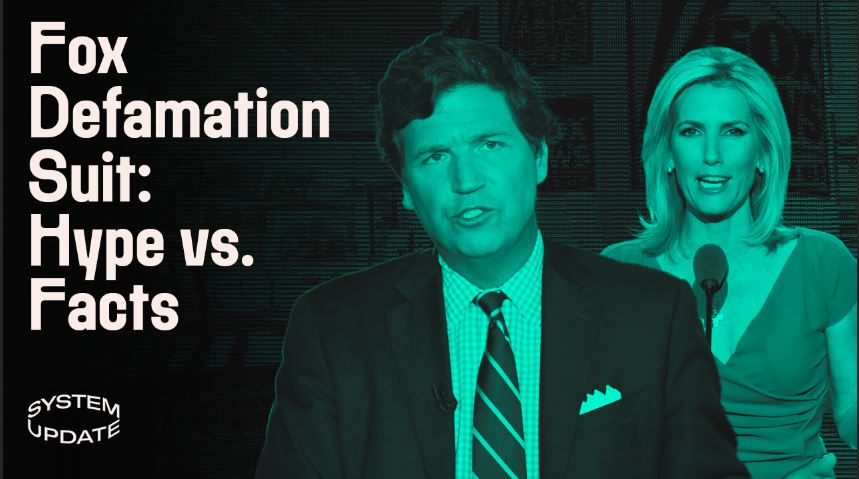
The part of the corporate media that hates Fox News and has long craved its destruction – meaning almost all of the corporate media except Fox News – believes with great excitement that this is what they have now proven. They believe they have now proven this about Fox's most-watched host, Tucker Carlson, as well as the other Fox primetime hosts such as Laura Ingraham. To listen to them tell it they have a smoking gun proof that, at the end of the 2020 election, both Carlson and Ingraham were privately mocking as frivolous and deranged Trump's allegations of widespread election fraud, while then going on their own shows and – in order to please the right-wing audience – were pretending to support and affirm the very theories of election fraud that they were privately mocking.
Similar to how CNN and MSNBC spent years bringing on various CIA, FBI and NSA operatives to promise bloodthirsty liberals that the walls really were closing in on Trump this time, that it was just a matter of time before he would be frogmarched out of the White House to finally receive his just desserts, liberal corporate outlets are celebrating the full-scale destruction of Tucker Carlson's journalistic credibility. That is because they insist they caught him red-handed publicly endorsing election fraud theories that, in private, he was mocking as fictitious and deranged.
The CNN media critic whose life appears to center around the only cable show that anyone watches, Oliver Darcy, published this obituary of Fox News, on February 24, under the headline “It's a major blow. Dominion has uncovered “smoking gun” evidence in a case against Fox News, legal experts say”. this whole article uses one of the favorite corrupt tactics of corporate media. They hand-picked so-called experts whom they know share their political worldview and ideology and then quote them – and only them – saying what they themselves really believe, all so that they can maintain the pretense that they're really just nonpartisan, objective reporters who, in a great stroke of luck, randomly chose experts “who all happen to agree with them”. That way, they get to launder their own opinions as just what “the experts say”. This article illustrating the narrative that almost every American liberal has embraced begins,
Fox News is in serious hot water. That’s what several legal experts told CNN this week following Dominion Voting Systems explosive legal filing against the right-wing talk channel, revealing the network's executives and hosts privately blasted the election fraud claims being peddled by Donald Trump's team, despite allowing lies about the 2020 contest to be promoted on its air. Rebecca Tushnet, the Frank Stanton professor of First Amendment law at Harvard Law School, described Dominion's evidence as a very strong filing ‘that clearly lays out the difference between what Fox was saying publicly and what top people at Fox were privately admitting”.
A cache of behind-the-scenes messages included in the legal filing showed Fox Corp. Chairman Rupert Murdoch called Trump's claims “really crazy stuff” and the cable network’s stars – including Tucker Carlson, Sean Hannity and Laura Ingraham – brutally mock the lies being pushed by the former president's camp asserting that the election was rigged. It also showed attempts to crack down on fact-checking election lies.
On one occasion, Carlson demanded that Fox News White House correspondent Jacqui Heinrich be fired after she fact-checked a Trump tweet pushing the election fraud claims. Tushnet said that in all of her years practicing and teaching law, she had never seen such damning evidence collected in the pre-trial phase of a defamation suit. “I really don't recall anything comparable to this”, Tushnet said. “Donald Trump seems to be very good at generating unprecedented situations” (CNN. Feb.24, 2023).
I'm sure that this First Amendment law professor at Harvard Law School who is saying all of that and holding that Donald Trump is very, very good at creating unprecedented situations is just a very nonpartisan and ideologically free First Amendment expert who just so happens to be telling CNN what they most want to hear, namely, that this is the most devastating defamation case she's ever seen in her very long life as being a First Amendment expert.
Congress's most brazen pathological liar, California Democrat Adam Schiff, removed from his seat on the House Intelligence Committee for exactly that attribute, explicitly accused Tucker Carlson of endorsing the voting fraud claims while privately repudiating them.
Weak men peddle false election lies while privately dismissing them as absurd. Weak men use fear and hate to motivate their followers. Weak men value money and notoriety over truth and decency. Tucker Carlson is a weak, weak man (March 3, 2023).
On Wednesday, the two leading Democrats in Congress, Senate Majority Leader Chuck Schumer and House Minority Leader Hakeem Jeffries did something infinitely worse and more dangerous than anything they're accusing Fox of doing. Namely, they wrote a letter to Fox executives full of demands about what Fox News must now say and do. That senior political leaders in Washington are now issuing orders to media outlets of this kind did not, needless to say, bother many employees of media corporations. After all, if they're not bothered by the FBI and the CIA dictating to Big Tech what should and should not be permitted on the Internet, then, of course, they're not going to be bothered by decrees from political officials about what media outlets must say. But the letter from these Democratic leaders also repeated the same central allegation, namely that Fox primetime host endorsed the election fraud claims of Trump despite admitting they were false.
Dear Mr. Rupert Murdoch et all. As noted in your deposition released yesterday, Tucker Carlson, Sean Hannity, Laura Ingraham and other Fox News personalities knowingly, repeatedly, and dangerously endorsed and promoted the big lie that Donald Trump won the 2020 presidential election. We demand that you direct Tucker Carlson and other hosts on your network to stop spreading false election narratives and admit on the air that they were wrong to engage in such negligent behavior.
As evidenced by the January 6 insurrection, spreading this false propaganda can not only embolden supporters of the big lie to engage in further acts of political violence but also deeply and broadly weakens faith in our democracy and hurts our country in countless ways (Letter to Fox from Dem. Leadership. March 1, 2023).
Meanwhile, The Intercept, a media outlet I founded back in 2013 to serve as an adversary against the intelligence community – partisan talking points in the corporate media – but which has instead become the exact opposite of that – namely, a carbon copy of CNN and MSNBC in its service to the Democratic Party – echoed, as it now always does, the CNN narrative, along with the Democratic talking points under this headline “Tucker Carlson Deserves A Raise For His Shameless Lies.” This entire article rests on the assumption that is implicitly assumed but never proven, namely, that Tucker Carlson told his audience that Trump's claims of election fraud were valid at the same time he was privately ridiculing those same claims.
Carlson's concern was that Fox viewers simply wouldn't accept the facts and, if presented with them, would flock to competitors who would tell them the comforting lies for which they yearned. At about the same time, Carlson texted his producer that, “We're playing with fire for real… an alternative like Newsmax could be devastating for us.”
It's easy and fun to jeer at Carlson for his hilarious deceit, and I wouldn't want to dissuade anyone from doing so. It's especially enjoyable to find out Carlson believes Trump is a “demonic force” (p.43 of the filing) yet has never told his audience this. In fact, Carlson still enjoys sharing a hearty guffaw with the demonic force at Saudi golf tournaments.
But once we're done pointing and laughing at Carlson, we have to think more seriously about […]
This person, by the way, who has no audience, whom nobody knows, who has never published a single thing that has made any impact, he's pointing and laughing at Carlson, the most watched and influential host on television. And he says,
[…] once we're done pointing and laughing at Carlson, we have to think more seriously about this if we'd like to have a society that's based – at least a little bit – on rationality and evidence. Because in the society we have now, Carlson should logically be rewarded for everything he's done…
In fact, seen from this perspective, the only thing Carlson did wrong was foolishly expressing his views in forms that were discoverable in a lawsuit. On Wall Street, the smarter executives are sophisticated enough not to do this and message each other “f2f” – i.e., face-to-face – to indicate to their co-workers when they need to discuss something that wouldn't look good if written out and cited in court…
For-profit news outlets can do great investigative reporting, but that reporting is itself generally not profitable and is subsidized by their cooking apps or sports coverage that actually do make money. By itself, telling the truth is generally not just unprofitable, it's also actively anti-profit. The lesson of the Dominion lawsuit isn't that Fox is extremely bad, although it is. It’s that to have a news system that works, we have to take profit out of the equation (The Intercept. Feb. 26, 2023).
Leave aside the nauseating irony that all of these lectures about truth are coming from people who work at media outlets, including The Intercept, that spread lies on a daily basis – they're all the same outlets, for example, that told Americans (because the CIA told them to) that the Hunter Biden laptop was Russian disinformation so that everybody would ignore the reporting about Joe Biden before the election and vote for Joe Biden instead. – leaving that aside, it's always amusing when employees of billionaire-funded nonprofits like The Intercept lecture everyone else on how journalism can only succeed if the profit component of the equation is removed.
It is true that dependence on corporate advertisers can place pressure on journalists not to alienate their audience but it certainly is equally true that people who work at nonprofits funded by a single billionaire are likely to feel great pressure to avoid angering that billionaire funder. Lest the funding disappears and their inflated salaries – meaning people like this with no audience or accomplishments and nonetheless receive very large salaries – will disappear along with that funding.
One of the key points in all of this is that all news organizations need a funding model unless one is from one of the nation's wealthiest families, which happens to be the case for at least several of the journalists who have worked over the years at The Intercept, then one needs a way to pay a livable wage to the journalists, editors, studio technicians, lawyers, technologists, camera crews, and the rest of the team necessary to produce high-quality journalism. And each of those funding models, including ones that depend on audience donations, does have the potential to carry with it various pressures to stay within certain lines or avoid alienating one's audience. All of that is true. The claim now is that Fox's primetime hosts endorse Trump's voting fraud claims, even though they privately admitted did not believe them because they were afraid that they would lose their audience to OAN or Newsmax if they did not do so.
Beyond the fact that as we're about to show you, nobody can point to a single Tucker Carlson segment or Laura Ingraham segment, from late 2020 or early 2021, where they endorse this election fraud theory, namely, the entire allegation central to this claim can't be proven. In fact, Tucker Carlson vehemently condemned those who are making the claim of election fraud without evidence, as we're about to show you. Liberal outlets such as CNN back then in late 2020 and 2021, were making the exact opposite claim about Fox. Namely, they were gloating about the fact that Fox was losing their audience due to their refusal of late-night hosts to endorse Trump's election fraud claims.
Here was CNN back then, saying exactly the opposite of what they're saying now, namely that Fox's integrity was starting to destroy their ratings.
Fox News is taking action to stave off newfound competition from Newsmax TV. Producers on some Fox programs have been told to monitor Newsmax’s guest bookings and throw some sand in Newsmax’s gears by encouraging guests who appear on both channels to stop saying yes to the upstart.
Up until Election Day, Newsmax barely had a pulse on Nielsen's TV ratings reports, which showed that the channel only averaged 34,000 viewers at any given time in August and September. A slight uptick in October became a groundswell of viewership after November 3. One of the obvious causes was Fox's projection that President Trump would lose the state of Arizona, drastically narrowing his path to reelection. Newsmax criticized Fox and gave viewers false hope about Trump's chances.
This tactic continued when Fox and all the other major networks called the election for President-elect Biden on November seven. Newsmax insisted that the race wasn't over and that the major networks were acting irresponsibly, when, in fact, Newsmax was the irrational actor. A subset of the Fox audience flock to Newsmax for shows that hyped voter fraud allegations and harangued the rest of the media (CNN. Dec. 8, 2020).
In other words, at the time they were mocking Fox for losing their audience to Newsmax and OAN as a result of the refusal of Fox hosts to tell many of their viewers what they wanted to hear – namely that the real winner of the 2020 election was Donald Trump, and that the only reason why it appeared that Joe Biden won was due to election fraud. Everybody knows – who watched Fox during this period – that the prime-time hosts of Fox News, Tucker Carlson, Laura Ingraham and Sean Hannity were not endorsing – were not endorsing – Donald Trump's claims of election fraud. There were hosts on Fox News like Lou Dobbs, who got fired for it, and Judge Jeanine and Maria Bartiromo, who did endorse those claims, but the Fox primetime hosts did not. And that's why every single one of these news reports – that I just read you – that is implicitly asserting or even explicitly claiming that Tucker Carlson and Laura Ingraham endorsed and supported and told their viewers valid Trump's election fraud claims, cannot point to a single instance in which they did that, because at the heart of this theory is a fabrication, the fabrication being that these Fox hosts were endorsing a theory of voter fraud that they secretly repudiated. In the case of Tucker Carlson, he didn't just secretly repudiate the election fraud claims, he went on the air and publicly did so in a particular episode that I remember because it caused enormous amounts of rage against Tucker Carlson from the Fox audience.
In other words, Tucker Carlson went on the air and did a segment that he knew would anger his own audience, and he did it anyway, something which not a single host of CNN or MSNBC can ever point to themselves doing, namely going on the air and scolding their audience for believing things that were untrue or for buying into the conspiracy theories of the Democratic Party, even though there was no evidence for it. All of these journalists are demanding of Fox hosts that they do something that those journalists themselves never have the courage to do, which is tell their viewers something they don't want to hear. But that is something that Tucker Carlson did. So, while nobody can point to him going on the air at this time and endorsing the idea that this election was won by Joe Biden due to fraud, we can watch this segment as I'm about to show you, in which he did exactly the opposite.
(Video 00:19:52)
Tucker Carlson: Which brings us to the bombshell at the center of today's press conference that was delivered by former prosecutor Sidney Powell, who also served as General Mike Flynn’s lawyer. For more than a week, Powell has been all over conservative media with the following story: this election was stolen by a collection of international leftists who manipulated vote tabulating software on to flip millions of votes from Donald Trump to Joe Biden. The other day on television, Powell said of Trump that when the fraud is finally uncovered, “I think we'll find he had at least 80 million votes”. In other words, the rigged software stole about 7 million votes in this election. Here's some of what Powell said today about the software.
Sidney Powell: One of its most characteristic features is its ability to flip votes. It can set and run an algorithm that probably ran all over the country to take a certain percentage of votes from President Trump and flip them to President Biden, which we might never have uncovered had the votes for President Trump not been so overwhelming in so many of these states that it broke the algorithm that had been plugged into the system. And that's what caused them to have to shut down in the states they shut down in.
Tucker Carlson: That was a few hours ago but Sidney Powell has been saying similar things for days. On Sunday night, we texted her after watching one of her segments. What Powell was describing would amount to the single greatest crime in American history – millions of votes stolen in a day, democracy destroyed, the end of our centuries-old system of self-government. Not a small thing.
Let me just stop there. You can see the tenor of this segment, which is that Tucker Carlson says this theory is a theory that Sidney Powell is endorsing. She is all over conservative media making these claims. He then goes on to say, if she's right in what she's saying, this would be the single greatest story, the single most important story, the grievous crime ever committed in American political history. You notice what he is not doing, very clearly not doing, endorsing those claims himself. He continues to distance himself from those claims by saying these are claims that she believes, these are claims that she is asserting. And he then goes on to explain that if this were true, this would be the biggest story in all of American history. Now, let's hear the rest.
(Video 00:22:26)
Tucker Carlson: Now, to be perfectly clear, we did not dismiss any of it. We don't dismiss anything anymore, particularly when it's related to technology. We've talked to too many Silicon Valley whistleblowers. We've seen too much. After four years, this may be the single most open-minded show on television. We literally do UFO segments, not because we're crazy or even been interested in the subject, but because there is evidence that UFOs are real and everyone lies about it. There's evidence that a lot of things that responsible people use to dismiss out of hand is ridiculous are in fact real. And we don't care who mocks it. The louder the Yale Political Science Department and the staff of The Atlantic Magazine scream “conspiracy theory”, the more interested we tend to be. That's usually a sign you're over the target.
A lot of people with impressive sounding credentials in this country are frauds. They have no idea what they're doing, their children posing as authorities and when they're caught, they lie and then they blame you for it. We see that every day. It's the central theme of the show and will continue to be. So, that's a long way of saying we took Sidney Powell seriously. We have no intention of fighting with her. We've always respected her work. We simply wanted to see the details. How could you not want to see them? So, we invited Sidney Powell on the show. We would have given her the whole hour. We would have given her the entire week, actually. That's a big story. But she never sent us any evidence, despite a lot of requests, polite requests, not a page. When we kept pressing, she got angry and told us to stop contacting her. When we checked with others around the Trump campaign, people in positions of authority, they told us Powell was never given them any evidence either in order to provide any.
Today at the press conference, Powell did say that electronic voting is dangerous. And she's right. We're with her there. But she never demonstrated that a single actual vote was moved illegitimately by software from one candidate to another.
Okay. He just got done saying over and over that not only did Sidney Powell refuse to provide evidence in support of her theory – that Donald Trump is the real winner of the election and Biden won only because millions of votes had been switched – he told his audience she has never provided that evidence to anyone. He said, ‘We would love to have her on our show. We would give her the entire night, in fact, the entire week, because if she has evidence, we would want to hear it. But clearly, she doesn't have that evidence because she refuses to show it to anybody when asked’.
This was at the peak of this controversy – it was November 19, two weeks, two and a half weeks after the election, while Trump was going around every day accusing the Biden campaign of having stolen the election through voting fraud and using Sidney Powell as the primary spokesperson for that theory. I'm asking you to leave aside for the moment your view of whether or not this is true or not. That's not relevant at the current moment. What I am instead interrogating is whether or not the narrative that has been universally adopted by the media that Tucker Carlson has no journalistic credibility because while he was privately expressing skepticism about the voting election theory, the voting fraud theory, he went on his show and endorsed it, I'm asking you to look at what he actually said and ask yourself if that is even viable. If anybody who has an iota of integrity could actually maintain that claim that Tucker Carlson went on the air and told his viewers that the election fraud theory was true. What I just showed you – three minutes of him carefully, though emphatically, doing exactly the opposite – making clear that there's no evidence at all for that claim. Let's watch the rest.
(Video 00:26:30)
Tucker Carlson: Why are we telling you this? We're telling you this because it's true. And in the end, that's all that matters. The truth. It's our only hope. It's our best defense. And it's how we're different from them. We care what's true, and we know you care, too. That's why we told you. Maybe Sidney Powell will come forward soon with details on exactly how this happened and precisely who did it. Maybe she will. We are certainly hopeful that she will. What happened with the vote counting this month and at the polling places in Detroit and the polling places in Philadelphia and so much else actually matters. It matters no matter who you voted for. It matters whether or not you think this election is already over. Until we know the answers to those questions conclusively and we can agree on them, this country will not be united.
The whole title of the segment, as you can see on the bottom of the screen, was “Voter fraud: separating fact from fiction.” And what he told his viewers is, look, you may feel real strongly about this. You may want this to be true. You may even believe that it's true. But what separates us from them – meaning the liberal outlets that will lie at the drop of a hat and not apologize when they get caught like it's happened so many times just in the last three weeks alone – what separates us from them is that we will not tell you things that we know you want to hear if we don't believe that they're true because there's no evidence for them. And in this case – meaning the case that Sidney Powell was making – we will not tell you it's true, because we have not seen evidence for it despite repeatedly asking.
And as I said, before showing you this clip, at the time that all of this was happening, the liberal parts of the corporate media – CNN, ABC News, the networks, The New York Times, The Washington Post – were saying the exact opposite of what they're trying to convince you of now. They were mocking Fox for losing their audience, for not endorsing these theories because it was true that their main hosts were, in fact, not endorsing these theories. To the extent they were opining them at all, they were telling their audience there was no evidence for them, as I just showed you.
How anybody can look at that four-minute segment with a straight face and claim that Tucker Carlson went on TV and endorsed the voting fraud theory is mystifying to me. That shows exactly what he just said, how willing and casual and frequent those sectors of the media lie.
Beyond that, I think it's extremely important to note that all of these claims that are being made about what happened here come from a single source, just one source. They come from a legal brief that was filed by the lawyers for Dominion. It's a request for summary judgment.
I just want to explain the legal standard that is at play here, because it's so relevant to how this document should be understood versus what the media is treating it as being. I don't think I have ever seen in my life the media take a legal brief in litigation, filed by one side, the lawyers for one side, and pretend that it is designed to – let alone that it actually does – reveal the objective truth. I've never seen any journalist take as gospel what is in a legal brief filed by one side in the lawsuit, which is exactly what they're doing.
The reason why this document in particular is so meriting of extreme skepticism is because it is extremely difficult when you're suing a news outlet, like Fox, about a matter obviously in the public interest – such as whether or not the voting machines are secure or whether or not there was fraud in an election – it is an extremely difficult task not just to win a lawsuit against a media outlet for defamation, but even to allow the judge, even to convince the judge to let you get to trial.
So, what happens is when you want to sue a media outlet for defamation about a public matter, you file the lawsuit, the other party responds, the media outlet, and then you have discovery, meaning the discovery of the facts. Discovery is where the lawyers for each side are allowed to ask each side for documents. So, the Fox lawyers asked Dominion for various documents in their possession, the Dominion lawyers asked for documents in their possession. That's how they got all these emails and group chats among all the Fox hosts and everything else that they're citing. During this process, they take depositions of each witness. So, they sit down with Rupert Murdoch, they sit down with the Fox CEO, Suzanne Scott, the Fox lawyers get to ask questions of Dominion and you produce a transcript with everybody's answers. And then what happens is the plaintiff in the lawsuit - the person or the company suing the media outlet - has to convince the judge that there is evidence that could allow a jury. If you looked at all of the evidence in the way most favorable to the plaintiff, if everything that was looked at by the jury was looked at in the most favorable way, then it's possible for a jury to rule in favor of the plaintiff, and only then will the judge allow there to even be a trial. The vast majority of lawsuits, the overwhelming majority of lawsuits brought by people claiming they were defamed by media organizations are dismissed before there's even a trial because the judge says that under the very stringent legal standards that you need to meet in order to win a case against a news organization, the evidence simply is not there. Even if the jury read everything in your favor, there still would not be enough of a case to allow a rational jury to rule in your favor.
What the lawyers in this brief are trying to do is to take every piece of evidence turned out of its context and give it the most biased and favorable interpretation to Dominion. By definition, you cannot have a more biased document than this legal brief. I'm not suggesting at all by saying that the lawyers have done anything wrong. They're doing exactly what they're supposed to be doing. They're supposed to be distorting, in the favor of their client, the evidence, by giving it it’s most biased and favorable rating possible, which means ignoring evidence that would negate the claims they're making, leaving that out of the brief, oftentimes taking evidence out of context. There are some limits on what a lawyer can do, some ethical limits when doing that, you can't go so far as to explicitly lie. But lawyers have an enormous license in terms of their ability to twist and interpret facts in the most biased way possible.
In a sense, you could really say that a legal brief like this is the exact opposite of what journalism is supposed to do. Journalism is supposed to look at the facts in the least biased way possible, in the most objective way possible. Whereas these lawyers’ job is, is the opposite of a journal. They're not trying to show the truth. They're trying to make the case in the most biased way they can that a jury has the ability to read the evidence in a certain way in order to decide that trial in favor of their client so that the judge will allow there will be a trial in the first place. What is amazing is to watch a journalist take a legal brief like this and treat it as though it's dispositive of the truth. What makes it especially egregious that all of the media is treating this legal brief as though it provides the answers, as though it tells the story in an unbiased way, is that Fox hasn't even responded yet to this legal brief. They haven't even told its side of the story. Imagine if you were a journalist in a very controversial case wanting to report a story, and the only thing you did is go to one side of the story and wrote the entire article by interviewing that person and never even trying to interview the other side to hear the other side's arguments, to hear why certain things were taken out of context, to hear what the answers were. This is exactly what these journalists have done with this legal brief. And as I just showed you in so many ways, what they are actually doing is distorting the evidence, including the central claim that the Fox host, whom they want to destroy most, namely the primetime hosts, endorsed that theory.
In fact, if you look at the legal document, even if you look at the one that the whole thing is based on, you will find that what's in the document contradicts in the most fundamental way the story the media is telling you. There is no place in this legal brief where the lawyers for Dominion claim that it was Tucker Carlson or Laura Ingraham who went on television and endorsed the voting fraud theory. To the contrary, they are citing Tucker Carlson and Laura Ingraham as proof that the voting theory was false and then saying the people were allowed to go on TV and support it weren't the prime time hosts Lou Dobbs, Jeanine Pirro, Maria Bartiromo and those people.
Let me just show you a couple of excerpts where the Dominion lawyers are relying on Tucker Carlson and Laura Ingraham to make their case that it was the other hosts who supported the voting fraud theory, but not the primetime ones. So, here's one quote where they say,
Indeed, multiple Fox witnesses called the allegations and the people making and repeating them, such as Sidney Powell and Jeanine Pirro – reckless at the time. Tucker Carlson told Sidney Powell on November 17 – this is what he told Sidney Powell directly in those e-mails he referenced: “You keep telling our viewers that millions of votes were changed by the software. I hope you will prove that very soon. You've convinced them that Trump will win. if you don't have conclusive evidence of fraud at that scale. It is a cruel and reckless thing to keep saying ex 177. And on November 21st, Carlson texted that it was shockingly reckless to claim that Dominion rigged the election if there's no one inside the company willing to talk, or internal Dominion documents or copies of the software showing that they did it and “as you know, there isn't” (Dominion Lawsuit Filing. Feb.16, 2023).
In other words, Carlson was berating Sidney Powell, exactly as he told his viewers that he was, about the fact that she was making claims for words, that she knew, there was no support. The legal brief also makes clear that Fox executives had confirmed with both, Tucker Carlson and Laura Ingraham that they would not go on air and support the voting fraud claims precisely because they didn't believe them.
On November 6, after Cooper received the forwarded email from Rupert Murdoch stating it was very hard to credibly cry foul and warning of Trump becoming a sore loser, Ex 151, Cooper and Fox Executive Ron Mitchell discussed whether their primetime hosts, Hannity, Carlson and Ingraham would push false claims of election fraud: “I feel really good about Tucker and Laura. I think Sean will see the wisdom of this track eventually but, even this morning, he was still looking for examples of fraud” (Dominion Lawsuit Filing. Feb.16, 2023).
All of the evidence, including this legal brief, make clear that Tucker Carlson and Laura Ingraham were refusing to go on air and endorse this voting fraud claim. And, in fact, they were working as hard as they could to ensure that the Fox audience understood that there was no evidence for it. In other words, the legal brief and the videos, all negate the story that the media is telling you, which is why they can't point to anything on Tucker Carlson Show or on Laura Ingraham Show that supports their claim that they were endorsing what Adam Schiff and what these Democratic leaders are calling the big lie because they didn’t.
Let me address a couple of critiques of Tucker Carlson and Laura Ingraham, that I think to deserve some more consideration. What it seems as though the anti-Fox part of the media is saying is that Tucker Carlson basically should have engaged in self-destructive behavior. He should have put on this Superman's cape and he should have gone on the air and done way more than what he did in that segment that I just showed you, which is to tell his audience there was no evidence for this fraud, that he instead basically should have mocked his audience. He should have called them idiots. He should have told them they were stupid, that they were believing a deranged theory, and that essentially he should have destroyed his relationship with his Fox audience by using language that he was using in private instead of using language a bit more respectful of that audience.
Let me ask again, when is even a single time, just even once, that any member of CNN or of NBC News or CBS or ABC was willing to do what they seemed to be insisting Tucker Carlson should have done – which is go on the air and tell their audience that they're all a bunch of idiots who have been convinced of insane conspiracy theories. I suppose if you really hold up somebody as this kind of Superman figure and demand that they act as such, you can make the claim that what he did in that segment that I showed you wasn't enough. He should have really assaulted his audience. But that is bizarre to demand of Fox hosts if you can't show that you've been willing to do that yourself.
The reality is that the hardest thing for a journalist to do – sometimes if you have integrity, you have to do it – but I'm speaking from experience, the hardest thing for a journalist to do is to go and tell their audience things that they know their audience doesn't want to hear and does not believe. And when you go and do that – as I've done many times, as I'm about to show you – the effective way to do that is not by telling your audience that they're all a bunch of idiots or deranged maniacs but to show the audience – your viewers, your readers – that you have respect for their views, that you understand why they've reached that conclusion but you, nonetheless, are here to convince them through evidence that what they believe is misguided and wrong.
One of the times I've done that – I've done this many times on this show, for example, I have, many times, for example, expressed my support for narratives that I knew this audience did not believe. I did a whole segment once on why Lula was not a Communist, and why I didn't think he won due to voting fraud, even though I knew a lot of my audience believed that was true. I've oftentimes criticized the right for essentially using manipulative claims of anti-Semitism to shut down debate over Israel, much like the left uses racism accusations to shut down debate – even though I know a lot of my audience doesn't want to hear that.
The very first time I’ve ever done that and I had to do it, was way back in 2010 before I was even an established journalist. I was writing at Salon and I had what I knew was largely a left-liberal audience. Not entirely. I've always had support from a lot of independents and libertarians, but by and large because I began by writing against the War on Terror and critiquing the Bush-Cheney administration, most of my audience, back in the early days of my writing, were Democrats, leftists and liberals. And, in 2010, the Supreme Court issued this ruling against Citizens United by a 5 to 4 ruling that held that certain laws of campaign spending finance laws were unconstitutional on First Amendment grounds. And when Citizens United was issued, there was an absolute consensus, among everybody from the center all the way to the left, that this is one of the most evil decisions on the planet. And because I was someone who wrote a lot about free speech and the First Amendment, which was the ground on which Citizens United was issued, I was getting all kinds of pressure from my readers to tell them what I thought about Citizens United. People started complaining, “Why haven't you written about Citizens United?” And the reason was that I agreed with the majority. I agreed that these campaign finance laws were a violation of the free speech clause. Remember, the case arose because this advocacy group, Citizens United, spent money to produce a film critical of Hillary Clinton before the 2008 election, and they were told they weren't allowed to spend their own money to produce an anti-Hillary film. And to me, that was a clear violation of free speech. I agreed with the conservative majority. And I was not going to lie to my audience and tell them that I disagreed because I knew, the minute I did that, I would no longer have any integrity at all. I would just be kind of a performing seal for liberals, and I had no interest in doing that. Instead, I had to tell them that, in fact, I agreed with the majority.
The 2010 article I wrote was entitled “What the Supreme Court got right” and the headline says, “It's best for the government to stay out of the business of restricting political advocacy.” So, I had to tell my audience what I knew they wouldn't want to hear. And believe me, they were enraged with me. I had to spend at least a month going back and writing four or five different articles, answering all their different attacks on my view. You see, I'm going to just show you the first paragraph that I wrote, that the tone of my article was not to say you're all a bunch of tyrannical censors for wanting the government to prohibit people from spending their money on political messaging. I instead showed respect for my audience, look, I understand where you're coming from but, nonetheless, I want to explain to you why you're wrong. And this is the tone I used:
The Supreme Court yesterday in a 5-4 decision declared unconstitutional (on First Amendment grounds), campaign finance regulations which restrict the ability of corporations and unions to use funds from their general treasury for “electioneering” purposes. The case, Citizens United v. FEC presents some very difficult free speech questions, and I'm deeply ambivalent about the court's ruling. There are several dubious aspects of the majority's opinion (principally its decision to invalidate the entire campaign finance scheme rather than exercising “judicial restraint” through a narrower holding). Beyond that, I believe that corporate influence over our political process is easily one of the top sicknesses afflicting our political culture. But there are also very real First Amendment interests implicated by laws which bar entities from spending money to express political viewpoints (Salon. Jan. 22, 2010).
That is how you go to your audience and instead of alienating them on purpose by telling them they're all a bunch of idiots or censors, you reason with them and you speak to them in a respectful tone and you say, ‘I understand where you're coming from, but here's why you're wrong.’ That's what Tucker Carlson did. As I said, he could have gone about it in a much more aggressive way and essentially destroyed forever his relationship with his audience. I understand why CNN and MSNBC wanted him to do that. They've been jealous for years of the fact that Fox has a gigantic audience and they have none. They would love for the Fox host to burn down their relationship with their audience. But they're demanding something of him that they never would have done themselves and that wouldn't have been smart to do anyway.
The one critique that I think people have made of Tucker Carlson in this entire controversy that merits an answer that we don't yet have is an email where he seemed to suggest that the White House correspondent Jackie Heinrich, should be fired for having fact-checked a Donald Trump tweet. And I want to ask you, any of you who believe that there is validity to this criticism, what is Tucker Carlson's answer to that critique? What is Fox News’ explanation for what it is that he's saying in that email? You don't know the answer. You don't know the explanation. Because, again, Fox News hasn't even responded to this legal brief yet – this legal brief where lawyers are not only entitled, but often do take things wildly out of context. And if you really dig deep into that email – and I'm not trying here to be a lawyer for Tucker Carlson – maybe what he said in the heat of the moment deserves a lot of criticism. We’ll find out once we hear all the explanations. I have not talked to anyone at Fox News about any of these issues, nor did I talk to anyone at Fox News before putting this program together. I just used what was in the public domain, knowing that Fox is prohibited from talking about it because of the lawsuit. But if you look deep into those emails, what you will find is that what Fox hosts were concerned about was not that Jackie Heinrich and other Fox reporters were fact-checking Trump's claim of election fraud and lacking evidence, as I just showed you. Tucker Carlson himself was doing the same thing. So, anyone who is going to claim that Tucker Carlson wanted Jackie Heinrich fired because she pointed out that there was no evidence to Trump's election fraud claim would have to reconcile that accusation with the fact that Tucker Carlson went on his own show and did exactly the same thing. What they were concerned about was that. the tweet she chose to fact-check from Trump was a tweet in which Trump implied inaccurately that Fox primetime hosts supported his election fraud theory. And so, what Jackie Heinrich's tweet seemed to be doing was fact-checking not so much Donald Trump, but the primetime hosts on Fox by saying the primetime hosts on Fox were spreading false theories about the election fraud, when, in reality, none of them had been doing that. That's what they seemed angry about. But we should hear from Tucker Carlson, we should hear from Fox News, in response to that accusation, something that we have not yet done to date, which is why it's so irresponsible for media outlets to assume they know the entire story. I'm open to the idea or the possibility that what he did, in that case, was wrong and I'd like to hear his explanation – and once we do, we can discuss it. But until then, if you look at what actually was being said, it is what I just described.
Obviously, Tucker Carlson has an open invitation to go on his show, to go anywhere else, including my show, to explain that. The reality is that as long as this lawsuit is pending, Fox will only speak through its lawyers. But I presume in this legal brief that they will soon file, they will have an explanation or a response, and we will then be able to adequately judge it.
The bottom line is this: if there is another case where journalists decided to assert an entirely devastating, accusatory framework based on nothing more than the accusations of a lawyer and a lawsuit, I'd like to know what that is. But they're doing it here for obvious reasons, which is they have always wanted to find a way to destroy Fox – they've never been able to find that way, and they think that they've now found it by concocting this theory. The problem is that the theory, in order for it to work, requires them to prove something that is blatantly untrue, which is that the Fox host themselves, the primetime ones, went on the air and told their viewers that Trump lost only because of voting fraud, when, in fact, none of them ever said that, which is why they can't ever point you to a segment where they did and to the extent they spoke on it at all, it was to warn their audience that there was no evidence for it.
So, the lying here, as usual, is coming from the part of the media that always holds itself out as the protector of the public against disinformation, when, in fact, as usual, they're the ones who disseminate it most aggressively.
So, to conclude our show, as I indicated at the top, this is the 50th episode of System Update, which I have to say may not seem like a huge and incredible number to you but – having been the person who was working with my team every day to put it together – it's been really quite a kind of an adventure to have – to figure out from scratch what it is that we want to do this year with this show, what we hope to accomplish and figure out the best way to do it.
I just wanted to take this moment to reflect a little bit on how this show has grown very rapidly beyond all of our wildest expectations and the way in which Rumble has become so crucial not only to the ability of our show to reach a large audience but the ability of so much in independent media to be able to do so without really any constraints of any kind.
We on our show have already created an audience size that every single night exceeds 200,000-250,000 people watching in various ways, which is starting to approach what the corporate media shows on primetime at CNN and MSNBC are able to attract for people under 65, despite the fact that we're only two months old, that we have no large corporation behind us supporting us, that we rely entirely on ourselves and on our audience to promote our show. That has become incredibly, incredibly encouraging.
There are shows, like Russell Brand's program, that air daily as well, that have been around for a few months longer than ours, that have an audience size even larger. I just want to show you some data that I think is incredibly encouraging about the future of independent media and the ability of Rumble to really foster it here.
Here, for example, from a Pew Research poll in May of 2022, which is now eight months ago, the numbers have almost certainly grown. You see here that 20% of Americans say that they've heard of Rumble, which is incredibly exciting, that we're able to build audience sizes this large when only 20% of Americans have yet to hear of Rumble. And it also means that the potential for growth is so enormous, given that 80% of Americans have yet to hear about this platform. As I said, my guess is that's much higher already since Rumble is spending a lot of money on national campaign ads, but the ability to construct an entirely different part of the media ecosystem – one that answers not to any demands for censorship or corporate advertisers – or the ability for people to demand that Rumble censor things or de-platform is very, very encouraging.
Rumble has already proven – when they defied the government of France’s demands to depart from RT – that they would rather lose the market than obey censorship demands. They are in lawsuits with Google over Google's manipulation of the algorithms. They have really demonstrated a commitment to not just independent media, but to the core values of free inquiry and free speech that I believe are absolutely vital to building a genuine alternative to Big Tech.
Equally interesting are some of these demographics about who is watching Rumble. Here you see that despite the media claim that it's just for the far-right, it's just for MAGA – notwithstanding the fact that the two hosts who have been the most promoted here on Rumble with live nightly shows are me and Russell Brand – you see that one of the five viewers of shows on Rumble identifies as Democrats, and the demographics are skewing very young –you see at least 80% of the people under 65 with a fairly sizable number being between 18 and 49. There is a very diverse range of viewers who are watching our show. It's to the point where even mainstream media outlets, very begrudgingly, are starting to acknowledge Rumble’s success.
Here, in October 2022, there's an article from The Atlantic entitled “What if Rumble is the Future of the Social Web” and it says It's the most serious of the all-tech social media platforms.
There's another article that actually was very surprising to me, in its honesty, from New York magazine that's headlined “The Only Success Story in Right-Wing Social Media”. And it talks about Rumble’s success and it even acknowledges, despite this headline, that, as I just said, much of the content on this platform is not right-wing at all, nor are many of the viewers. And as Rumble begins to diversify its programming to gain an even better reputation for being a place that guarantees free speech and free inquiry to everybody, not just people of a certain ideology, this will only continue to grow.
I think one of the things that we've been doing is experimenting with different ways that our show would work. The kind of conventional wisdom is that in the Internet era, people have very short attention spans and as a result, in order to attract viewers and keep viewers, you need to kind of keep this kinetic, frenzied pace where you're constantly changing stories and constantly bringing on new gas that people only can pay attention for five or six or seven minutes at a time. And one of the things we set out to do early on was disproved that view. We respect the attention span of our audience. We sometimes take the entire show, as we did tonight, to delve very deeply into just one topic, which oftentimes is crucial for telling the full story, especially if what you're trying to do is tell a story that is different from the conventional wisdom on the rest of media. If, for example, all I wanted to do was to say, Oh, this legal brief shows that Fox host got caught lying, I would need about 3 minutes. Everybody would understand what I was saying. Everybody would nod their head. But since the narrative I wanted to present to you, since the story that we wanted to show you as true, completely contradicts what virtually every other media outlet is saying, it's necessary to take the time to delve in an in-depth way to show you the evidence that uproots those core assumptions.
It's very similar to when I began writing about politics in 2005 as blogs were starting to really emerge, the conventional wisdom back then was the only way to attract an audience was if you spoke in one or two sentences. Blog posts had to be this short and you had to constantly post 20 or 25 a day changing topics at all times, or else the people wouldn't want to read them. And I would write every single day 3,000 to 4,000-word very detailed posts about one topic containing all kinds of evidence and hard evidence of documentation and statistics and all that happened is my audience size continued to grow because I really believe, and I've always believed, that there is a real appetite for actual journalism.
It is true that if you're just feeding people superficial tripe if you're just talking about the news gossip of the day, people don't want to hear much of that. They're willing to give you three or four minutes of a trivial topic but if you're creating a show that has a high enough quality, that is designed to inform people and to illuminate – not based on my assertions, or in my words, but with evidence – people are willing to give you their time because it is something nutritious and provocative and thought-provoking and ultimately real journalism.
The fact that our audience size continues to grow, the more we continue to follow this format, is something that's very encouraging and we expect, as I said early on, that within a year, we strongly believe that the audience size for our show, for the other shows that Rumble is investing in as a nightly live show will have not just an audience similar to but greater than the standard audience that the largest news corporations in the country have for their nightly shows that have been around for many years, then they have a much greater budget.
We strongly believe we will soon equal and then surpass that audience size and continue to grow. This is the part of the media that is really thriving, the independent part of the media that operates with no constraints, that is not captive to any dogma and that is not susceptible or vulnerable to censorship of every kind. That continues to be the kind of mentality and driving framework of our show. We're thrilled that it has continued to work for the first 50 episodes, and we look forward to continuing throughout the year in building the show even further.
So that concludes our show for tonight. Thank you so much for watching and staying with us through our first 50 episodes. We really could not have done it without your support. The fact that it continues to grow is what enables us to keep doing what we're doing.
I hope you have a great evening, everyone. Have a great night, everybody.