New reporting from the journalist Matt Taibbi using the still-rich Twitter Files sheds all new light on the scam disinformation industry: the nefarious network of government-funded groups with benign-sounding names that claim to protect you from disinformation all while working hand in hand with the U.S. Security State and Big Tech to disseminate their own disinformation campaigns and to censor dissent from the Internet.
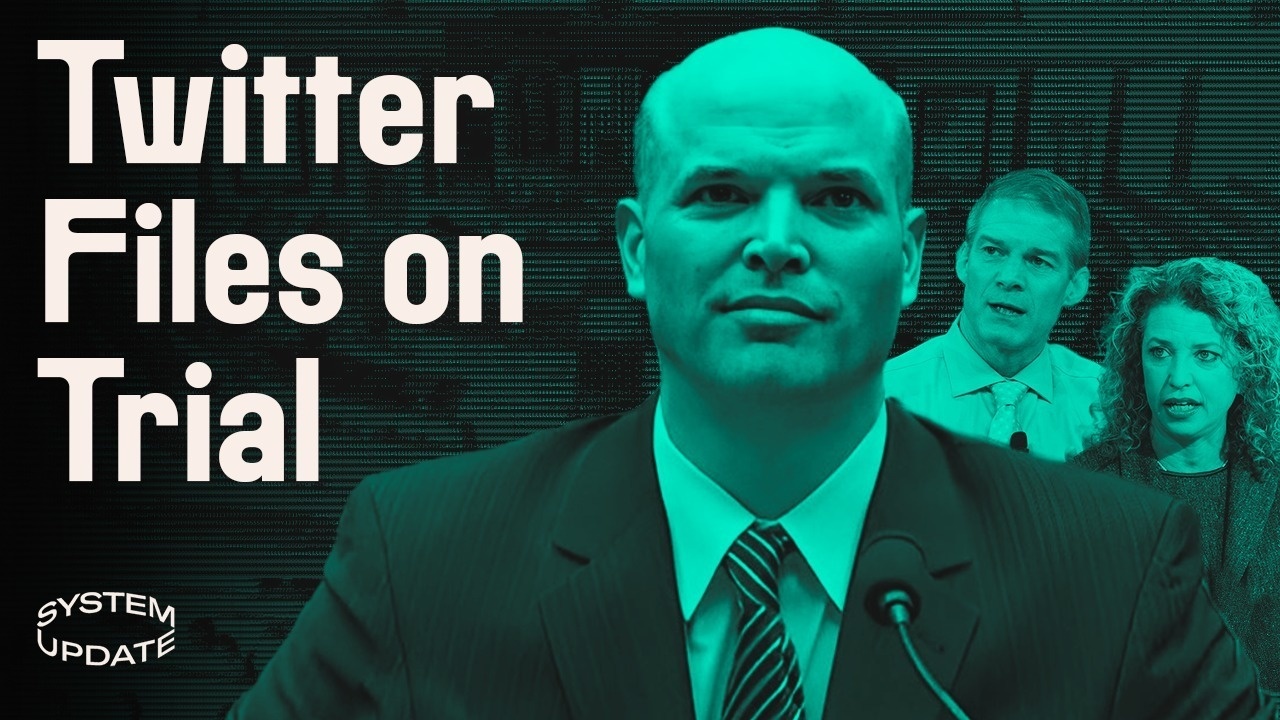
Most of the day was consumed by Democratic members of the House Judiciary Committee hurling invective and vitriol at the two journalists who broke most of those stories, Matt Taibbi and Michael Shellenberger, in large part because this reporting has exposed the corruption of Big Tech and the U.S. Security State, the two entities the Democratic Party most passionately and aggressively serves. They're enraged that this reporting sheds light on how these agencies, the CIA, Department of Homeland Security and FBI are working hand-in-hand with Big Tech to censor dissent from the Internet because Democrats rely on this censorship regime for their own interests. We'll show you the key aspects of this hearing that really got quite rambunctious and ugly today.
For now, welcome to a new episode of System Update starting right now.
Monologue
Earlier today, there was a rambunctious and quite ugly hearing before the House Judiciary Committee in which journalists Matt Taibbi and Michael Shellenberger were invited to appear before this committee to share with not just the Congress but the American people the reporting that they've been able to do on what is the censorship regime that has been constructed to police the Internet and how this censorship regime has been constructed to allow the U.S. Security State, the FBI, the CIA, the Department of Homeland Security, to have a direct channel into the control room, as it were, of our Big Tech platforms, to instruct them on what views should and should not be permitted. And we're going to show you many of the key highlights from that hearing, really better described as lowlights, as Democratic members of Congress spent the day assaulting the integrity and character of those two journalists because those Democrats are enraged that their allies in the U.S. Security State and Big Tech have been exposed.
Remember for four years during the presidency of Donald Trump, we heard that any time a mean thing was said about Jim Acosta or Wolf Blitzer, there was some kind of grave crisis where our free press was under assault? Jim Acosta actually wrote a bestselling book depicting him as being in grave danger for telling the truth. This grave danger means that occasionally Donald Trump and other Republican politicians said critical things about him. What happened today in the House before the House Judiciary Committee is in a different universe as Democratic members of Congress didn't just criticize these two journalists, but tried to invade their relationship with sources, tried to impugn the motives why this journalism was done, to claim that these journalists were directly threatening people who are citizens with different views, really trying to gin up hatred and even violence against these journalists. If even 1/10 of this were done to Jim Acosta or Taylor Lorenz or anyone on MSNBC, there would be weeping and all sorts of segments about the trauma these journalists are suffering. And yet none of the Democratic-aligned parts of the corporate media had a peep of protest as Democratic Party members of Congress threw rocks, figuratively, at these two journalists for the crime of exposing the FBI, the CIA, and Big Tech. It's really incredible some of these passages, and we're really looking forward to showing those to you because they shed a lot of light on what the Democratic Party is, what their true agenda is, and what their real values are.
But before we do that, by design or otherwise, Taibbi, this morning, posted to Twitter a new installment of the Twitter Files that contain some of the most important revelations yet. In particular, the object of his reporting is the thing that I have spent a great deal of time reporting on as part of my own written journalism, as part of this show, which is this scam disinformation industry, this network of groups that are funded either by the U.S. and Western intelligence agencies or by the same two liberal billionaires, namely George Soros and Pierre Omidyar. They all bear very benign-sounding names like the Alliance for Securing Democracy or The Atlantic Council or the Center for Combating Extremism. And what they claim they are intending to do is to identify disinformation and combat it when, in reality, all they're really doing is trying to disguise a very politicized agenda – a politicized censorship agenda – as some sort of science. So, these are experts who have somehow become experts in identifying disinformation, and therefore, these are the people whom Big Tech should rely upon when deciding what views are and are not permitted on the Internet. Taibbi’s revelations that come right from the bowels of Twitter shine a great deal of light on how this network functions and specifically on how to identify them. So, let's take a look, before we get to the hearing, at what he was able to show today.
Here we see the first tweet, which he entitled “Twitter File's statement to Congress”, and he calls it “the censorship-industrial complex”, which is really what it is. It's an industry that ten years ago did not exist, after the 2016 election when the Democrats were humiliated by losing to essentially a host of a game show on television – because they ran the most unpopular presidential candidate in two generations, Hillary Clinton – instead of accepting responsibility for their defeat, they sought out villains and culprits to explain why they lost. And along with the long list of villains – the Russians, James Comey, WikiLeaks, Jill Stein, and the media – they really concluded that free speech on the Internet was something they could no longer tolerate. They needed to find a way to pretty up and beautify and disguise what their real intention and their agenda became – not an ancillary agenda, but central to their tactics – which was to start censoring and policing the Internet. And they knew, given the values of free speech with which Americans were all inculcated from childhood, that they couldn't just be blunt about it. They couldn't just say we're censoring the Internet because we want to exclude people who are challenging our agenda from being heard. So, what they instead set out to do was to finance and concoct a brand new expertise that is a complete fraud – people who suddenly proclaim themselves disinformation experts. And then, they got their allied billionaires, like George Soros and Pierre Omidyar, or sometimes just the U.S. Security State itself, or MI6, to finance directly or indirectly, through the National Endowment for Democracy and quasi-government agencies like those, a whole variety of groups that purported to employ disinformation experts whose goal was to identify disinformation. In all cases, the disinformation they identify is always views or ideas, or stories that undermine global neoliberal institutions of power. The Democratic Party narrative is propagated by the large media, the corporate media in the United States and throughout the West. It's a political movement that pretends to be based on science. It's funded by the same people, by the government, and their goal is basically explicit: to encourage and pressure and coerce Big Tech to censor from the Internet any dissent to the Democratic Party, to the U.S. Security State and to neoliberal institutions, international neoliberal institutions, not by admitting that they're censoring dissent, but by claiming that they're only censoring what they have identified as disinformation. And so often what they claim is disinformation is actually completely true – what they claim is true is actually disinformation.
These are the same people who told you that the reporting of Joe Biden's business activities in Ukraine and China, right before the election, should be ignored because it was Russian disinformation. They're the people who told you that it was disinformation to wonder whether the coronavirus came from a leak from the Wuhan Institute of Virology. They're the same people who claimed it was disinformation to question the U.S. and NATO proxy war in Ukraine. Whatever subverts or undermines their agenda and the agenda of those that finance them gets labeled disinformation, mostly so that they can censor the Internet and propagate their own disinformation without being challenged.
So, this is what Taibbi calls it, after having spent a lot of time looking through the files. And he gives an example here in which they are acknowledging that some of what they want censored is not even information they consider disinformation. It's information they acknowledge is true, but that has bad consequences in their view.
So, one example here and you can see it on the screen, it's called, “True content, which might promote vaccine hesitancy”. This is part of what they wanted censored – information that was true, but that could make people more hesitant to take the COVID vaccine. And examples were, “Viral posts of individuals expressing vaccine hesitancy or stories of true vaccine side effects; true posts which could fuel hesitancy such as individual countries banning certain vaccines”.
These were all things they wanted censored, things they admitted were true, but that undermine their agenda. That's a major revelation that these groups were acknowledging that they were trying to get things censored, that not even they were pretending was disinformation.
Here in the next tweet, he writes, “Twitter was more like a partner to the government. With other tech firms Twitter held a regular “industry meeting” with FBI and DHS and developed a formal system for receiving thousands of content reports from every corner of government: HHS, Treasury, NSA, even the local police”.
Here you see a variety of emails where those – not just the U.S. Security State agencies like Homeland Security and the NSA, but the Treasury Department and the Health and Human Services Department – were sending requests, slash demands to Twitter saying, “here are all the posts we want removed”. They had an open channel to do that. It was disguised as a Twitter censorship program that in reality was being directed by government agencies. These are all things we've known before. These are all things that have been reported before. It's the reason so many Democrats hate Matt Taibbi and the other journalists who worked on these files for the crime of exposing a censorship regime they support and the role of these agencies that they revere in this censorship regime. But what he today focused on and expanded the lens to include is this industry of “disinformation experts”, which I use scare quotes for.
I'm at the point where I genuinely believe it's not hyperbole that any individual identifying themselves as a disinformation expert or an anti-misinformation activist or any groups that label themselves as having among their mission the combating of disinformation, those groups should be held with extreme amounts of suspicion. In almost every case, those groups are the groups that want to disseminate disinformation, not combat it. And their attempt to censor is an attempt to shield their disinformation campaigns from being questioned and challenged in a meaningful way. I personally, when I see somebody identifying as a “disinformation expert” or a journalist claiming they work on the disinformation beat, I automatically assume that they're frauds, in large part, because there is no such thing as a “disinformation expertise”. That is fake expertise. Where did that come from? You can study cardiology, you can study how to be a pilot, you can study to be an aeronautical engineer. These are all real expertise. These are actually things that you can go and learn and have a greater capability than people who haven't studied, in how to do it. But there is no such thing as a person trained in an apolitical way to recognize disinformation. These groups aren't financed by the U.S. government and liberal billionaires because these liberal billionaires and the U.S. government just want a world filled with greater truth.
You're going to see a Democratic congressman who defended at this House hearing this censorship regime by claiming what I just mockingly said with a straight face – that our friends in the U.S. Security State just want to protect us from disinformation, and that's why they're participating in censorship. And he told Matt Taibbi that he should have a tin foil hat on if he believes otherwise.
So here you see the evidence of how this disinformation industry works. Here are more emails that Taibbi included in this tweet that just email after email after email from government agencies with a long list of Twitter users or tweets they want banned or removed.
Here, for example, is one of the FBI agents whose name is Elvis Chan, who was apparently responsible for being the go-between the FBI and Twitter because he was almost on a daily basis sending to Yoel Roth and to other Twitter executives things that he wanted censored. And here's his list of issues on which he wanted censorship to take place. He said, “Please forward to whomever you deem appropriate”. It's about an FBI meeting with Twitter instated. The email date is July 30, 2020. So, just a few months before the 2020 election. They were very active in trying to get information censored off Twitter. The U.S. government, the Security State, was interfering in our political discourse very directly and actively. Here you see they had issues of censorship they wanted with regard to Russia, China and “Global Status” – this includes Iran, Venezuela and North Korea – and “Planning for the election”.
So, the FBI was explicitly meeting with Twitter to direct them on how to censor in anticipation of the coming 2020 election.
Now, here is where Taibbi expands the scope to include these private disinformation groups. He says,
We came to think of this grouping – state agencies like DHS, FBI, or the Global Engagement Center, along with, “NGOs that aren't academic” and an unexpectedly aggressive partner, commercial news media, as the Censorship-Industrial Complex (Twitter Files. March 9, 2023)
They constantly are writing to Twitter and Facebook and Google, pressuring them to censor information that they think violates the terms of service of these platforms. Imagine being a journalist, someone who goes into journalism and then having as your function, being a leader, a leading agitator for demanding that political content be removed from the Internet. And yet that's what so many of these journalists, these corporate journalists, have as their primary function.
Here in the next tweet, Taibbi writes – this is basically a who's who in the censorship-industrial complex. “Twitter, in 2020, helpfully compiled a list for a working group set up in 2020. It included the National Endowment for Democracy, the Atlantic Council's DFRLab and Hamilton 68 creators, the Alliance for Securing Democracy”. And here you see the list where Twitter essentially was debating which group should be included in these meetings, and which group should be allowed to have a megaphone to tell Twitter what to censor. And on this group, you see things like the Alliance for Securing Democracy, which is the group of neocons and Democrats that had former members of the FBI on it and CIA on it, led by Bill Kristol, a former aide to Marco Rubio, a former aide to Hillary Clinton, leading this group. They were the inventor of that scam, Hamilton 68 dashboard, that purported to identify who was influenced by the Kremlin and who wasn't. Here you see the Atlantic Council, which gets a great deal of funding from Western security agencies. And if you go and look at the online profiles of any of these groups, every one of them – let’s go look at one in particular, Jared Holt. Jared Holt. He worked for the Atlantic Council. He's become very popular online and has a couple hundred thousand Twitter followers. He's exactly what I'm talking about. He claims to be an “expert in disinformation”. His only purpose, on behalf of the Atlantic Council – which is in bed with Big Tech in the U.S. Security State, getting funding from them – is to censor the Internet. And that's why his fan base are liberals – because liberals, more than anybody else in the United States, by which I mean the left-liberal wing of the Democratic Party, not only tolerate this censorship regime but cheer it, approve of it, crave it, want it strengthened because they know how crucial it is for their political interest. So, if you go and look at Jared Holt’s profile, who works for the Atlantic Council, you will see exactly the kind of person I'm describing. When I say a person who should be ignored or held in a great deal of suspicion for proclaiming himself to be a “disinformation agent” while he dedicates himself to this censorship-industrial complex type.
Taibbi goes on:
The same agencies (FBI, DHS/CISA, GEC) invite the same experts (Thomas Rid, Alex Stamos) funded by the same foundations (Newmark, Omidyar, Knight) trailed by the same reporters (Margaret Sullivan, Molly McKew, Brandy Zadrozny) seemingly to every conference, every panel (March 9, 2023).
It's exactly right. If you see a panel anywhere in the West on disinformation, on how to keep misinformation off the Internet, it's the same exact people, funded by the same exact entities, who appear at every one of these conferences, and every journalist like Margaret Sullivan, of the Washington Post, and Brandy Zadrozny, Ben Collins at NBC News, have anointed themselves “Disinformation activists” –, people who are journalists, whose only goal in life is to censor your views from the Internet if your views deviate from theirs, that's the only purpose and function that this has.Taibbi goes on:
The Twitter Files (#TwitterFiles) repeatedly show media acting as a proxy for NGOs, with Twitter bracing for bad headlines if they don't nix accounts. Here, the Financial Times gives Twitter until the end of the day to provide a “steer” on whether RFK, Jr, and other vax offenders will be zapped (March 9, 2023).
This is the main way that the tech reporters of The New York Times, like Mike Isaac and the entire tech team – as well as NBC News and The Washington Post – this is how they coerce Big Tech to censor. They write to them and they say, here's an account that's endorsing views that we regard as disinformation and we are going to write a story on your refusal to remove this content unless by the end of the day you tell us that you're going to remove it. And so often that's how these media outlets pressure these organizations, these Big Tech companies, to remove the content that they want – by basically writing stories, accusing these executives of having blood on their hands for their refusal to censor.
So, we have been following this industry for a long time. Digging into who finances it, who these people are, and how they function is something to which we devoted a lot of our journalistic attention and will continue to. Taibbi’s reporting today is yet another important step in unmasking all of this.
That sets the perfect stage for today's hearing, in which, as I told you, they treated Matt Taibbi and Michael Shellenberger basically like traitors. It's extraordinary. They treated them as criminals. And to Democratic members of Congress, they are criminals. And the reason they're criminals is that they exposed the crimes of the most important allies of the Democratic Party, the CIA, Homeland Security, the FBI, and Big Tech in the mission that the Democratic Party considers central to their future viability, namely the power to censor the Internet. And it is the U.S. government that is acting as the key agent in coercing this. And they know this is unconstitutional. They know that the U.S. government cannot indirectly, through pressure, censor in a way the constitution would forbid them from censoring directly under the First Amendment. They know that Americans would find all of this objectionable and dangerous, that the FBI and the CIA and Homeland Security, which were told are here to protect us from foreign threats, instead are directly involved in our politics by deciding for American citizens which viewpoints we can and can't hear or who will and will not be permitted to have a platform online. So, they wanted this all in secret. It's the same reason why Julian Assange is in a prison. Why Edward Snowden's in exile. Why Daniel Ellsberg almost spent his life in prison. Anyone who exposes the secret crimes of the U.S. Security State becomes the enemy of politicians because politicians support these agencies and want this hidden and not exposed. And what Taibbi did was expose it. And that's why this rage that we're about to show you that got directed at him, all day, only from Democrats - that’s where it comes from. That they want all of this hidden is what accounts for the behavior we saw today.
Let's take a look at this first video here, this is from Stacey Plaskett. She, for some reason, is the ranking member of this committee, even though she's not even really a member of Congress. She's a delegate from the Virgin Islands. She's not even officially a member of Congress. She can't vote on any bills. There's barely anything she can do except sit in committees like this and pontificate. And she spent the day lecturing Taibbi, accusing him of all sorts of things while barely letting him speak all while liberal idiots in the media – like Aaron Rupar and others – cheered as though she had done something courageous and brave. Imagine standing up on a podium where the only power you have, as a delegate from the Virgin Islands, is that you get to use the 7 minutes you get however you want, and you use it to basically accuse journalists of being the liars and threats and fraudsters. And then, when they go and try and defend themselves, you interrupt them and say, “You do not speak”. You just sit there while I berate you and Hector you and try and ruin your reputation. Imagine reporting something this abusive, this pathetic and cowardly. But that's what happened all day. So, let's listen to why they're so enraged with these journalists.
Stacey Plaskett (D-VI): Mr. Chairman, I'm not exaggerating when I say that you have called before you two witnesses who pose a direct threat to people who oppose them.
She said that Matt Taibbi and Michael Shellenberger are “direct threats” to people who oppose them. Do you remember for four years we would hear that anyone criticizing Jim Acosta or Taylor Lorenz were putting these people in danger? What is this doing to Matt Taibbi and Michael Shellenberger – having this delegate who looks and tries to act as if she's a member of Congress, labeling these journalists a direct threat to those people who oppose them? And in what conceivable way are they “direct threats”? What did they do other than expose the U.S. Security State and Big Tech, the most powerful actors in the country? But this was the tenor of the entire hearing. Let's look at another clip from this delegate from the Virgin Islands.
Stacey Plaskett (D-VI): And to praise him for his work. This isn't just a matter of what data was given to these so-called journalists before us. Now, there are many legitimate questions about where Musk got the financing to buy Twitter. We know for a fact that foreign countries like to talk. […]
First of all, she's trying to imply that he did something nefarious because he got funding from foreign sources. She obviously doesn't know – I really would be shocked if she knew – sometimes when people lie, you wonder if they actually know and are lying on purpose or if they're just too ignorant to have known. I'd bet any amount of money in her case, it's the latter. She has no idea that long before Elon Musk bought Twitter, some of the biggest shareholders in Twitter were Saudis and other foreign investors and foreign financiers. The second largest shareholder of Twitter before Elon Musk bought it, after Jack Dorsey, was a Saudi billionaire. No one pretended to be concerned about that then. Now that Elon Musk is allowing free speech and refusing to censor, on behalf of the Democratic Party, she wants to impugn Elon Musk, too.
But do you notice how she called Matt Taibbi and Michael Shellenberger, “so-called journalists”, not real journalists, “so-called journalists?” Now I'm about to show you Taibbi’s answer, which was actually quite humble, about why he should not be called a “so-called journalist”, but in fact, a journalist. But the ironic part about all of this is that she is a “so-called member of Congress”. She's not a member of Congress, actually. She has no constitutional standing to do anything. The Congress decided to give them fake representation – the District of Columbia, the Virgin Islands, and a couple of other places – and now she sits up there lecturing journalists, trying to incite violence against journalists, even though she is not even a real member of Congress. She's a so-called member of Congress. Here was Taibbi's response:
Matt Taibbi: Ranking Member Plaskett, I'm not a “so-called journalist”. I've won the National Magazine Award. They have still an award for independent journalism. And I've written ten books, including four New York Times best-sellers.
In other words, Matt Taibbi spent years as the star investigative reporter at Rolling Stone. He uncovered some of the worst abuses of the derivatives fraud that led to the 2008 financial crisis. He has won all of the most prestigious awards in magazine writing, including the National Magazine Award, and he's written ten books on news and politics. In other words, he has so many more accomplishments than she has votes to even sit there and yet she spent the day trying to impugn his integrity, having no interest in what he reported. And yet you see as well how after she got done deriding him when he was finally given a chance to respond – not by her, but by Jim Jordan, the chair of the committee – she just ignored him. How infantile is that? You throw insults at somebody in public and then when they try, in a very civil manner, substantive and civil manner, far better than she deserved, to explain to you why the insult that you hurled is inaccurate, you turn away and look at your phone and you chatter with the lawyer who's telling you what to say. But that's how this hearing was conducted.
Now, let's look at some of the substantive attacks on these journalists from Democrats, to the extent you can call any of them that. Here again, is delegate Plaskett talking to Taibbi.
Actually, just to set this up. What's important about this is many Democrats, not just delegate Plaskett, spent the day demanding to know Matt Taibbi’s sources and whenever he tried to say, “I'm a journalist, I don't reveal my sources”, they continued to berate and demand that he revealed the source of the Twitter Files, the specific individuals who gave him access, who provided these documents. Again, calling Jim Acosta an idiot or a liar, a grave First Amendment Crisis, merits a book about how Jim Acosta is in grave danger. But Democratic members of Congress or fake members of Congress demanding a journalist give up their stories for no reason in the fun of it? None of these fake free press advocates have a word to utter about it because they were never interested in a free press. They were interested in protecting their friends in the media for purely political reasons. So, let's watch this.
Stacey Plaskett (D-VI): Who was the individual that gave you permission to access the email?
Matt Taibbi: Well, the attribution for my story is sourced at Twitter, and that's what I'm going to refer to.
Stacey Plaskett (D-VI): Okay. Did Mr. Musk contact you, Mr. Taibbi?
Matt Taibbi: Again, the attribution for my story is sourced on Twitter.
Stacey Plaskett (D-VI): Mr. Shellenberger, did Mr. Musk contact you?
Michael Shellenberger: Actually, no. I was brought in by my friend Bari Weiss. And so, this story, there's been a lot of misinformation.
Stacey Plaskett (D-VI): Mr. Weiss. Mr. Taibbi. Ms. Weiss, thank you. Mr. Taibbi, have you had conversations with Elon Musk?
Matt Taibbi: I have.
Stacey Plaskett (D-VI): Okay. Mr. Taibbi, did Mr. Musk place any conditions on […]
Rep. Jim Jordan: {One second…} ?
Stacey Plaskett (D-VI): As long as my time is not used.
Rep. Jim Jordan: Are you trying to get journalists {to tell their sources}?
Stacey Plaskett (D-VI): No, I'm not talking. No, I'm not. I am.
Rep. Jim Jordan: {It sure sounds like it}.
She has spent the last 45 seconds demanding to know the identity of Matt Taibbi’s sources. And then when asked, ”Are you trying to get a journalist’s sources?” she said, “No, I'm not.” In this case, is she lying? Is she too dumb to understand what she's saying? Honestly, in this case, I don't know. I can't actually imagine that anyone is too dumb to realize that after spending a full minute demanding to know the identity of someone's source, when they didn't, then, turn around and deny that they're doing exactly that which they've just spent the last minute doing – I don't believe there's any human brain incapable of understanding the lie there.
But let's look at the next exchange. This is from one of the newest members of Congress, Dan Goldman. He was elected from Manhattan, the richest borough in New York City. He ran against a long group of people of color, leftist activists, of leftist officeholders in New York, and he crushed all of them. He received the endorsement of The New York Times. And to me, Dan Goldman is the perfect avatar, an expression of what the Democratic Party is. I'm glad he won. He should win because it's a very clear expression of what the Democratic Party is.
Dan Goldman is one of the richest members of Congress. He has a net worth of $250 million, but not because he earned any of it. He was born into the billionaire family that created Levi Strauss. His great-grandfather was the founder of Levi Strauss, and therefore, he is the heir to that fortune. So, he's worth a quarter of $1 billion despite having not earned any of it. He was educated at one of the most expensive private schools in the United States, Sidwell Friends, in Washington – I believe that's where Matthew Lacy went to – where most of the D.C. elite are educated. It's something like $60,000 or $70,000 a year to go there. Imagine spending 60,000 or $70,000 a year to educate your child in third grade. But that's where he was educated. He then went to Harvard and then Stanford Law School. The reason he was so popular among the wealthy white liberals who voted for the member of Congress in Manhattan is that he spent the last three years as a lead lawyer in the Mueller investigation – which ended up concluding that there was no evidence for the Central Democratic Party claim that the Trump campaign had criminally colluded with the Kremlin to hack the emails of the DNC and the Clinton campaign.
So, that’s Dan Goldman. And here he is defending this censorship regime and essentially denying that there was any censorship at all that came from the U.S. government, even though we have reported example after example after example from the Twitter Files that show exactly that and you'll see an example shoved in his face while he insists that there is none.
Rep. Dan Goldman: Now, Twitter, Twitter, and even with Twitter, you cannot find actual evidence of any direct government censorship of any lawful speech. And when I say lawful, I mean non-criminal speech, because plenty […]
Rep. Jim Jordan: I'll give you one. I'd ask unanimous consent to enter into the record the following email from Clarke Humphry, Executive Office of the Presidency, White House Office, January 23, 2021. That's the Biden administration. 4:39 a.m.. “Hey, folks”. This goes to Twitter. “Hey, folks, wanted to use the term, Mister. They used the term Mr.. Goldman just use one and to flag the below tweet and then wondering if we can get moving on the process for having it removed asap. That is.
So that's three days into the Biden administration. It's somebody from the Biden White House directly demanding that Twitter remove a specific tweet that the Biden administration wanted. Three days into the Biden presidency. They're wasting no time controlling what can and should be heard on the internet. The very thing that Daniel Goldman, the billionaire heir to the Levi Strauss fortune, just ended up denying ever happened. He said there was no example of that ever happening. There's hundreds, if not thousands that have been revealed through this reporting. But Jim Jordan gave him one. So, then the only little wiggle room that he has, he being a lawyer for the wiggle room was to say, well, no, I said there's no examples of the government demanding this censorship of legal speech. Maybe they wanted removed criminal or illegal speech, but not legal speech. So, the only space that he has left is to demand to know the content of the tweet that the Biden White House was demanding be censored. So, watch what happens.
Rep. Jim Jordan: […] the below tweet. And then if we can keep an eye out for tweets that fall in this same genre, that would be great”. This is a tweet on the very issue that […]
Rep. Dan Goldman: Can you read the fullness of the record. Can you read the – because I've not seen this. Can you read the tweet that it's referencing?
Rep. Jim Jordan: I don't have the tweet with me, but the gentleman was […]. Try to tell Twitter to take that. to explicitly remove something. And […]
Rep. Dan Goldman: No, I said just remove lawful speech. Lawful speech. We're going to conflate. The First Amendment is not absolute.
Rep. Jim Jordan: This is something from Robert Kennedy Jr.
Stacey Plaskett (D-VI): Point of order, Mr. Chair.
Rep. Jim Jordan: Because Robert Kennedy, Jr, senator […]
(Overlapping of speeches)
Stacey Plaskett (D-VI): Mr. Goldman, Mr. Chair…
Rep. Jim Jordan: All I'm saying is in no time did the government explicitly say to take a tweet down. Here we have it, right here. They knew they couldn't even wait two days, two days into this administration. They were asked – Twitter – to take something down. And we will get you the underlying tweet.
Stacey Plaskett (D-VI): Thank you […] Will you place it into the record as well, sir? The underlying tweet.
Rep. Jim Jordan: Robert Kennedy Jr. is talking about… He's talking about Hank Aaron's death after he received the vaccine.
So that was the tweet that the Biden White House wanted removed. It was a tweet from Robert Kennedy Jr, the son of RFK, who is not a criminal. At least he's never been charged with crimes. And the tweet was suggesting or implying that there may have been a relationship between the premature death of Hank Aaron, the baseball star, and the fact that he got the COVID vaccine. Maybe you agree with that. Maybe you don't. Maybe you think that's an interesting topic. Maybe you think it's absurd. One thing it's not – even conceivably – is illegal – to suggest that there's a relationship between Hank Aaron's death and the COVID vaccine. And that three days in the Biden White House, there was that explicit email coming from a senior Biden official right to Twitter saying, we want this tweet removed. Exactly what Dan Goldman denied had happened. That's how it went all day.
That is exactly what has been happening: we have a First Amendment that bars the U.S. government from censoring speech, so, instead of going and taking it down themselves through laws, through executive action, they write to their friends at Twitter, and they say, take this down for us. There's no question that's unconstitutional. At some point that will be tested in court.
But whatever else is true, the only reason we know about it is because Elon Musk opened up the files of Twitter and allowed real journalists to come in and look through it all and tell us what's in there. While imposing no conditions of any kind on what can and can't be reported. I had Taibbi on my show. I have Shellenberger on my show. I've had Lee Fang on my show and David Zweig on my show, all of whom did the reporting on the Twitter Files and all of whom stated emphatically that there was no limitations or conditions of any kind on what they could report. The only reason we know about this is because Taibbi and his colleagues journalistically reported it, and that is what makes Democrats so angry. They wanted all of this hidden. And if you don't believe me, let's listen to Colin Allred, who is a Texas Democrat look at Matt Taibbi, refused to allow him to speak and give a very eloquent and moving and passionate defense of the censorship regime that we know about only because the Twitter Files exposed it.
Rep. Colin Allred: We live in an information age where malign actors do want to use social media to influence our elections both big, once you've spent a long time talking about and small, like mine. This should be a bipartisan goal […]
Matt Taibbi: Mr. Congressman […]
Rep. Colin Allred: Now, you don't get to ask questions here. It should be a bipartisan goal to ensure that Americans and only Americans determine the outcome of our elections, not fear-mongering. And I think I hope that you can actually take this with you, because I honestly hope that you will grapple with this. That it may be possible if we can take off the tinfoil hat, that there's not a vast conspiracy but that ordinary folks and national security agencies responsible for our security are trying their best to find a way to make sure that our online discourse doesn't get people hurt or see our democracy undermined. And to the very right, do you think they're trying to undermine? They may be trying to protect.
So that's the Democratic Party for you right there, summed up perfectly. There is not a single member of the Democratic Party in Congress – not Chuck Schumer or Nancy Pelosi or Hakeem Jeffries. Not AOC or Ilhan Omar or Bernie Sanders – who would disagree with a word of what was said? That is the perfect expression of the core view of the Democratic Party, namely that the CIA, the FBI and the NSA are not malevolent actors at all but, instead, are benevolent actors. And that not only should we trust those U.S. Security State agencies to censor for us, but we should be grateful to them for it. Because they're just trying to help. That's censoring for any nefarious purposes. Since when is the CIA or the FBI or the NSA or Homeland Security? When are they nefarious? Since when do we distrust them? They're the good guys. We want them censoring information because, as he said, all they're trying to do is to protect us from speech that harms us or that undermines democracy. Everyone knows that's what the CIA and the FBI are for. And the only way that you could possibly believe that it might be dangerous to allow these agencies to do that is if you're a kooky conspiracy theorist, exactly what they said.
You'll recall from yesterday's show about people who believed or wanted to hear more about whether the COVID virus came from a leak in the Wuhan lab. You were called a conspiracy theorist by the establishment for thinking that. The people who say that stuff are always lying and are always trying to discredit and malign those who are onto them. It's not a conspiracy theory when you hold the evidence in your hands of what's happening. And the reason we have this evidence in our hands is that these journalists did what journalists are supposed to do, which is not agitate for censorship, not disseminate the propaganda from the FBI and the CIA and Wall Street, not defend the Democratic Party, but instead reveal the secrets of these most secretive agencies that the U.S. public has the right to know. And that is the reason these Democrats heaped hatred and invective and vitriol on Matt Taibbi and Michael Shellenberger all day because this was the last thing they wanted was for this censorship regime to be out in the public. And now that it is, they're forced to defend it.
I think we should be very grateful to Colin Allred for offering that one-minute passionate defense while he told Matt Taibbi to sit in the corner and shut up and just listen because that really is how the Democratic Party thinks about the FBI, the CIA, Big Tech values of free speech, and the virtues of censoring the Internet and keeping the truth from you. That is the core goal of the Democratic Party.
Thank you so much for tuning in. We hope to see you back here tomorrow night and every night at 7 p.m. EST, exclusively here on Rumble.
Have a great evening, everybody.