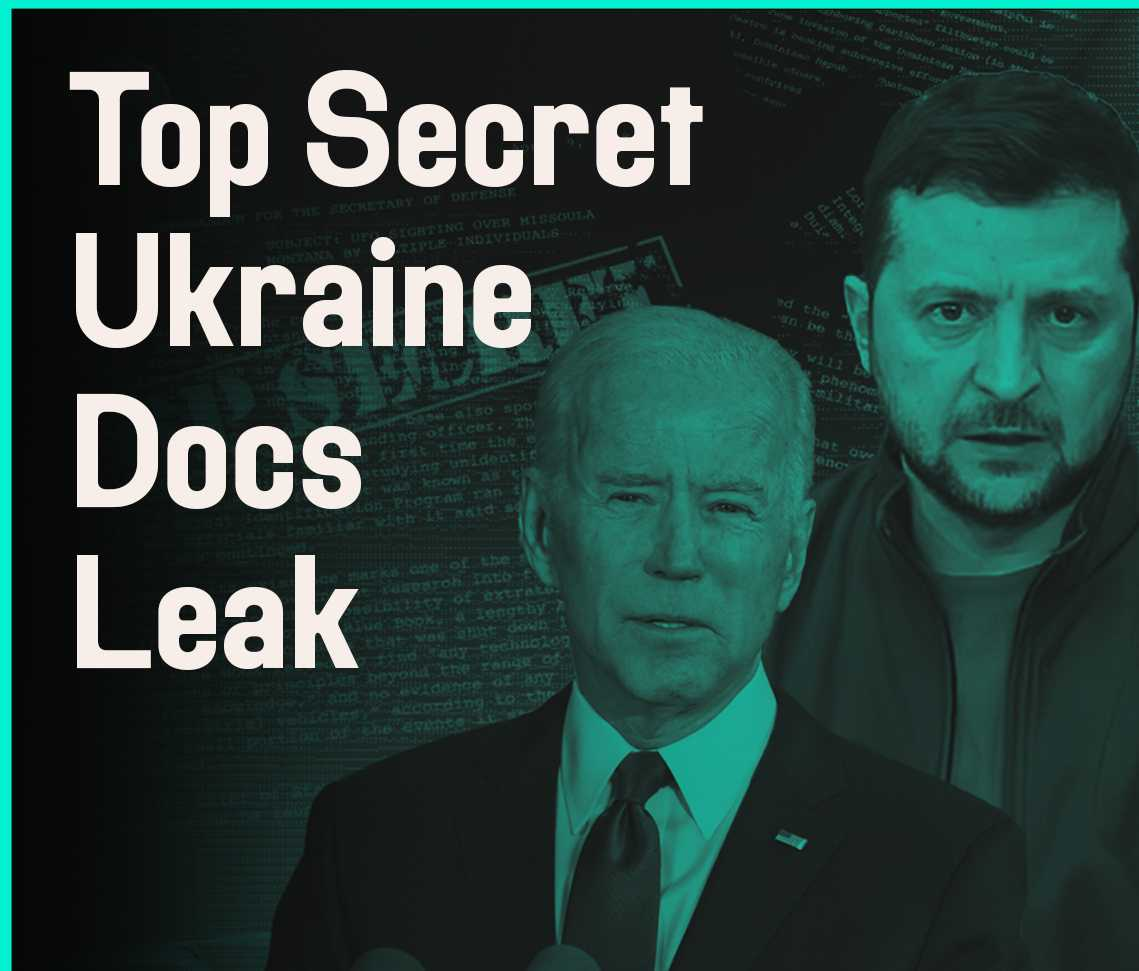
A very strange leak of top-secret documents in the U.S. government has made its way onto the Internet, though these documents have been on obscure corners online for at least a couple of months, U.S. media outlets led by the New York Times and NBC News have noticed them only now and continue to use quite a dramatic language to describe them. NBC, for example, warns, “It could represent the most serious breach of U.S. Intelligence secrets since the contractor for the NSA, Edward Snowden, passed on thousands of classified documents to journalists about U.S. electronic surveillance in 2013.”
Despite that melodramatic language, almost nothing is known about who leaked this archive or why. Many of these documents pertain to the U.S. proxy war in Ukraine, though many pertained to other topics. And while corporate media outlets keep insisting that these materials contain embarrassing revelations for the U.S. government, none has really been identified, at least none that wasn't already widely known, leading some in the region of that war to speculate that they may be intended as a disinformation campaign from American officials themselves. We'll examine all these competing theories and developments and some of the documents themselves to explain what can be done and what can't and how to think about this leak.
Then, last week, a Texas federal judge ruled that the U.S. FDA, the Food and Drug Administration, acted illegally when it approved the use of the so-called abortion drug, used in more than half of abortions performed in that state. While the Biden administration immediately announced it will appeal the ruling, which is what citizens and government entities do when they disagree with a court ruling, some leading elected Democrats, including Sen. Ron Wyden of Oregon and Congresswoman Alexandria Ocasio-Cortez of New York, began urging Joe Biden to simply ignore the ruling – just ignore the order of the court. What are the implications of national Democrats now advocating that the president of the United States simply ignores court rulings with which he disagrees on the ground, as Andrew Jackson put it, the court has no army and therefore let them enforce it.
Then finally, today, Republican House Speaker Kevin McCarthy expressed his full-throated support for President Biden's policy of pursuing an endless proxy war in Ukraine. McCarthy, who sent signals before the 2022 midterms that agreed with growing portions of the public that more constraints are needed on war spending by the United States, now basically says he didn't really mean anything by that, and instead decided that it was the greatest importance that Ukraine and the world win the war against Russia and that the United States must do everything to make that happen. We'll look at those comments in the House speaker today,
As a reminder, System Update is available in podcast version 12 hours after we air, live, here on Rumble. Simply follow us at System Update on Spotify, Apple, and every other major podcasting platform and you'll be able to listen to the show that way as well.
For now, welcome to a new episode of System Update, starting right now.
Large-scale leaks of documents have become really the only way for Americans to learn what their government in general and what the U.S. Security State in particular, are doing in their name. For decades now, but particularly in the wake of 9/11, the CIA, the FBI, Homeland Security and the NSA have constructed such a large and impenetrable wall of secrecy behind which they operate that characterizes almost everything that they do, that American citizens, even members of Congress, really have very little idea – really no idea – what these agencies are doing in the name of our democracy, except when people inside these agencies decide to leak documents to journalists or others that enable those who get the documents to tell their fellow citizens what their government is doing in their name.
Perhaps the first of these modern-day large-scale leaks occurred in 1971, when Daniel Ellsberg, who had worked inside the Defense Department and then for the RAND Corporation with very high levels of secrecy, leaked the Pentagon Papers to The New York Times and The Washington Post. And the purpose of the Pentagon Papers, which was a gigantic volume of top secret classified documents - was not to reveal – not to reveal –specific, war plans that the United States had in prosecuting its war in Vietnam. Such details were never published, either by the papers or by Ellsberg, because that wasn't the purpose of the leak. The purpose of the leak instead was to prove to the American people that the government, the Pentagon and the CIA had been lying to them for over a decade about their views of the Vietnam War, in public. Leading Pentagon officials and leading officials of the Johnson administration were telling the public that they believed and in fact knew that the U.S. was on its way to winning the war in Vietnam, that all that was needed was another offensive around the corner, another 10,000-troop collapse. They were constantly insisting that they were winning the war and believed that they would win. Internally, though, in private, they were saying exactly the opposite. They were admitting that the most that they could hope for was a stalemate, that they would never really be able to conquer Vietnam, to install the rule of the South Vietnamese allies of theirs in North Vietnam, that essentially the most that they could hope for was simply having the war continue on and on and on with no resolution in sight - that the Vietcong would fight forever - and there was no way American power could be brought to bear to win the war. In other words, they were lying to the American public by telling the American people the exact opposite of what they were saying in private. And Daniel Ellsberg, when he saw that thought: I know I'm going to go to jail probably for life if I do this, but I, in my good conscience, cannot allow my fellow citizens to continue to believe this lie about the Vietnam War. I need to expose what Pentagon officials are really saying in secret so that Americans can decide whether they want to support this war or not, based not on the lives that were being fed through the media, but based on the truth. Ellsberg would have gone to prison for doing that had it not been for the fact that the Nixon administration broke into his psychoanalyst’s office to try and steal his psychoanalyst’s records, to reveal his psychosexual secrets and discredit him and distract attention away from the leaks which caused the court to rule that that misconduct warranted dismissing the espionage charges against him. But had it not been for that – and Daniel Ellsberg himself says that to this very day – he would have gone to prison for life. It was almost impossible to beat an espionage charge when the United States brings it under the Espionage Act of 1917, which was a law that Woodrow Wilson implemented to criminalize dissent into the U.S.'s participation in that first World War in Europe.
Those are the kinds of leaks that illuminate and that allow us to know what the government is doing. Those are the kinds of leaks that WikiLeaks has repeatedly published beginning in 2010 when they revealed the realities of what the United States government was doing in Afghanistan and Iraq and as well as what its allies around the world were doing, particularly our tyrannical and despotic partners in the Middle East. And it's also what Edward Snowden did when he decided to leak documents to journalists, including myself, not that revealed the names of agents overseas, which none of those documents did, nor to reveal specific plans of how the U.S. was spying on its enemies like China or al-Qaida. That was something Snowden was adamant about not to be disclosed. Instead, it was to reveal to the American people that the NSA, unbeknownst to almost every member of Congress and the American people, was spying not on al-Qaida or the Chinese, but instead, primarily, domestically, on our conversations, on our telephone calls and our email activities, on our browsing records and the like, a program that we were able to expose because Edward Snowden allowed us to do so was ultimately ruled a violation of the American Constitution and relevant statutes by a circuit court of appeals. Those are the kinds of leaks that are constructive and that shed a gigantic light on the U.S. Security State, even though they need to be done with care. You don't just dump all the documents onto the Internet. WikiLeaks never did that. They redacted documents carefully. We certainly did the same in the Snowden case. We ended up not publishing a majority of the documents, only publishing the ones necessary to inform the public debate about what the NSA was doing in secret against their privacy and against people's privacy around the world. So, these kinds of leaks are crucial to journalism because if you don't have them, what you have instead are leading media outlets like The New York Times, The Washington Post, NBC News and CNN, doing the bidding of the U.S. Security State. They get secrets past them all the time and they publish those but they’re secrets the CIA wants you to hear. They're the secrets the Pentagon wants you to hear. So, it basically just states media feeds you constantly leaks that seem like they're unauthorized because they come from anonymous sources. So, they have that feeling of something edgy and radical. But that's all that is, feeding you guys the propaganda and deceit that they want to give the veneer of some sort of journalistic achievement to. That's how Russiagate was constantly propagated. The CIA would go to Ken Dilanian, ABC News, or Natasha Bertrand, who worked at MSNBC and then worked her way up to The Atlantic and CNN and Politico. She's now at CNN. And every one of the reports would say, “Intelligence officials tell us…” The Washington Post and The New York Times won Pulitzers for that kind of reporting that in reality was just propaganda on behalf of the U.S. Security State. The only counterweight to that is when we get these giant leaks of the kinds I just reviewed that allow us to shed light on what the U.S. Security State is doing in secret.
There's a current claim that we have a similar leak of that kind, namely a kind where someone inside the U.S. government leaked top secret documents in order to expose secrets of the American government that supposedly are very embarrassing to the American government. And yet there's something extremely strange, many things extremely strange about this claim that we have a new Snowden-type leak or a new WikiLeaks-type leak or a new Pentagon Papers-leak. For one thing, we have no idea who leaked this material. We don't even know. The category of person is that we don't know their name. We don't even know where they supposedly work. We don't have confirmation they worked inside the U.S. government. We have no idea who did that. We also have no idea what the motive is because they didn't bring these materials to journalists and asked journalists to curate them and report on them, nor did they bring them to places like WikiLeaks, which might be willing to, in a very high profile and prominent way, leak them all or publish them all or most of them. Nor did they publish these documents in a way that would be noticed. They started instead appearing back in January or February on very obscure places on the Internet, including Discord servers, which are used for people who play video games. They can often be private. The first time they appeared reportedly, is in a Discord server used only by a dozen people or so. And only from there did they make the leap to a more populated forum on the Internet. And then only in the last week did they start to appear in places like Telegram and more popular Discord channels and now the media has noticed them. But there's no guarantee that these would have leaked, nor was there any attempt to direct how they ended up being disclosed or even what kinds of information is being covered in the way the media is talking about this is very odd. I think it raises more questions than it answers. So, let's first look at what the media is telling you about this leak. Let's look at some of the documents themselves. We've picked the ones that we think are worth looking at, and then let's try and examine them.
So, we have the first story, which is from The New York Times. It is entitled “How the Latest Leaked Documents Are Different from Past Breaches.” That's an article from The New York Times today: “The freshness of the documents – some appear to be barely 40 days old – and the hints they hold for operations to make them particularly damaging, officials say.” This is how the New York Times frames so often what they do. They state something and then at the end, they add “officials say”. So, they're not really technically affirming the veracity of this claim, but it sounds to the reader as though they are. They're stating something, namely the freshness of the documents – “some appear to be barely 40 days old” and “the hints they hold for operations to come to make them particularly damaging – comma – “, officials say”. So, The New York Times is not saying that anonymous officials are enabling us. Officials want you to believe this, which is why they told this to The New York Times. This is by David Sanger, today. He's a journalist who has all kinds of ties to the CIA, to the U.S. Security State; he has spent years, decades, publishing authorized leaks from sources inside the intelligence community. That's what he does. This is what the article says,
When WikiLeaks spilled a huge trove of State Department cables 13 years ago, it gave the world a sense of what American diplomats do each day, the sharp elbows, the doubts about wavering allies and the glimpses of how Washington was preparing for North Korea's eventual collapse and Iran's nuclear breakout (The New York Times. April 9, 2023).
Let me just stop there. It is unbelievable to describe WikiLeaks' disclosures that way. He's doing it on purpose to make it seem like it was a completely unjustified and banal leak that didn't really tell you anything about the world other than giving you a “sense of what American diplomats do”. This is just the business of diplomats. They throw sharp elbows. They have some doubts about wavering allies. And you got some glimpses about how Washington was preparing for North Korea's eventual collapse and Iran's nuclear breakout. So, they pick the things that they know you're fine with the State Department doing in order to make this leak sound like it was something that told you nothing important – but at the same time was incredibly dangerous.
This eventual collapse of North Korea, I don't think we have that yet. This is 13 years later. So, there's no collapse in North Korea, maybe “eventually” means 100 years now. And Iran has not broken out in the sense that it has nuclear weapons. Nobody claims that. But these are things that you would want the government to be doing and that's why The New York Times purposely described the WikiLeaks releases in this way to make you think these WikiLeaks releases told you nothing but endanger the public. In reality, the exact opposite was true. They revealed all kinds of secrets about tens of thousands of people, innocent civilians, that the United States government, the military, had killed in Afghanistan and Iraq; they had revealed a video showing the U.S. government, the U.S. military, gunning down innocent people, including journalists who work for Reuters when they were on the ground and scrambling to try and leave. They revealed widespread, rampant corruption among all kinds of U.S. allies in Saudi Arabia in Bahrain, Jordan and Egypt, and all kinds of lies about a whole range of issues that the U.S. government told the public. But it's bizarre, although not really, that David Sanger, who is an ally of the intelligence services, started his article trying to demean WikiLeaks’ releases knowing Julian Assange is in prison. This is the way that a CIA agent who hates Julian Assange would describe those releases, not the way a journalist would. So already you know that he's serving an agenda that is the U.S. Security State's agenda. That's what he always does. But this is the first clue. Now here's the second one.
This paragraph enrages me. It's full of lies, as I will document in a minute once I show you what this article says about these newly leaked documents but here is what it says about the Snowden leaks:
When Edward Snowden swept up the NSA's secrets three years later, Americans suddenly discovered the scope of how the digital age had ushered in a remarkable new era of surveillance by the agency [This is what he says the NSA's Snowden reporting revealed] enabling [the NSA] to pierce China's telecommunication industry and to drill into Google’s servers overseas to pick up foreign communications (The New York Times. April 9, 2023).
So, David Sanger is saying the only thing that Snowden reportedly did was reveal that the NSA was spying on China, something that every American would be okay with them doing and drilling into Google servers to pick up foreign communications, which most people would probably be fine with as well. A complete lie. The crux of the Snowden report showed how the NSA was spying on the conversations of American citizens and the telephone activities of Americans to the point that courts were able to rule them unconstitutional, as I said earlier. But again, if you work for the NSA, this is what you would want people to think the Snowden report was about. He's counting on the fact that it's been ten years and people don't remember. So, he's just rewriting history. And I will show you that the only people who ever revealed any secrets about how the NSA spies on China are The New York Times itself, not any of the other journalists who actually worked with Edward Snowden. So, we'll get to that in a minute. The New York Times goes on:
The cache of 100 or so newly leaked briefing slides of operational data on the war in Ukraine is distinctly different. The data revealed so far is less comprehensive than those vast secret archives, but far more timely (The New York Times. April 9, 2023).
I'm not sure that's even true. There were Snowden documents that we began reporting on, engaged in, in June – that was only three months old. Snowden gave us the archive only a couple of months before we began reporting. There were some that were only two or three months old. So that's not even true anyway.
And it is the immediate salience of the intelligence that worries White House and Pentagon officials.
Some of the most sensitive material – maps of Ukrainian air defenses and a deep dive into South Korea’s secret plans to deliver 330,000 rounds of much-needed ammunition in time for Ukraine's spring counteroffensive – is revealed in documents that appear to be barely 40 days old. It is the freshness of the “secret” and “top secret” documents and the hints they hold for operations to come that make these disclosures particularly damaging, administration officials say. On Sunday, Sabrina Singh, Pentagon spokeswoman, said U.S. officials had notified congressional committees of the leak and referred the matter to the Justice Department, which had opened an investigation.
The 100-plus pages of slides and briefing documents leave no doubt about how deeply enmeshed the United States is in the day-to-day conduct of the war, providing the precise intelligence and logistics that help explain Ukraine's success thus far. While President Biden has barred American troops from firing directly on Russian targets and blocked sending weapons that could reach deep into Russian territory, the documents make clear that a year into the invasion, the United States is heavily entangled in almost everything else (The New York Times. April 9, 2023).
Didn't we know that already - that the United States is heavily involved in the war in Ukraine with everything except combat troops on the ground? I mean, the Biden administration boasts of how much it's done for Ukraine. Republican members of Congress, including Kevin McCarthy today, demanded that the Biden administration do everything possible to ensure Ukraine wins this war. So, what exactly is it that these documents have revealed that is so bothersome to the United States? Nothing, really. I mean, you could look at them in a certain way and say, well, the United States doesn't want it known how they have special services stationed and deployed in Ukraine. And there are some documents that reveal how the U.S. government even spies on its own allies, something that was widely known during the Snowden report. You may recall that a major controversy erupted between the United States and Germany when it was reported – not as part of the Snowden files, but from a different source – that the United States is spying under Angela Merkel and Obama had to call her and apologize. And she compared the United States to the Stasi of East Germany, where she grew up. And there was a similar diplomatic scandal between the United States and Brazil – we did a report based on the Snowden materials – that the Obama administration was spying on the personal cell phone calls of Brazilian President Dilma Rousseff, the Brazilian oil company, Petrobras, all kinds of economic conferences. So, all of this has been known for a long time. I don't even feel like, let alone can point to anything specific, that makes this seem like the kind of leak, like the Pentagon Papers or the Snowden reporting or WikiLeaks that it is really bothersome to the United States in the sense that it would cause scandal and disrepute for American leaders. The Pentagon Papers show that the American government lied to the American people about the war in Vietnam for a decade, the Snowden reporting showed that the U.S. government was spying on its own citizenry in violation of the Constitution and the law, WikiLeaks showed all kinds of hidden war crimes. What do these documents show that is similar to what would really be upsetting and destabilizing to the United States? We keep hearing that they're like those other cases. We keep hearing from the U.S. government about how disturbing this leak is. I haven't really seen anything in these documents yet that would be comparable.
Let's look at NBC News's version of events and of course, it's very similar because they're talking to the same people and serving the same agenda: “Leaked secret Pentagon documents lift the lid on U.S. spying and Russia's war in Ukraine.” NBC News obtained more than 50 of the leaked documents, many of them labeled ‘top secret’.” They say they obtained them. So, this is their story, this is their work – when they're all over the Internet, everyone can just get them. That's all they did was they obtained them not by having sources that gave them to them, but just by going on the Internet like everybody else and looking at them. They have four journalists on this story, including Kendall Jenner, notorious for serving the agenda of the CIA. And there you see the framing, which is very similar to The New York Times. This is what they say,
Dozens of leaked Defense Department classified documents posted online reveal details of U.S. spying on Russia's war machine in Ukraine and secret assessments of Ukraine's combat power, as well as intelligence gathering on America's allies, including South Korea and Israel. NBC News obtained more than 50 of the leaked documents, many of them labeled top secret the highest level of classification.
The documents first appeared online in March, and a senior U.S. official said Saturday that the government's “working theory” is that they are real, although some of them could have been altered (The New York Times. April 9, 2023).
These are government documents taken right from the files of the Pentagon or the intelligence community, they can't know whether they're real. They only have a working theory that they are real. Of course, they can look in their own files and know.
The full impact of the leak remains unclear [I would say so] but it could represent the most serious breach of U.S. intelligence secrets since a contractor for the NSA, Edward Snowden, passed on thousands of classified documents to journalists about U.S. electronic surveillance in 2013. In this case, the scale of the disclosure is much smaller [much, much smaller] involving dozens instead of thousands of documents.
The documents include repeated references to information based on secret signals intelligence – electronic eavesdropping – a crucial pillar of U.S. intelligence gathering. A former U.S. intelligence official said the disclosure of some signals intelligence reporting about Russia and its spy agencies could cause significant damage if Moscow is able to cut off those sources of information (The New York Times. April 9, 2023).
So, again, I see a lot of speculation about how this leak could be very damaging, but I don't see any specific revelations that are causing any problems for Joe Biden or the Biden White House or any leaders of America's foreign policy or its defense and intelligence community. Do you? I don't.
That fact has led some in the region, in Ukraine, including some Ukrainian officials, some Russian officials, some prominent journalists in the region, to speculate that this might actually be a disinformation campaign by the United States to demoralize Russia, because a lot of it claims that Russia is suffering in the war, that Russia might even be losing the war. And by letting people in Russia, including potential troops, think this is a real leak from the United States government that shows intelligence that Russia is suffering grave losses in the war. It could be an attempt to demoralize the Russians. That is possibly not at all affirming that that's true. But I do, again, think it's odd that U.S. intelligence officials are so hellbent on claiming to the public these documents are real and that they're very damaging. They go right to their favorite reporters to do that – David Sanger of The New York Times. The media outlets always serve their agenda and write down whatever they tell them to say. As I just showed you, they did duly and loyally, but I don't actually see anything that is so disturbing.
The Economist today has an article, “A leak of files could be America's worst intelligence breach in a decade.” You see, they're all using similar languages, but they have a paragraph that caught my attention because it supports that hypothesis that I just expressed that others in the region are claiming, namely, that it's actually intended to suggest that the Russians are losing the war, to embolden European governments to continue to provide aid and encouraged the American public to be willing to do so as well. This is what this paragraph says from The Economist:
However, the leaked documents hardly paint a rosy view of Russia's armed forces, though it has devastated the eastern city of Bakhmut – the situation there was, “catastrophic” by February 28, according to Ukraine's military-intelligence chief, who was quoted in one report – its combat power is crippled. America's Defense Intelligence Agency reckons that 35,000 to 43,000 Russian troops have died, twice the number of Ukrainian casualties, with over 154,000 wounded, around 40 times the Ukrainian figure (the agency acknowledges that these numbers are ropey). Russia has lost more than 2,000 tanks and now fields only 419 “in theater”. Another slide says that Russia’s “grinding campaign of attrition” in the East is “heading toward a stalemate” and that the result is likely to be a “protracted war beyond 2023” (The New York Times. April 9, 2023).
So, get ready. We're being told through these scary, unauthorized documents that Russia cannot win this war, that they're heading toward a stalemate and we should expect a “protracted war beyond 2023”. And that's what the Russians are to understand as well.
I'm not at all suggesting this was a disinformation campaign planted by U.S. operatives. I'm generally not suggesting that. But I'm also not ready to buy into this narrative that the media is feeding us at the behest of the intelligence community, that these documents are confirmed to be authentic and are somehow so destabilizing to the U.S. government. Let's look at the ones that would most plausibly be described as damaging to the U.S. government. These are the ones the media is touting.
Here is a document that purports to show that native countries have special forces deployed to specific parts of Ukraine, and it actually details the specific countries that have special forces in Ukraine, including the United States and purports to show their location. Again, we're not showing anything that hasn't been all over the Internet and that isn't being talked about in every journalistic outlet. The slide shows the number of NATO's special forces in Ukraine. And it says the U.S. has 14 14 Special forces; Germany, 50; France 15; Latvia 17; The Netherlands, one; for a total of 97 purportedly here to show their locations in terms of what their bases are in those native countries. And I guess that's something that is supposed to be incriminating to the United States, as though people didn't know that the U.S. likely has covert operations in Ukraine. Of course, they do. We've given them all kinds of weapons. They can't operate on their own. It's been repeatedly reported that we give them real-time intelligence on the ground that they use to target Russian forces and where to activate their air defenses. It would be almost impossible for us not to have U.S. special forces on the ground, in fact, early in the war, one of the reasons the Biden administration gave for why it wouldn't provide some of these weapons systems to Ukraine is because they couldn't be operated without having special forces on the ground to show them how to do it and help them do that. We've given those systems to them. They're in use in theater. So of course, everybody already knew that special forces were on the ground in Ukraine.
So, this is the big revelation that's supposed to be so incriminating to the Biden administration. I would suggest, again, this leak is nothing of the kind. Virtually everyone in Washington – with the exception of seven dozen Republicans or so – supports this policy, as we're about to show you. Kevin McCarthy, the Republican House speaker, came out today and basically said exactly that we need to do everything we can to ensure Ukraine wins the war. No one in Washington is going to care that we have special forces in Ukraine. That's an open secret. This is not some shocking revelation of the kind of Daniel Ellsberg or WikiLeaks or Snowden.
Here is a second document that suggests different ways that Israel might provide lethal aid to Ukraine. Israel has been very reluctant to involve itself in the war in Ukraine because their relations with Russia are an important part of its national security plan. They bomb Syria at will and need Russia not to do that. They have all kinds of relations with Russia and there are a lot of influential Russian Jews in Israel. They have ties to that country and they've really tried hard to stay out of this war because they don't want to alienate the Russians. They obviously can't side with Russia because they would alienate their biggest benefactor, the United States. So, neutrality has essentially been their only option. That's the one they more or less have chosen. And yet this suggests different ways Israel might be able to provide lethal arms to Ukraine, although it doesn't suggest that Israel has yet done so. These are just ways that the U.S. government might propose to Israel that they would do so. I don't really consider these documents particularly interesting, let alone incriminating at all. But those are the second set of ones that are being cited as proof that this is some sort of devastating leak. And then there is the document that purports to reflect the “status of the conflict as of March 1,” which is one of the things that they're so alarmed about, supposedly, that these documents are so new. March 1 is only 40 days ago, as The New York Times said over and over and tried to convince you that this was something so damaging. And here's what they're pointing to as the thing that is so damaging.
This is one of the documents, I believe the only one, where the claim is being made that it was altered. The original document, according to the U.S. government, purported to show that the Ukrainians have lost double the number of soldiers as Russia, and that twice as many Ukrainian soldiers have been killed in this war as Russians. This document here, the version that ended up online, purports to show that, in fact, Ukraine has suffered five times more, killed in action. There you see it's something like 61 to 71,000 troops, whereas the Russians are estimated to have lost 16 to 17000. This is the document they claim has been altered, that the original one shows double the number of Ukrainian troops killed. Again, the fact that Ukraine is losing a huge number of people in this war is well known. In fact, Zelenskyy recently, again, had to increase the penalties for desertion because Ukrainian men actually don't want to fight in this war. They know they're being used as cannon fodder. So, while Kevin McCarthy and Joe Biden and Bill Kristol and David Frum feel proud and strong because we're fighting this glorious war, the people who are actually dying in the war and fighting in the war, as usual, don't actually want to be fighting and dying in this war. They're being forced to Zelenskyy. He's using a conscript army, not a volunteer one. So, if this, again, is the most incriminating document or the most destabilizing document, I just don't find this leak particularly threatening to the United States government. I find it very odd that they're insisting through their media outlets that they manipulate and control what it is. I can see how these documents might concern Russia and Russians and Russian troops by claiming that this whole thing is a stalemate. They're never going to win. They have to fight at least another year throughout 2023. I can see how that would be beneficial to convincing the American public to get ready for another $100 billion in authorizations to support this war beyond 2023. As this document says, I just don't see what is supposedly so scandalous about this from the perspective of the CIA, the Pentagon, or the Biden White House. And, in fact, there is no scandal being generated by these documents, even though we keep being told it's the most damaging leak in at least a decade.
I mentioned earlier – I do want to show you this because it's just such a perfect example of how The New York Times lies all the time. I showed you that paragraph: this is how they described the Snowden reporting. This is what they wanted you to think about what Edward Snowden, the reporting from Edward Snowden revealed. This is David Sanger’s article:
When Edward Snowden swept up the NSA's secrets three years later, Americans suddenly discovered the scope of how the digital age had ushered in a remarkable new era of surveillance […] (The New York Times. April 9, 2023).
So, we learned about a remarkable new era of surveillance. What did they spy on? Here is what The New York Times says:
[…] enabling it to pierce China's telecommunication industry and to drill into Google’s servers overseas to pick up foreign communications (The New York Times. April 9, 2023).
According to The New York Times, the only thing you learned from Snowden was that the NSA spied on China and its telecommunications infrastructure and that they were using Google to spy on foreign nationals and their communications.
That is just an outright lie. Here's the very first article that I published in The Guardian that kicked off the Snowden report. And there you see the headline, NSA collecting phone records of millions of Verizon customers daily. That was on June 6, 2013. And the subheadline was – and this is one of the articles cited by the Pulitzer Committee – “Top secret court order requiring Verizon to hand over all call data shows the scale of domestic surveillance under Obama.” Isn't it odd that the New York Times, 10 years later, wants to rewrite the history of what the Snowden story showed by claiming it was only about how they spied on China and how they spied on foreign nationals and not what it was actually about, which is NSA spying on Americans? And it wasn't just that they were spying on Americans. The high court, the highest court to rule on it, ruled that spying was unconstitutional, that it violated your constitutional rights. “NSA surveillance exposed by Snowden was illegal, court rules seven years on.”– that from The Guardian, in 2020, reporting on a ruling from the Court of Appeals that that surveillance program I just showed you – that we exposed that domestic spying – was in violation of the Constitution.
Here's what The Guardian reported about that ruling, “Seven years after the former NSA contractor Edward Snowden blew the whistle on the mass surveillance of American's telephone records, an Appeals court has found that that program was unlawful and that the U.S. intelligence leaders who publicly defended it were not telling the truth.” Why would the New York Times just lie about what this reporting showed?