Watch the full episode here:
Good evening. It's Monday, May 29. Happy Memorial Day and welcome to a new episode of System Update, our live nightly show that airs every Monday through Friday at 7 p.m. Eastern, exclusively here on Rumble, the free speech alternative to YouTube.
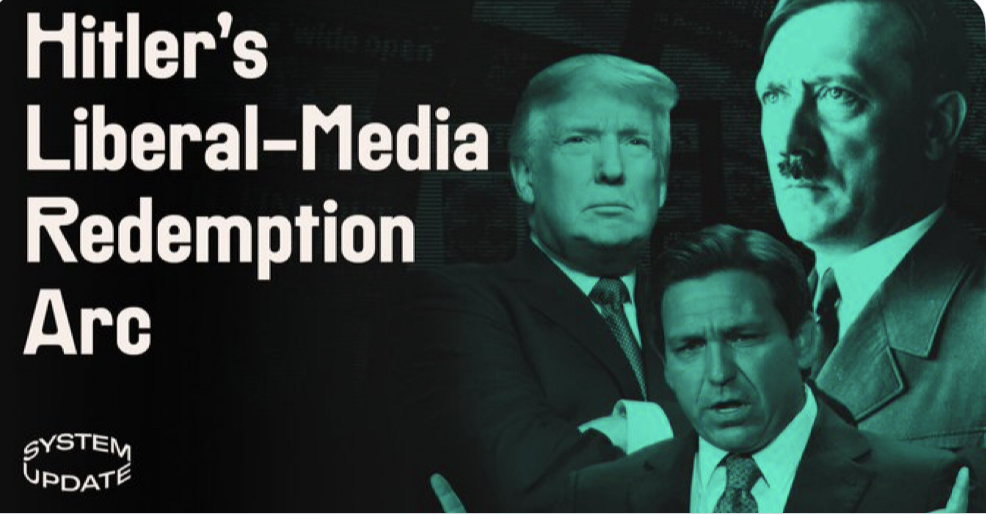
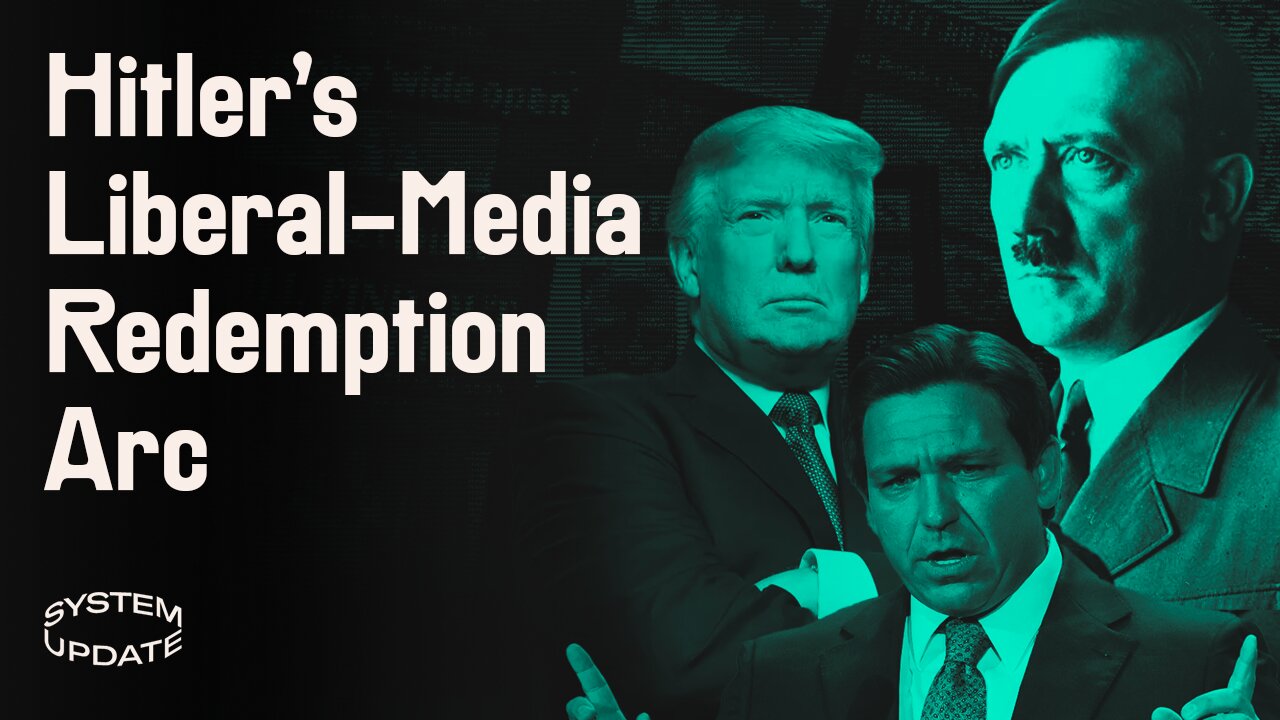
Tonight: Was Hitler really so bad after all? That seems to be the question being continuously posed, at least implicitly, sometimes explicitly, by the U.S. corporate media. Ever since Trump's presidential campaign began to be viable in early 2016, equating Trump to Hitler has become increasingly common, even obligatory, despite the small fact that Trump has never actually done nor advocated any of the things that have made us understand Hitler to be a singularly evil historical actor. Things like attempting to exterminate entire races of people until eliminating any forms of even minimal dissent to launching an aggressive war of conquest that led to the Second World War; the deaths of tens of millions of people, indiscriminate air bombing of civilians in large metropolitan areas, and little things that are Hitler's signature as acts and ultimately the use of the first nuclear weapons in Japan. Those are little things that are Hitler's signature acts that Trump never stated or implied that he favored, let alone actually did, during four years in power. Nonetheless, that Trump is “literally Hitler” became a very common theme in the most mainstream sectors of liberal corporate media, far more than I actually even recalled as I realized on the compared material for this evening's program.
The tactical problem for the media in branding Trump a white supremacist and then a fascist and even the new Hitler was obvious at the time. The latest Republican presidential candidate always must be described as worse than the prior one, the worst in history – hence the rehabilitation of Mitt Romney, John McCain, and even George W. Bush and Dick Cheney, in order to declare Trump an unprecedented evil. As Jeff Zeleny put it today, regarding a clip from an MSNBC show that convened a panel to announce that DeSantis is even more dangerous than Trump, i.e., the new Hitler, “Think about many of what is shown like entertainment instead of education. The sequel has to be scarier than the original. Why else would people watch?”
But once you've branded someone “the new Hitler” where do you go from there when it's time to say that they are even worse now than before, or that their successor is worse? The media is giving us its answer. These new people are literally worse than Hitler. Or the converse must also be true: Hitler is better, more moral, and less evil than the 2024 version of Donald Trump, Ron DeSantis, and anyone else liberal media employees seek to demonize, including Vladimir Putin. They can't help themselves, and as a result, they are doing something that Jewish groups formed after the Holocaust have always regarded as uniquely dangerous – they are trivializing the threat of Hitler and of Nazis by elevating him and them from a singular evil into just another ordinary bad guy, someone who actually deserves credit sometimes for not going as far as Trump, DeSantis, Putin, or whomever they need to villainize.
Some of this is just the deranged mentality of failing TV and newspaper outlets desperate for ratings and clicks. If you're just in an ordinary political battle, that's not very interesting; if you're fighting to protect the country from “New Hitler,” that's exciting. But it also captures a vital truth about the liberal intelligentsia in the United States: they do not believe they are engaged in their ordinary political battle, but rather in a world-historic, unprecedented fight against a singular worse-than-evil Hitler. And for that reason, they have come to believe – often explicitly stated – that anything and everything they do in the name of advancing their cause is justified by the indisputably noble and morally paramount nature of their battle. And that mentality is another defining characteristic of Adolf Hitler.
Then there is a brand new standard being created for Russian and Belarusian professional athletes, namely that they are morally responsible for the acts of their own governments to the point that they should be banned from competing in athletic competitions or are required to issue statements denouncing their own government as a condition for earning their livelihood or – as is now happening right this minute at the French Open Grand Slam tennis tournament held in Paris – they can play but not have their nationality mentioned or their national flag displayed. The International Soccer League, FIFA, banned Russia from global competition and continue to ban them to this day. To call this a double standard is to be unfair to double standards. American and British athletes have traveled the world for decades, including when their governments were engaged in some of the most egregious and destructive wars of aggression from the invasion of Iraq to bombing multiple countries under President Obama and were never banned from any athletic competition nor told they bore responsibility for those acts or were required to denounce them. That China is currently engaged in genocide against the Uyghurs or that the Saudi regime was responsible for the brutal murder of a journalist is the gospel in the West. Yet Chinese and Saudi athletes are free to play and play under their own flag with no similar obligations imposed. It's particularly bizarre to simultaneously assert, on the one hand, that Russia and Belarus are totalitarian regimes or that any dissidents are instantly murdered or imprisoned, and then on the other, tell individual athletes from those countries that they somehow bear responsibility for their government's actions as though they live in a democracy or have the responsibility to denounce it, even while they and their family continue to live in that country. There's a lot more than about tennis or athletes or professional sport. It's about how the Western press manufactures propaganda in seemingly innocuous ways. It's about how so many propagandistic precepts are absorbed, even by those of us seeking to be critically minded, because it's made to be pervasive in the culture and in the ether. And it raises very profound questions about how we see ourselves and our own obligations to abide by the moral obligations we so joyously and self-righteously and endlessly seek to impose on others.
As a reminder, System Update is available in podcast form. You can follow us on Spotify, Apple and all other major podcasting platforms. Simply follow us there, and you can also rate and review the show, which really does help our program's visibility. We are climbing the charts and have been on both Spotify and Apple, getting near the top, and the higher we go, the more that this show will be heard and seen by more people.
For now, welcome to a new episode of System Update starting right now.
For decades since really the end of World War II, one of the central missions of Jewish groups and other groups dedicated to memorializing the Holocaust and ensuring that it never repeated was to avoid what they called a trivialization of both Adolf Hitler and Nazism, on the one hand, and anti-Semitism on the other. And yet, over the last several decades, we've seen this trivialization happening. Often while all those groups cheered, in all sorts of ways, anti-Semitism has often become a tool that is attached to the foreheads of anybody who expresses ideas that the liberal elite sectors in media and politics disagree with, including by and only criticism of Israel making that term that used to be and should be a very serious accusation, become less and less credible, the more casually and manipulatively – and cynically – it's tossed about.
But the same is true for Nazism and Adolf Hitler. We had been taught since childhood that Adolf Hitler was not just another bad dictator, not just another immoral leader who initiated a war of aggression, that he was a singular evil, that he was somebody who had reached a new level of villainy, somebody whom we were supposed to regard as existing essentially in a category unto himself. And it wasn't hard to see why, given the historical consensus – one of the central products projects of Adolf Hitler was not only to launch an international war of conquest but to exterminate an entire race of people from the planet. And yet it has been truly stunning to watch that long-standing convention be aggressively eroded in the name of first, stopping Donald Trump, and now, stopping essentially anybody who comes into the radar screen and becomes a target of the liberal media discourse. That Trump is essentially or not even essentially, but literally, the new incarnation of Adolf Hitler, as bad as Hitler, essentially the same as Hitler, became a theme so pervasive in liberal media that it is almost impossible to overstate. As I said, I had actually forgotten how commonplace this assertion became once it became clear that Trump stood a real chance to become president. And then, after he was elected, to say that Trump was Hitler, Trump is Hitler, Trump is Hitler, over and over and over again, was something that became so commonplace – I think that's the reason I had forgotten how common it was – that we became inured to hearing it because it was everywhere. Even though, as I said, kind of seems important that Trump never actually engaged in or even advocated all of the defining evils of Adolf Hitler. And yet Democrats and liberals and establishment Republicans devoted to destroying Trump and his movement didn't care about any of that. They were more than happy to playfully use Adolf Hitler like it was their little toy – similar to the way that liberal discourse now uses terms like white supremacy or white supremacist and fascist to be applied to anybody who questions any part of liberal dogma. Even the most piecemeal or mainstream questioning of liberal orthodoxy results in those maximalist claims. If you question whether or not a seven-year-old should be taught in public schools that perhaps they're non-binary or question whether or not trans women can fairly compete in professional sports or any other dissent from liberal dogma, suddenly you are essentially somebody who advocates genocide, you are a fascist. These terms have become utterly stripped of all their meaning. And it's particularly dangerous to do that to Nazism and Adolf Hitler, not because it was intended to be shielded as a historical analog. The value of things like the Nuremberg trials and memorializing what happened during World War II was precisely that we ought to learn the lessons of history and be aware of similar dangers. That's not what's happening. It's become a plaything in liberal discourse. And the problem for them is that now that they want to essentially say that Trump is even worse than he was in 2016, or that Ron DeSantis is more dangerous than Trump – once you start with the premise that Trump was literally Hitler in 2016, where does that take you? It necessarily must mean if Trump is worse than he was before, when he was Hitler, or that Ron DeSantis is more dangerous than Trump, who is Hitler? That those figures are more dangerous than Hitler? Or to put it another way, Hitler was better than they were. There were things about Hitler that either were commendable, that isn’t true for Trump and Ron DeSantis, or that there are certain kinds of moral evils that Hitler refrained from doing and Ron DeSantis and Donald Trump actually do. We heard this explicitly at the start of the Russian invasion of Ukraine, where some of the most influential public voices in U.S. foreign policy began arguing, to the point they had to apologize, that, well, at least Adolf Hitler never did things like extinguish ethnic speaking Germans the way Putin is seeking to do to with ethnic speaking Russians. Once you put yourself into this mindset – that you are really battling the new Hitler or worse than Hitler – it not only means you become rhetorically deranged, but I think it's an extraordinarily dangerous mentality to convince yourself that you are fighting a world-historic battle against a singular, unique and unprecedented evil because what that means is that anything and everything you do – censoring dissenting voices, disseminating disinformation campaigns, hiding the truth – journalistically, all becomes justified in the name of stopping this unprecedented evil. And that's why I think this is worth discussing. Not so much because of the rhetorical embarrassment that they placed themselves in, though that is worth looking at, but because of the underlying mentality that both causes it and that it then creates.
So let me just show you a few of the examples that, as I say, made me realize as we put the show together, that this comparison was actually much more common than I realized – maybe I realized it at the time, but that I recall it being.
From Reuters, on September 6, 2018, the headline “Michael Moore Compares Trump to Hitler in a New Documentary.”
Filmmaker Michael Moore compares U.S. President Donald Trump to Adolf Hitler in his provocative new documentary, “Fahrenheit 11/9” that got its world premiere at the Toronto International Film Festival on Thursday to a sold-out audience.
The documentary examines the forces Moore believes contributed to Trump’s election victory in November 2016, drawing parallels with the rise of Hitler in 1930s Germany. (Reuters. Sept. 6, 2026).
This was two years into the Trump presidency when he did this, which is even more excusable than doing it during the campaign when you're not actually certain what Trump is going to do with power. This is two years into the Trump presidency. There were no concentration camps set up. There were no efforts to exterminate entire races of people. Trump was the first American president in decades – I know so many people hate to hear it but it's nonetheless true – not to involve the United States in a new war, not to start a new war. He inherited some but he didn’t start new wars. Starting new wars, aggressive wars is kind of fundamental to Hitler being Hitler. In fact, the Nuremberg trials called aggressive war, the kingpin crime, the crime that enabled all of the other subsequent crimes that made Adolf Hitler a war criminal in the eyes of that tribunal. Donald Trump had none of that and yet Michael Moore still compared him to Adolf Hitler two years into his presidency with very little controversy, as I recall.
But Michael Moore was by far not the only person to do that. Here in The Washington Post, in September 2016, so just a couple of months before the 2016 election, there you see the title “New York Times ‘Hitler’ Book Review sure reads like a thinly veiled Trump comparison.”
In The New York Times, Michiko Kakutani, the longtime book reviewer for The New York Times, reviewed a new book about Adolf Hitler titled “Hitler: Ascent 1889- 1939.” To many observers, though, it read like a bit more than a book review. It read like a comparison between Hitler and Donald Trump.
It's true that the review didn't name Trump or even allude to the 2016 U.S. presidential race, but it came across to more than a few readers as an intentional point-by-point comparison of Hitler's rise and Trump's. And it's not hard to see why. From the headline – In ‘Hitler’, an Ascent from Dunderheads to Demagogue – to the conclusion 1,300 words later, nearly everything Kakutani says about Volker Ullrich’s book reflects long-standing warnings by some about how Trump shouldn't be dismissed as some sideshow, and that history shows where this can lead. (The Washington Post. Sept. 28, 2023)
So that's The Washington Post and The New York Times. In case you think it's only confined to marginalized clowns like Michael Moore, here from The Huffington Post, after a campaign rally where Donald Trump asked his audience to take a pledge to support him. It seems like a pretty innocuous act to me. It's very common in a political rally to urge supporters to pledge loyalty to the cause and to do everything possible to elect the leader. This is a common language unless you put a Nazi prism on it, as of course, they did. There's the headline, “This Donald Trump rally looks like a scene from Nazi Germany.” So here the comparison, of course, is not only Donald Trump being Hitler, but Trump supporters being Nazis.
It is getting way too scary.
Donald Trump’s ascent to the top of the Republican presidential candidate heap has been increasingly likened to the rise of Adolf Hitler, as both men have used racist rhetoric and blamed select groups of minorities for many of the country's problems. (The Huffington Post. March 5, 2016).
Is that all it takes to be Adolf Hitler these days? Using what the Huffington Post believes is racist rhetoric and blaming select groups of minorities for many of the country's problems? That is something that every politician has been doing for time immemorial – including in the United States, including in both political parties. And now suddenly that became sufficient to justify equating Donald Trump to – at least to the 20th century’s singular evil, according to a consensus of historians.
Here from ABC News, in December 2015: “Donald Trump shrugs off Hitler comparisons” is the headline there. “He prefers to cite FDR in defending his plan to bar Muslims from the United States.” As you may recall, Trump during the 2016 campaign said that there should be a ban from certain Muslim countries – not on Muslims, from certain Muslim countries – entering the United States “until we can figure out what's going on,” in his words. That became mischaracterized as a ban on all Muslims, which it never was, and then, that got used to say that this was something akin to the Holocaust.
Donald Trump's plan to ban Muslims from entering the United States has prompted a comparison to Adolf Hitler. But that hasn't given the GOP presidential frontrunner any pause.
Asked whether “increasingly being compared to Hitler” is cause for concern, Trump told ABC News George Stephanopoulos today that he instead finds comfort in what he sees as his proposal’s similarity to the work of a previous U.S. president.
“No, because what I'm doing is no different from FDR,” Trump said during a phone interview this morning” – presumably referring to FDR, his mass incarceration of Japanese Americans during World War II with no due process. Something that was done, not in terms of an immigration policy to govern who can and cannot come into the States from certain countries, but instead rounding up huge numbers of people inside the United States based solely on their ethnicity, American citizens, and putting them into camps during World War II. That to me seems a lot more Hitler-like than anything Donald Trump ever imagined doing now.
Let me just show you a couple of videos so you can get a sense of just how pervasive this really was and often how unhinged there really was.
So here is a CNN segment from July 2021. So, again, now we're into the Biden administration. You've had Trump in office for four years, no concentration camps, no wars of aggression, none of the things that we've just gone over as kind of important, being in Hitler's category. And yet, listen to what not even – I forget his name, but I don't really need to know his name. If someone in the control room knows, you can tell me and I'll say it. But it doesn't really matter. He's just some interchangeable CNN host whom nobody watches. Listen to what he said.
(Video. CNN. July 21, 2021)
Pannel: In all its derangement, terror and horror.
Pannel: And just one more quote so people know exactly what Carl and Dan are talking about here. General Milley on The Big Lie and what Trump was saying about the election, the lies he says this is a Reichstag moment, Milley told aides, the Gospel of the Führer. The Reichstag moment refers to Adolf Hitler using the burning of the German parliament, basically, to seize all power in Germany, suspend habeas corpus, and suspend civil rights. A coup more or less.
What is he even talking about? When did Trump propose suspending habeas corpus or banning all rights? And what does the Reichstag fire have to do with a three-hour riot on January 6? But this is the kind of unhinged rhetoric we get.
I just want to add, it's possible that this reporter misstated Trump's proposed 2016 ban. The policy itself ended up banning immigrants from, I believe it was six or eight Muslim-majority countries. But maybe I'm just remembering maybe he did actually want to ban all Muslims. We're going to check on that. But even so, again, there's a gigantic universal difference between immigration policies designed to ban immigration from certain countries –we have that right now where certain countries have priority and other countries are subjected to more rigorous scrutiny – and the Holocaust. But we'll check on that just for the sake of accuracy.
Here is a video from Bill Maher where he just outright says that he thinks Trump is like Hitler. You can listen to him do that.
(Video. CBSN. March 2016)
Bill Maher: So, I had one of Hitler's speeches translated into English, and I think this tells us a lot about where Donald Trump is getting his ideas. Look at this Hitler speech and we've translated it for you.
(video in German) It's mangle. Thank you. We're going to make Germany great again so that I can tell you, believe me.
Supporters: So, when people ask why you support Donald Trump, you just tell them.
Supporters: He's going to take our economy from here to here. All right.
Supporters: He's not some cautious politician. He says what I'm thinking.
Supporters: I don't know what it is. I just like the guy.
Supporters: A message from racists for Donald Trump.
So again, you can see here that it wasn't just that they were comparing Donald Trump to Adolf Hitler – this was from March 2016, but also, continuously – Trump supporters to Nazis and white supremacists and members of the Ku Klux Klan. You saw all Trump supporters depicted there were white, notwithstanding the fact – the rather inconvenient fact – that Trump has done better with nonwhite voters than any Republican candidate in a long time. He won Texas in 2020 almost entirely because of a huge surge of support among Latino voters who apparently don't see Trump's immigration policies the same way as a lot of immigrant groups who report purport to speak on behalf of all Latinos. These are no East Coast college graduates who majored in liberal-arts-style majors and who now purport to speak on behalf of Latino working-class people who continue to vote in larger and larger numbers for Donald Trump and the Republican Party.
So just to clarify, the 2016 position of Donald Trump was originally in that statement he issued to ban all Muslims from the United States. The policy he then was implementing was to ban immigrants from seven specific Muslim-majority countries.
So, there you have it. That was just a partial sampling of how often this rhetoric was invoked of comparing Donald Trump to Adolf Hitler.
Now, here we have the problem. The Washington Post, on May 24, so just a few days ago, has an article that is headlined: “The Deepening Radicalization of Donald J. Trump. Watch How the former president's positions and rhetoric have grown more confrontational and extreme as he seeks a second term.” So, if Donald Trump, in 2016, was Adolf Hitler, and Donald Trump is now worse and more radical and more extreme than he was back in 2016, that must necessarily mean he's now evolved to be worse than Hitler or that Hitler is better than Donald Trump. So, Hitler's kind of rising on the chart through history, rising in the rankings, by virtue of this attempt to constantly assert that all sorts of people, as we're going to show you, are worse than Hitler. It's an extremely dangerous rhetorical device, an extremely dangerous historical framework to constantly impose. And obviously, four years now, in 2028, when there are other Republican candidates, or maybe it'll be Ron DeSantis, they're going to have to keep going and going and going because that's what they always do, to get to the point where we're going to hear that half the Republican Party or half the country is worse than Hitler. That again, conversely, Hitler is up here in terms of moral weight and ethical constraints and Donald Trump and Ron DeSantis, Vladimir Putin and tons of other people who are on the target list of the liberal media are down here.
The Washington Post article to support that claim reads,
On this and a host of subjects, from sexual assault to foreign and domestic policy, Trump's positions have become even more extreme, his tone more confrontational, his accounts less tethered to our reality, According to a Washington Post review of Trump’s speeches and interviews of former aides. When he was at times ambiguous or equivocal, he's now brazenly defiant. (The Washington Post. May 24, 2023)
In addition to claiming that Trump is worse than before when he was equated to Adolf Hitler, we also have the increasingly common theme that Ron DeSantis is even worse than, and, specifically, more dangerous than Donald Trump. In other words, Ron DeSantis is worse than and more dangerous than Adolf Hitler. It's necessarily the logical implication of this assertion. And again, you see it all over the media.
Here from The Huffington Post, just from last week: “No one is more dangerous for the White House than Ron DeSantis – including Donald Trump.”
Imagine Trump but with a stalwart dedication toward legislation that moves the country in a direction that should terrify most reasonable human beings. Enter Florida Governor Ron DeSantis. (Huffpost, May 17, 2023)
Which legislation that Ron DeSantis has advocated or has overseen the implementation of is comparable to Nazism or what Adolf Hitler did and that should terrify citizens everywhere. I understand that people disagree with some of Ron DeSantis’s legislation. That's reasonable. There are culture war debates that the country is split on and he's on one side and of course, other people would be on the other. That's commonplace. That's true of Democratic Party candidates as well. But to say that he's more dangerous and he's terrifying. What is the basis for that? The NAACP issued an advisory warning for nonwhite people in Florida. That's how much they're trifling with these concepts. I'm not even going to make an argument for why that's preposterous. Huge numbers of black voters and Latino voters voted for Ron DeSantis, twice, for governor. And yet the ICP again, a group of East Coast elites who have very little in common with the black working class or other nonwhite members of the working class, who purport to speak on their behalf, nonetheless, are issuing statements that bear no resemblance to reality and in the process of doing so, are completely, really harming themselves. They're watering down and rendering laughable concepts that actually ought to be taken seriously.
Here from MSNBC, April 2022, and again, they read from the same script. The headline is “Florida Governor Ron DeSantis is a far more dangerous politician than Donald Trump. Like Trump, DeSantis in his time in office would be marked by attempts to pit Americans against one another. But unlike Trump, DeSantis has the proven ability to follow through.”
Pit Americans against one another? Hillary Clinton, in 2016, said that a large chunk of Trump supporters, namely 25%, 30%, or 35% of the country, were “irredeemably deplorable” – irredeemably deplorable. It is the official position of the Democratic Party that anyone who doesn't vote for them is racist and fascist and white supremacist. Joe Biden famously or notoriously told the host of “The Breakfast Club,” Charlamagne, that if he had any questions at all about whether he wanted to vote for Joe Biden, that meant ‘that Charlamagne isn't even black’. Pitting the country against one another – if that's enough to make you a terrifying Hitler figure – which politicians don't do that?
So, from this MSNBC article:
Ron DeSantis is the governor of Florida, a frontrunner for the Republican presidential nomination, and quite possibly the most dangerous figure in American politics. The most dangerous figure in American politics. While it's hard to imagine any politician wrestling that title away from Donald Trump [and yes, it should be hard to imagine any politician wrestling that title away from Donald Trump], DeSantis brings something to the table that Trump lacks – his ability to translate political vindictiveness, cruelty and demagoguery into policy results.
It isn't only Ron DeSantis and Trump's current iteration in 2024 that are said to be worse than the Hitlerian version of Trump in 2016. As I indicated, that also became a tactic used by lots of liberal elites to try to claim that the Russian invasion of Ukraine was like anything we've seen, including during World War II – was somehow vastly more dangerous than the Nazi march through Western Europe. And in order to do that, they actually started explicitly praising Adolf Hitler, which is where all of this leads.
Here is Michael McFaul, the former Obama ambassador to Russia for the United States under President Obama, who's now become one of the most deranged and hawkish pro-war voices when it comes to Ukraine. He was on Rachel Maddow Show and listen to what he said as he tried to claim that Putin is worse than Hitler and in doing so, actually went out of his way to praise Hitler for having some constraints that Putin lacks.
(Video. MSNBC. March 12, 2022)
Michael McFaul: One of the Russian journalists said, you know, there's one difference between Hitler when he was coming in and Putin. Hitler didn't kill ethnic Germans. He didn't kill German-speaking people. That's a very I think people need to remember that when we're talking about cities like Kharkiv and Mariupol and Kyiv, there are large populations there. You know, up to a third and sometimes as much to a half that are Russian speakers and are ethnic Russians. And yet Putin doesn't seem to care about that. He slaughters the very people. He said he’s come to liberate.
First of all, it wasn't even true. Of course, there were German-speaking or I think Germans who died as a result of Hitler's advance through Czechoslovakia and through Poland and through other parts of Western Europe but even if it were true, what moral relevance does that have? And how do you not have an instinctive aversion to going out of your way to praise Hitler or to suggest that Hitler somehow had ethical constraints that Vladimir Putin lacks? Again, whatever you think of the invasion of Ukraine, it's far more comparable to the U.S. invasion of Iraq than it is to anything that made Hitler Hitler during World War II. And in fact, I would say – and I've made this argument before – that there's a big, big difference between sending your troops into a neighboring country over the border, that is the most sensitive part of your border, that the West has been very actively engaged in running and manipulating and putting weapons into and flooding with lethal arms, than packing up your entire military and going to the other part of the world all the way across the other part of the world to invade and occupy and destroy a country that has never once threatened to attack you, let alone have the ability to do so.
I've said from the very beginning that I believe Russia's war and invasion of Ukraine are not legally or morally justified. And I had Norman Finkelstein on the show who yelled at me for that, saying the logical conclusion of observing that there were provocative acts by the West going all the way up to the Russian border with all sorts of interference on the part of the U.S. and NATO necessarily justifies the invasion, and anyone like me, or Aaron Martel, or others who's afraid to say that, and who still maintains that the Russian invasion of Ukraine is unjustifiable, as either being a coward or morally consistent. That's what Norman Finkelstein told me. I think you heard that argument, but I do actually believe that the Russian invasion was unjustified. I don't think the conditions were met ethically or legally to justify a military invasion of a sovereign country like this. But it is far more like what the Americans did – and the British and the Australians did – in Iraq, than it is to anything that you have Hitler did. And yet you have these voices so casually going out of their way to downplay Hitler's evil in order to take whomever they want to villainize and make them worse than Hitler. It is a deranged discourse. It's a historical discourse. And it's a very dangerous discourse because these are the people who really do believe that they are in power now to do anything and everything because of the nature of the enemy that they're fighting. That is the Sam Harris video that went viral that we've shown you many times. The reason it went viral is that Sam Harris annunciated what their actual mentality is when justifying the lies that were told and the censorship that was invoked around the Hunter Biden laptop and the stories and reporting that came from that right before the election, which was the evil we’re fighting is so much worse – It's a different level. It's Hitlerian. Not saying Sam Harris said that, but that's what he said conceptually, that the evil is so much worse than anything else that we could ever do to stop it, that anything we can do to stop it is morally justified and even obligatory. That is the mentality, the driving mentality, of the coalition that has emerged, the union of Power Centers that has emerged, in the name of stopping Trump – the U.S. security state, the Democratic Party, Wall Street and Silicon Valley that back the Democratic Party against Trump and his movement or anything that is perceived to be that like they just perceive Ron DeSantis for the moment. Being the corporate media, that is the access that it has assembled, and their driving impetus is that the nature of the evil they are fighting means they're justified to do anything and everything. And I think that, as I said, is a defining attribute of Adolf Hitler and it's what makes that coalition so remarkably dangerous.
We're going to move on to a separate topic that may seem a little bit uncharacteristic for this show since it involves professional sports and activities and events taking place within it. To say that the show doesn’t typically report on or cover professional sports, I think is quite an understatement. I am, however, a tennis fan. I've talked about this before. I was actually going to do a documentary on someone who is one of my childhood heroes Martina Navratilova, the Czechoslovakia tennis player who escaped Czechoslovakia when she was 18, to defect to the United States – because, you know, she didn't want to live under communism – and became an outspoken dissident in all sorts of ways. It didn't end up working out. But tennis is something that has been an interest of mine since I was young. I still follow it, and that's what has kind of animated my interest in this. But it goes so far beyond tennis, so far beyond professional sports, it really provides a window into the ways in which we're propagandized, often without realizing it – because it seems trivial. “Oh, it's just about sports.” And yet it enters our brain and plays a major role by design, in shaping how we understand the world. But it also has a lot to do with the question of how we see ourselves in the world and whether we believe we're obliged to adhere to the moral tenets and the moral obligations we seek to impose on others.
The immediate news event that raises this topic is there is currently a tennis tournament being held in Paris, called Roland Garros, or the French Open. It is one of the four grand slam tennis tournaments held every year. The Grand Slams are the most important tennis tournaments in terms of financial reward, in terms of points and rankings. The world media descends upon the four grand slams. The other is the Australian Open, at the beginning of the year; then, Wimbledon and then the U.S. Open, in September in New York. So, it's Melbourne, Australia; Paris; London and New York. So, it's designed to bring a lot of attention to the world.
Tennis is actually the fourth most popular sport in the world. There are hundreds of millions of people who follow it, and the rule that most tournaments have adopted, including the French Open currently being played, is that Russian and Belarusian tennis players are permitted to participate in the tournament, but they are considered to be neutral players. And that really doesn't have much pragmatic effect except an absurd one, which is when they are announced their country cannot be identified in any way, nor can their flag be displayed next to the name the way it is typical for tennis tournaments because one of the appeals of professional tennis is that it has always been a global sport, an international sport. It has become increasingly globalized, increasingly international, no longer based just in Western Europe and the United States. IN Asia, it has skyrocketed in popularity; Latin America has always been a continent that has produced a lot of good tennis players, but Asia is where it's growing the most – even in Africa and the Middle East, there's a lot of growth as well. And so, part of the appeal are the different players and the cultures they're from. And it creates a lot of conflict and drama in different ways of playing tennis. And it's always been one of the things most interesting about tennis, about this new rule, is that Russian and Belarusian players are prohibited from being identified in any way as representing their countries, even though every single other country and the players that play for it are permitted to be so identified.
So, let's just take a look at one of the ways in which this is manifested. Here is a small portion of the draw from the first round of Roland Garros. It is from the men's draw. And here you see, because some of the best players in the world are from Russia, both men and women, that has always been the case, Russia has always been a very strong country when it comes to tennis – at least over the last 30 years. So, one of the Russian players is the world’s number two player. There you see him. His name is Daniil Medvedev. He won the U.S. Open in 2022. But – notice is – while his flag is missing – so here you see a player from Brazil with whom he's playing – there's the Brazilian flag. Here's an American player, Francis Chaffee, who also has an American flag. And then here's another Russian player, and you'll see that his flag is missing. So, this seems like a kind of absurd, petty and trivial way to punish them. The same is true on their scoreboard. Their flag is not permitted to be shown.
One of the interesting parts about that is that they are the only countries who suffered this ban because, apparently, the war in Ukraine is the only crime taking place in the world that is sufficient to justify this sort of stigma.