Glenn Greenwald
Politics • Culture • Writing
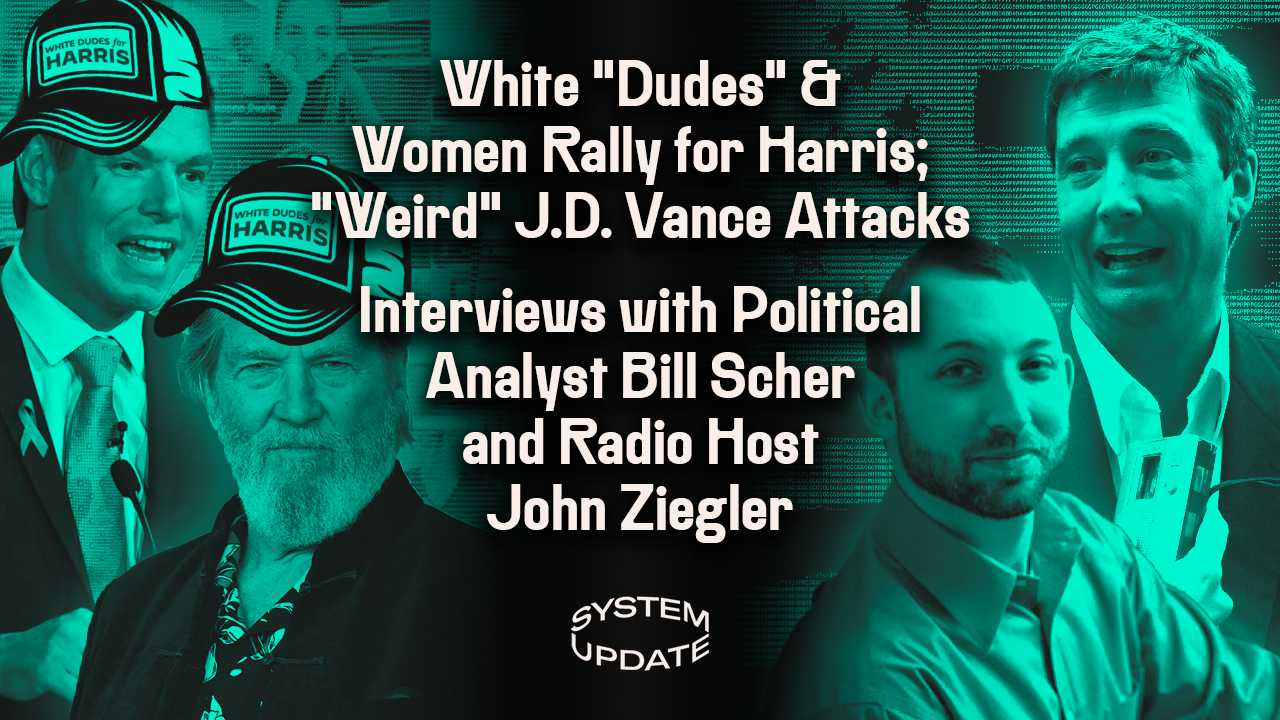
White "Dudes" and Women Rally for Harris; "Weird" J.D. Vance Attacks; Interviews with Political Analyst Bill Scher & Radio Host John Ziegler
Video Transcript
August 01, 2024
post photo preview

Watch the full episode HERE

Podcast: Apple - Spotify 

Rumble App: Apple - Google


Good evening, ladies and gentlemen of the Internet. It is Tuesday, July 30. 

Glenn is once again away on vacation. So, sorry to break it to you, but you're stuck with me again. I'm Michael Tracey, inspired by Kamala Harris’s campaign, our show tonight will be limited exclusively to white dudes, so we'll discuss this sudden peculiar embrace by the Democratic Party of white identity politics. 

Then: journalist, media critic, and fellow white dude John Ziegler and I will confront our shared whiteness in relation to the new Kamala juggernaut. 

And finally, Bill Scher, editor at the Washington Monthly and yet another white dude will analyze with me how he stopped worrying and learned to love our new Kamala overlord. 

But for now, welcome to a new episode of System Update, starting right now. 


AD_4nXcfQv56tO7UPZPf-ozQc-CV6DOgZFyq18eeC-a4u0CRYFu608ecEtGQeuo6TbhIXuoWfaJJrCH_dfXsdg9bMfj3qzJUM_cUN1OSFVFd7QcK7LTUDJ9muP3_2G5baVu4RthcahRb1fwaq3PVyzucojhTFhk2eLrnZEHjFh-G?key=6iU-AGlGTmYl5jXBqTLDzw

So, the Democratic Party has taken an interesting turn. First, they seem to have collectively decided that Donald Trump is no longer a fascist: he's just weird. So, for months and years and what seems like decades, what's been slightly shorter than that thankfully, the Democrats have been histrionically shrieking that Donald Trump is this existential threat to democracy; he's undermining our democratic order irreparably and irreversibly; he wants to overturn everything great and sacred about American and liberal internationalist values, and we need to all come together as a popular front to thwart his next rise to power. And Democrats seem to have taken an entirely different course these past couple of days, and they've decided that it turns out most people don't actually believe that Trump is this existential threat to democracy. So, you could have plenty of criticisms of Trump – we've shared some on the show–, you could do critical reporting on Trump – as I've done for now, eight, nine years, whatever the hell long it's been – without endlessly lurching into this just tedious refrain that Trump is going to destroy our democratic order, which never made a whole lot of sense.  Democrats appear to have decided that, at the 11th hour, they're just going to start calling Trump weird and not explain how they made that logical transition. 

And they're bolstered in this, apparently, by J.D. Vance having said some quote-unquote weird stuff over the past couple of years. So, we'll talk with our guests about that weird shift on Democrats' part. 

What I want to get to now is an even more shocking turn of events in terms of how the Democrats are handling their current electoral argument. They've decided to embrace white identity politics. Fascinating. 

Take a look at this beautiful trucker hat

AD_4nXd6w0Wqea0zXWJ4m6g5-6F8A7qKVpB0kJ8-VOj80GUrl91GOxVR8UaVo9skUxESEYNDUmUVwNkn3hbdLbWJsJHsWOjly4w594AKNxt1GpmJi50Jr3DOtH56fozKiS__I50RDcpEDrwyuBKyyZXVp7c-HBu2AKpHTGowprW3?key=6iU-AGlGTmYl5jXBqTLDzw

This was developed and created by a group of Democratic operatives and strategists and they convened last night a Zoom call of lots of white dudes. So, they're having racially exclusivist gatherings, I suppose, where they're emphasizing the racial identity and gender identity of the participants. And I should note, in fairness, they did clarify at the outset of this Zoom call that everybody was technically welcome, but it was branded first for white dudes. It was for white dudes to demonstrate their racial solidarity with Kamala Harris. So, they were showing how important it was to be allies of the newly presumptive Democratic presidential nominee with their racial identity. And you can purchase that hat. Take a look at it again. Gaze at it with wonder and joy.

That is available to you for the low price of $35, I'm told, plus $7.05 shipping. So, for approximately $42 that could be yours. And you'll have an in-kind contribution to the Harris campaign. And if you're a white dude like myself, then you'll, I guess, be repurposing your whiteness toward a positive, progressive end, at least in terms of how the organizers put it. 

So, let's hear a little bit from the intro, from this magnificent Zoom call that I actually sat and watched. So, the things I do for you people. Glenn, whenever the heck he gets back, really should elevate my compensation drastically. Because what I did this afternoon was I sat through like 3.5 hours of White Dudes for Kamala Zoom call and collated all the funniest bits so you don't have to watch it all yourself. So, for that alone, man, I should be getting his entire salary, frankly. So, let's have a look at what this white dude had to say vis-a-vis the intro of this Zoom call. [Short clip version]


Video. White Dudes for Harris, July 29, 2024


Ross Morales Rocketto: And I'll start by really addressing the elephant in the room, which is a lot of people feel and felt uncomfortable about the call, and I think that's understandably so. You know, throughout American history, when white men have organized, it was often with pointy hats on. And so I think that discomfort, I think the skepticism is understandable. The reason that we are doing this is because, we've just, you know, the left has been ceding white men to the MAGA for way, way too long. You know. […]


So, that's the organizer of this White Dudes for Harris call, preempting whatever discomfort some might understandably have. He acknowledges the impetus for this call being shared racial and gender identity, which, at least in terms of whites, the Democrats used to be pretty aggressively skeptical of and you might even say hostile to in recent years. But they're diving into it headfirst, apparently, now, because it can be marshaled toward the self-absolving and heavily virtuous end of electing our first half Asian. And you have to go through every historic first that Kamala would represent. You can't just say, woman, it's half Asian and half Black and also woman and also first person from Berkeley, California, and almost also first San Francisco district attorney and also the first vice president to be theoretically elected president, who was picked basically as an emotional blackmail tactic by an incumbent, or by a presidential nominee in 2020, Joe Biden, who had was basically pressured into selecting a Black woman after the George Floyd uproar Emerged that year. There was some political necessity for him to demonstrate his own solidarity in that election cycle, I guess, racially or something, and pick a Black woman, and Kamala ended up rising to the top of the pack after her surrogates and supporters kind of basically kneecapped her other rivals for the VP slot. But that's neither here nor there. Let's look at what's the white dude in chief himself, Jeff Bridges, had to say. This is funny. 


Video. Jeff Bridges. White Dudes for Harris. July 29, 2024


Jeff Bridges: Kamala is just so certainly our girl. You know, I can see her being pressed. I'm so excited a woman president, man. How exciting, you know, and her championing of women's rights. But for that. 


 Okay, so, Jeff Bridges, I guess is just really excited about a woman president. So, would he have been excited about Nikki Haley? Perhaps. How about, I don't know, Sarah Palin? Marjorie Taylor Greene? Lauren Boebert, who we interviewed at the Republican convention recently? I mean, so much of what was discussed on this call as this rallying cry around Kamala was just pure recitation of her identity traits, which was thematically in keeping with the organizational reason for this call, purportedly, which is that these are all white dudes, and they have to stand together as white dudes and show that they will very dutifully line up behind Kamala, despite having divergent racial characteristics, and that's supposed to be very heartwarming for us all in this pluralistic democracy that we're so fortunate to live in. 

Let's go to Governor Roy Cooper, of North Carolina, yet another white dude. As I mentioned, this is a whites-only space tonight. This is a safe space for white dudes. If you're not a white dude watching, you might not even want to turn off the broadcast because maybe you'll feel uncomfortable. And frankly, you're not even welcome as far as I'm concerned, because I'm going with the vibes that have been sent forth by the Democratic Party. 

Don't turn off the broadcast! That would be bad for Rumble and our advertisers. I'm just kidding. But you get my point, right? This is all about, apparently, racial solidarity. So, we're trying to model that, we're emulating what the Democrats are doing. It's all in service of racial justice. 


So, here is Governor Roy Cooper, Democrat of North Carolina, we're told, just took himself out of the running for a potential VP pick for Kamala as of yesterday. But he nevertheless made time to appear on this White Dudes for Kamala Zoom call. 


Video. Gov. Roy Cooper (D - NC). White Dudes for Harris. July 29, 2024


Gov. Roy Cooper: I'm going to get right to it, guys. Real men respect women. Their decisions. Their careers. And it's pretty clear that Donald Trump and JD Vance don't. 


So I guess all real men out there, and I consider myself a very real man – look, you just see me radiating with masculinity, I feel like I'm going to overdose on masculinity, my muscles are just going to burst out at the seams of my shirt here and, actually, probably seductive for many of you watching – but what Roy Cooper's point is, I gather, is that real men know when it's time for them to defer to women. And the number one woman to be deferred to now is Kamala Harris. 

Notice they're marshaling this woman argument, which it seemed like it was played out with Hillary Clinton but, I guess, you know, never say never with the Democrats, it's back baby. They're saying that, you know, real men would understand that what they ought to do, what they have a moral obligation to do, is defer to the divine rights or the obviousness of Kamala Harris ascending to the presidency, again, as we've gone over many times on this show, without having won a single vote, acquired a singular delegate through a single popular vote outcome in a single state or territory in two presidential primary cycles. But that's all being swept to the side and, according to Roy Cooper, real men understand that it's our duty to defer to Kamala. 


Next, we have Mitch Landrieu. He's the former mayor of New Orleans. He's also a Biden campaign operative. And here's his take. 


Video. Mitch Landrieu. White Dudes for Harris. July 29, 2024


Mitch Landrieu: We need to stand in this moment. Kamala is carrying on her shoulders 248 years of pain, of agony, of hope, of frustration. And no matter how high she jumps, no matter how many degrees she has, no matter how good her grades are, she's never good enough because they're always moving the line. And I think in that idea, she holds the heart of so many people who have been left out. 


So, there's Mitch Landrieu. Yes, a white dude, as indicated by his participation in this call, taking it upon himself to assert that Kamala Harris as a personage, as a figure that hasn't been elected to any office in terms of this current election cycle, yes, she's the elected vice president, but nothing beyond that in terms of having acquired delegates or votes in the nomination cycle. But even if she had, it's very bizarre for Landrieu to ascribe to Kamala this, like, world-historic importance as like a racial forgiveness vessel or racial absolution vessel, where Landrieu is suggesting that she carries centuries of racial injustice on her shoulders. Really? According to who? I mean, did she carry that on her shoulders when she was locking up plenty of young Black men in California as a district attorney and then as attorney general? I'm not sure. I'm not even sure what entitles Mitch Landrieu to posit all these extravagant racial narratives onto the personhood of Kamala Harris. It's all very strange. You could easily imagine this being taken much differently if similar narratives were being concocted by Republicans where they're trying to appropriate the racial suffering of, I guess, Blacks and say that they stand for this, you know, historic remedy to the centuries-long plight of Black Americans and you can break that glass ceiling, I guess, by voting for their preferred nominee. 


So, here's an even funnier one. I hope you all enjoy this. I hope you go to bed tonight and you just replay this over and over again in your head because I know I will be doing so. This is from Josh Gad. I have to confess, I wasn't exactly familiar with him prior to subjecting myself to this White Dudes for Kamala Zoom call. But now I'm a huge fan of his work, so I'll be studying his filmography very closely. I have his IMDb page loaded up and ready to go. Let's hear from Josh. 


Video. Josh Gad. White Dudes for Harris. July 29, 2024


Josh Gad: I'm. I'm a white dude. That much you can probably tell by now, but I also happen to be a father of two girls. I have a ten-year-old and a 13-year-old, and I'm not sure if you guys can recall that feeling you had on the night of Tuesday, November 8, 2016. I stood over my kid's bed and I wept. I wept because I felt like I let them down. I wept because they had the chance, and we had the chance to have a female president for the first time in our lives and in the history of this nation. 


Isn't that wonderful? I need my tissues, where are my Kleenex and my other supplies to dab my eyes just because I'm so moved by his performance there? It really is something. I mean, what is there really to add? I like what he says.” As you can see, I'm a white dude. That much should be clear.” I think I'm going to introduce myself in every social situation from now on by saying the same thing. So, I'm just going to burst into a room and say, “I should be clear, I'm a white dude, but” then I'll make my point. I'll offer whatever greetings I was planning on offering, but I want to preface everything by announcing that I am, in fact, a white dude, again, inspired by the Democratic Party's recent turn toward white identity politics and what makes this so just unbelievably ironic? 

In 2020, you might recall, during the summer of George Floyd, you had a bevy of bestselling books, Atlantic magazine articles and viral tweet threads where white people were being instructed to, for the first time, develop a sense of racial identity that maybe they had been oblivious to or had neglected in the United States, where they have a stature of privilege. This was the theory, but they needed to cultivate a sense of white racial identity in order to recognize the racial grievances of their fellow Black Americans, or POC Americans, and to understand that they had to listen to them, value them, and allow them to take the lead in all kinds of endeavors and step back. You know, white people were being instructed “to know their role and shut their mouths,” to quote Dwayne The Rock Johnson, one of my idols. 

What was clear at the time was that what a lot of these white liberals were doing, in a fit of racial hysteria, was echoing what much of the white reactionary right like truly extreme online racialist right had been obsessed with for a very long time and were desperate to get some kind of mainstream acceptability, for which is to also cultivate white racial identity, but for their preferred ends, which is some kind of white nationalism, perhaps overblown term, but to foster a political movement around this sense of collective white identity, to preserve whites' interests or even whites' racial purity. 

So, the irony was that the white liberals who thought that they were cultivating this white identity politics to elevate Blacks or something, or to forge this new racial utopia or progressive utopia, they were giving a huge favor to the genuine reactionary, racialist right-wing types who wanted to foster this sense of identity politics for entirely different reasons. And that's continuing now because what are the white dudes for Kamala doing? Well, yeah, I mean, they are further entrenching this idea that white dudes have these distinct interests or there are distinct racial groups and there's like maybe any other racial group or ethnic group that organizes amongst themselves. I'm not even endorsing or opposing the logic of that. I'm just noting for the record that the function, it seems to me, of this new embraced by the Democratic Party and the Harris campaign of white identity politics in service of its own ends, just kind of underscores the creation of this new category of political, racial organizing. 

That can have some potentially worrisome downstream effects or it's at least something not to just be mindlessly cheered, I wouldn't think, especially if you, at least at one point pretended to be into, like, a colorblind society, like, I don't know, Barack Obama kind of was. He was into that rhetoric in the ancient days of 2008 or 2010, which I guess is an entirely different epoch in our collective history here. 


Let's go to Scott Galloway, who I'm told is some kind of internet celebrity. I don't understand the appeal, I have to say, every time I see him on some program, he just looks entirely dour, you know, he's, like, lecturing in this really morose way. Apparently, he inspires a lot of people to listen to it like marketing podcasts or something, but, hey, different strokes for different folks, right? And I'm certainly a different folk myself. So, I'm not one to judge. He graced the White Dudes for Kamala Zoom call with his presence as an internet celebrity. That's how he was introduced actually. And here's what he said. This is amazing. 


Video. Scott Galloway. White Dudes for Harris. July 29, 2024


Scott Galloway: Thanks very much. My name is Scott Galloway. I teach at NYU. I consider myself a man and I think my job is to provide and protect and the way that manifests in this age is to ensure that Vice President Harris is in the White House. 


So, Professor Scott says how he manifests his masculinity at the moment is to elect Kamala Harris. Again, so selfless. You could tell why he's such a popular internet celebrity, that he's willing to put it out there for anyone to see, that he is of the belief that what his commitment to true, pure and righteous masculinity entails in this moment, in this trying moment when the soul of America is once again at stake in the most important election of our lifetimes – which is the case for every election, we're told, right? I mean, 2016, 2020 and even go back. I mean, I would love to resurrect the ghost of Bob Dole, or at least go through the archives from the 1996 election, because I'm sure there are some schmucks who said that the election of 1996 between Bob Dole and Bill Clinton was the most important of all time. They say it every election cycle. And it's always a bit of a ruse because. It's all about just inflaming Partisan sentiment to get people rushing out to the polls, marching dutifully to the polls to pull the lever, checking the box or mailing the postcard or what have you to keep in power the two major parties, and then they can just usher in their respective professional classes who get empowered as a result of the voter going and voting in the Republican and Democratic Party, and then look forward to next election cycle also being the most important of all time. 

So, in light of that, I'm very thankful for Scott Galloway instructing us, or lecturing us because he's such a brilliant NYU professor and he really has the academic expertise to inform us what it means to be a man in this moment is to ensure that Kamala Harris is in the White House. Isn't that inspiring? 


Next, let's go to Eric Swalwell. Always a fun guy to hear from. 


Video. Rep. Eric Swalwell (D - CA). White Dudes for Harris. July 29, 2024


Eric Swalwell: And you know who's tough? It's Kamala Harris. And so, she's tough. She's real. She's ready. She's smart. And something that we're all starting to really see that I really like is that she's fun, and she's a person who can be serious without taking herself too seriously. But what I was hoping to impart onto everyone tonight, in my experience of like telling the story of why Kamala and not the past president, is a few things. And so, I wanted to just give you kind of three things that we all can do. And something that I've found helpful in my messaging is these three things. And if there's anything that us white dudes like to do it's to have a good hot take. 


I couldn't agree more, Eric. Congressman. If there's anything that we, white dudes, love to do more than rattling off hot takes. I don't know what it is. I know I associate my whiteness and my white dudeness intrinsically with the art of the hot take. Like the Art of the Deal, written by another infamous famous, depending on your point of view: white dude Donald J. Trump. We, white dudes and our hot takes, you know, it's just, something we're born with. I'm once again very inspired by Eric Swalwell, marshaling his inborn propensity to muster hot takes in service of what is now all our righteous and collective duty, which is to elect Kamala Harris, apparently. 


One more of this stuff, but this one also tickles me. This is another actor who I have to familiarize myself with because I'm just so moved by his thespian skill. 


Video. Rory O’Malley. White Dudes for Harris. July 29, 2024


Rory O’Malley: For having me. What's up, my white dudes? Ross, it was my honor to do anything for this call. I want to thank you and everyone who's been a part of it, and all of you who are on the call and will have donated that crazy amount of money. I'm in shock that this is happening. I'm here because I'm a dude. I'm clearly very white. I'm representing the pasty white contingency of the delegation, and I'm voting for Vice President Harris because she is the candidate who stands for justice, freedom and the future. She's the embodiment of the backbone of the progressive movement. She's a woman. More specifically, she's a Black woman and Black women have been showing up to elect progressive white dudes for generations. And it's time we show up for […] 


Okay, so there is, there's Rory fellow of White Dudes for Harris, one of the organizers, saying “It's time we, white progressives, show up for Black women.” Have you heard, like, one statement of a policy stance associated with Kamala Harris over the course of any of these declarations? I heard very little in sitting through that 3.5-hour session. It's all about how white progressives – I have to say, many of them seem like gay men – which is fine, not that there's anything wrong with that – who feel like they have some extra identity-based obligation to defer to Black women and show how supportive they are of Black women and how they're going to leave everything out on the field for Black women. Because Black women, as Rory said, are the backbone of the Democratic Party. And it's time for white dudes to show their appreciation electorally and get to work and sacrifice for others for once. Just like Black women have always sacrificed for white dudes. So, it seems like it's more like a racial karma ritual for a lot of these people than it is about governance or policy or anything that would really substantively relate to Kamala Harris's conduct in the office of the presidency, the most powerful position in world history. I mean, forget foreign policy, forget national security. They don't give a crap about that, as far as I could tell. It's all about, like, this racial trade-off, mystical kind of conception of how American politics works. That's what they're most fixated on by far. And as a white dude, I know I'm here for it. 

And just to end this tantalizing monologue, let's hear from our gender compatriots. I'm gonna make one exception. Okay? This was a white dude-only session tonight inspired by the Democratic Party, but I couldn't resist. White women also held their own Zoom and it was also a joyous occasion. I want to share this with you because I feel like this will really ring in your heart for some time. So, let's hear this. 


Video. Arielle Fodor. White Women for Kamala. July 29, 2024


Organizer: Arielle Fodor, affectionately known as Mrs. Frazzle to her combined audience of over 1.5 million followers, is here to help gently parent us through this election. 


Arielle Fodor: Thank you. Hi everybody. I am so honored to speak today. I am like shaking to just be among such incredible company. We are here because as if you were here earlier you've heard, Bipoc women have tapped us in as white women to step up, listen, and get involved this election season. This is a really important time, and we all need to use our voices and influence for the greater good. No matter who you are, you are all influencers in some way. So tonight, I'm going to share some do's and don'ts for getting involved in politics online and navigating the toxicity that comes with it and spoiler alert; as much as the toxicity […] 


Okay, I'm pausing because, honestly, I think I would blow my brains out if I listened to that full clip. So, I apologize to our production team but I really cannot bear to listen to that full thing. But you get the idea. She says she’s shaking because she's so honored by being in the presence of all these illustrious people who are on the call. I'm shaking to listen to that, but for much different reasons. I do appreciate, though, that she says we're all influencers. She's a TikTok influencer. She is a teacher, I guess, and she makes cute little videos about her classroom experiences. But now she's a political mogul, I guess, or something, and she wants to give us all tips on how we can best share the message of Kamala in these tumultuous and turbulent political times. And I know when I'm listening to that, I really do feel like I'm in a third-grade classroom. And I guess that's what a lot of people in the Democratic Party like now. They want to feel like they're being educated in a third-grade context, because that's about the level of sophistication with which they're approaching this stuff, which is why identity politics, I mean, if this is up your alley, then I don't know. You guys are on a different wavelength than me. I find that really repulsive. But now let's move on.


Interview: John Ziegler

AD_4nXe7c2tAD5jsuKBSZ-dal25IO1qp8Kx0gdKnmXpAYxSq8d_vtElcW5Iz1PJcK2X5LJktY1Np1gzB3kC6wHaLGXeZcpMlaXVcuZLrd5VwpWpAKjw4Zl0dSctdEBhgp0gMlgOgN_cvWUNhAdftmVrzSTbzE476doV_Xejm3gqESg?key=6iU-AGlGTmYl5jXBqTLDzw

 All right, so I want to welcome John Zeigler. He's a long-time media critic, I think it's fair to say. Also, I would call him a journalist. I'm not sure if you would appreciate that designation or not – sometimes journalist is not the most flattering title. I'm even inclined to reject it myself – and also a long-time radio host, he's a podcaster, and so forth. So, let's go to John Ziegler. 


M. Tracey: John, how are you? 


John Ziegler: I'm doing well. Thanks for having me. 


M. Tracey: So, John, I recall hearing of you first back in the day when you were a staunch defender for Sarah Palin, the vice presidential nominee in 2008 with John McCain. So, in light of that, I do want to get your take on something to do with J.D. Vance, obviously, the recently named vice presidential nominee for Donald Trump. And let's go to this clip. This is JB Pritzker. He's the governor of Illinois. He was on ABC's “This Week”, this past Sunday. I want to get your response to it. 


Video. JB Pritzker. ABC This Week. July 28, 2024


JB Pritzker: […] They're just weird. The differences between these two candidates, I mean, on the other side, they're just weird. I mean, they really are. The things that they stand for. Donald Trump, of course, is afraid of windmills. And, you know, he talks about, all kinds of crazy. You know, his running mate, as you probably have heard, is, you know, getting known for his obsession with couches and somebody who is hiding his views on a woman's right to choose, and then just broadly, the attack on people […] 


M. Tracey: So, John, as best I can tell, when JB Pritzker is invoking JD Vance, having some weird fixation with couches, what he's referring to is a fabricated internet meme that people just outright made up, that then got turned into a new story about J.D. Vance, like, having sex with a couch. I'm sorry I'm even having to say it here, but that was the genesis of what Pritzker is alluding to and you know notice, Martha Raddatz, who I think was the anchor of ABC News’s “This Week” on the Sunday show this past weekend, she doesn't catch it. She just lets J.B. Pritzker make this allusion to some literally made-up claim about JD Vance to underscore this newfound Democratic talking point, that J.D. Vance is weird. And I'm sure he is weird in certain respects. In fact, I'm pretty certain that he is weird in certain respects, but, you know, so am I; so are most Democrats. John, I'm sorry to say you might be weird in certain respects as well. A lot of us are weird, but to just let fly that fabricated claim about Vance and having some sexual liaison with a couch, I don't know. This seems like it could raise your hackles a bit, given your experience in 2008 with Palin or am I drawing too loose of a connection there? 

Only for Supporters
To read the rest of this article and access other paid content, you must be a supporter
8
What else you may like…
Videos
Podcasts
Posts
Articles
Lindsey Graham: Senator from Tel Aviv

New video: Glenn discusses Sen. Lindsey Graham's (R-SC) extreme devotion to Israel.

00:18:06
The NYT Performs Loyal Stenography—Masquerading as Journalism—to Protect AOC

The New York Times dutifully protected AOC after her disastrous interview flop at the Munich Security Conference, watch Glenn's reaction here:

00:31:25
AOC Makes Her Big Foreign Policy Debut, Falls Flat on Her Face
00:23:22
Listen to this Article: Reflecting New U.S. Control of TikTok's Censorship, Our Report Criticizing Zelensky Was Deleted

For years, U.S. officials and their media allies accused Russia, China and Iran of tyranny for demanding censorship as a condition for Big Tech access. Now, the U.S. is doing the same to TikTok. Listen below.

Listen to this Article: Reflecting New U.S. Control of TikTok's Censorship, Our Report Criticizing Zelensky Was Deleted
Good news about your Locals membership and our move to Substack

Dear Locals members:

We have good and exciting news about your Locals membership. It concerns your ability to easily convert your Locals membership to SYSTEM UPDATE into a Substack subscription for our new page, with no additional cost or work required.

As most of you know, on February 6, we announced the end of our SYSTEM UPDATE program on Rumble, or at least an end to the format we’ve used for the last 3 years: as a live, nightly news program aired exclusively on Rumble.

With the end of our show, we also announced that we were very excited to be moving back to Substack as the base for our journalism. Such a move, we explained, would enable us not only to continue to produce the kind of in-depth video segments, interviews, and reports you’ve grown accustomed to on SYSTEM UPDATE, but would also far better enable me to devote substantial time to long-form investigations and written articles. Our ability at Subtack to combine all those forms of journalism will enable (indeed, already is enabling) us to ...

Super article, one of his best. Excellently persuasive. Thanks Glenn!

I am going to pick a quotation that has a pivotal focus for the reading:

”(oil is often cited as the reason, but the U.S. is a net exporter of oil, and multiple oil-rich countries in that region are perfectly eager to sell the U.S. as much oil as it wants to buy)”

There is another argument that states that it is to prevent Iran from selling oil to China. So then there is the question, that if Iran only agreed to not sell oil to China, would we still be on the brink of a new war with Iran?

There is also the question of how much money does it cost simply to transport all that military hardware to that region in order to “persuade” Iran and then if Trump decides to return all that military hardware back to home base how much is that cost in addition to the departure journey?

https://open.substack.com/pub/greenwald/p/the-us-is-on-the-brink-of-a-major?r=onv0m&utm_medium=ios

NEW: Message from Glenn to Locals Members About Substack, System Update, and Subscriptions

Hello Locals members:

I wanted to make sure you are updated on what I regard as the exciting changes we announced on Friday night’s program, as well as the status of your current membership.

As most of you likely know, we announced on our Friday night show that that SYSTEM UPDATE episode would be the last one under the show’s current format (if you would like to watch it, you can do so here). As I explained when announcing these changes, producing and hosting a nightly video-based show has been exhilarating and fulfilling, but it also at times has been a bit draining and, most importantly, an impediment to doing other types of work that have always formed the core of my journalism: namely, longer-form written articles and deep investigations.

We have produced three full years of SYSTEM UPDATE episodes on Rumble (our premiere show was December 10, 2022). And while we will continue to produce video content similar to the kinds of segments that composed the show, they won’t be airing live every night at 7:00 p.m. Eastern, but instead will be posted periodically throughout the week (as we have been doing over the last couple of months both on Rumble and on our YouTube channel here).

To enlarge the scope of my work, I am returning to Substack as the central hub for my journalism, which is where I was prior to launching SYSTEM UPDATE on Rumble. In addition to long-form articles, Substack enables a wide array of community-based features, including shorter-form written items that can be posted throughout the day to stimulate conversation among members, a page for guest writers, and new podcast and video features. You can find our redesigned Substack here; it is launching with new content on Monday.

For our current Locals subscribers, you can continue to stay at Locals or move to Substack, whichever you prefer. For any video content and long-form articles that we publish for paying Substack members, we will cross-post them here on Locals (for members only), meaning that your Locals subscription will continue to give you full access to our journalism. 

When I was last at Substack, we published some articles without a paywall in order to ensure the widest possible reach. My expectation is that we will do something similar, though there will be a substantial amount of exclusive content solely for our subscribers. 

We are working on other options to convert your Locals membership into a Substack membership, depending on your preference. But either way, your Locals membership will continue to provide full access to the articles and videos we will publish on both platforms.

Although I will miss producing SYSTEM UPDATE on a (more or less) nightly basis, I really believe that these changes will enable the expansion of my journalism, both in terms of quality and reach. We are very grateful to our Locals members who have played such a vital role over the last three years in supporting our work, and we hope to continue to provide you with true independent journalism into the future.

— Glenn Greenwald   

Read full Article
post photo preview
The Epstein Files: The Blackmail of Billionaire Leon Black and Epstein's Role in It
Black's downfall — despite paying tens of millions in extortion demands — illustrates how potent and valuable intimate secrets are in Epstein's world of oligarchs and billionaires.

One of the towering questions hovering over the Epstein saga was whether the illicit sexual activities of the world’s most powerful people were used as blackmail by Epstein or by intelligence agencies with whom (or for whom) he worked. The Trump administration now insists that no such blackmail occurred.


Top law enforcement officials in the Trump administration — such as Attorney General Pam Bondi, FBI Director Kash Patel, and former FBI Deputy Director Dan Bongino — spent years vehemently denouncing the Biden administration for hiding Epstein’s “client list,” as well as concealing details about Epstein’s global blackmail operations. Yet last June, these exact same officials suddenly announced, in the words of their joint DOJ-FBI statement, that their “exhaustive review” found no “client list” nor any “credible evidence … that Epstein blackmailed prominent individuals as part of his actions.” They also assured the public that they were certain, beyond any doubt, that Epstein killed himself.


There are still many files that remain heavily and inexplicably redacted. But, from the files that have been made public, we know one thing for certain. One of Epstein’s two key benefactors — the hedge fund billionaire Leon Black, who paid Epstein at least $158 million from 2012 through 2017 — was aggressively blackmailed over his sexual conduct. (Epstein’s second most-important benefactor was the billionaire Les Wexner, a major pro-Israel donor who cut off ties in 2008 after Epstein repaid Wexner $100 million for money Wexner alleged Epstein had stolen from him.)


Despite that $100 million repayment in 2008 to Wexner, Epstein had accumulated so much wealth through his involvement with Wexner that it barely made a dent. He was able to successfully “pilfer” such a mind-boggling amount of money because he had been given virtually unconstrained access to, and power over, every aspect of Wexner’s life. Wexner even gave Epstein power of attorney and had him oversee his children’s trusts. And Epstein, several years later, created a similar role with Leon Black, one of the richest hedge fund billionaires of his generation.


Epstein’s 2008 conviction and imprisonment due to his guilty plea on a charge of “soliciting a minor for prostitution” began mildly hindering his access to the world’s billionaires. It was at this time that he lost Wexner as his font of wealth due to Wexner’s belief that Epstein stole from him.


But Epstein’s world was salvaged, and ultimately thrived more than ever, as a result of the seemingly full-scale dependence that Leon Black developed on Epstein. As he did with Wexner, Epstein insinuated himself into every aspect of the billionaire’s life — financial, political, and personal — and, in doing so, obtained innate, immense power over Black.


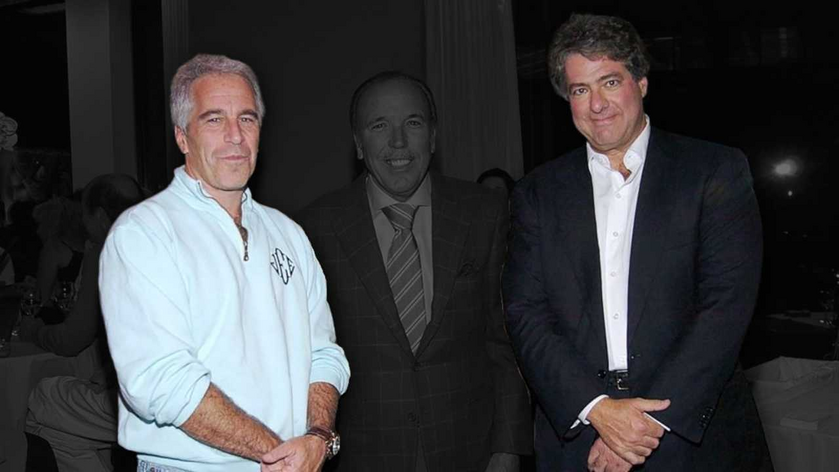
The recently released Epstein files depict the blackmail and extortion schemes to which Black was subjected. One of the most vicious and protracted arose out of a six-year affair he carried on with a young Russian model, who then threatened in 2015 to expose everything to Black’s wife and family, and “ruin his life,” unless he paid her $100 million. But Epstein himself also implicitly, if not overtly, threatened Black in order to extract millions more in payments after Black, in 2016, sought to terminate their relationship.


While the sordid matter of Black’s affair has been previously reported — essentially because the woman, Guzel Ganieva, went public and sued Black, accusing him of “rape and assault,” even after he paid her more than $9 million out of a $21 million deal he made with her to stay silent — the newly released emails provide very vivid and invasive details about how desperately Black worked to avoid public disclosure of his sex life. The broad outlines of these events were laid out in a Bloomberg report on Sunday, but the text of emails provide a crucial look into how these blackmail schemes in Epstein World operated.


Epstein was central to all of this. That is why the emails describing all of this in detail are now publicly available: because they were all sent by Black or his lawyers to Epstein, and are thus now part of the Epstein Files.


Once Ganieva began blackmailing and extorting Black with her demands for $100 million — which she repeatedly said was her final, non-negotiable offer — Black turned to Epstein to tell him how to navigate this. (Black’s other key advisor was Brad Karp, who was forced to resign last week as head of the powerful Paul, Weiss law firm due to his extensive involvement with Epstein).


From the start of Ganieva’s increasingly unhinged threats against Black, Epstein became a vital advisor. In 2015, Epstein drafted a script for what he thought Black should tell his mistress, and emailed that script to himself.


Epstein included an explicit threat that Black would have Russian intelligence — the Federal Security Service (FSB) — murder Ganieva, because, Epstein argued, failure to resolve this matter with an American businessman important to the Russian economy would make her an “enemy of the state” in the eyes of the Russian government. Part of Epstein’s suggested script for Black is as follows (spelling and grammatical errors maintained from the original correspondents):


you should also know that I felt it necessary to contact some friends in FSB, and I though did not give them your name. They explained to me in no uncertain terms that especially now , when Russia is trying to bring in outside investors , as you know the economy sucks, and desperately investment that a person that would attempt to blackmail a us businessman would immeditaly become in the 21 century, what they terms . vrag naroda meant in the 20th they translated it for me as the enemy of the people, and would e dealt with extremely harshly , as it threatened the economies of teh country. So i expect never ever to hear a threat from you again.


In a separate email to Karp, Black’s lawyer, Epstein instructs him to order surveillance on the woman’s whereabouts by using the services of Nardello & Co., a private spy and intelligence agency used by the world’s richest people.


Black’s utter desperation for Ganieva not to reveal their affair is viscerally apparent from the transcripts of multiple lunches he had with her throughout 2015, which he secretly tape-recorded. His law firm, Paul, Weiss, had those recordings transcribed, and those were sent to Epstein.


To describe these negotiations as torturous would be an understatement. But it is worth taking a glimpse to see how easily and casually blackmail and extortion were used in this world.


Leon Black is a man worth $13 billion, yet his life appears utterly consumed by having to deal constantly with all sorts of people (including Epstein) demanding huge sums of money from him, accompanied by threats of various kinds. Epstein was central to helping him navigate through all of this blackmail and extortion, and thus, he was obviously fully privy to all of Black’s darkest secrets.


At their first taped meeting on August 14, 2015, Black repeatedly offered his mistress a payment package of $1 million per year for the next 12 years, plus an up-front investment fund of £2 million for her to obtain a visa to live with her minor son in the UK. But Ganieva repeatedly rejected those offers, instead demanding a lump sum of no less than $100 million, threatening him over and over that she would destroy his life if he did not pay all of it.


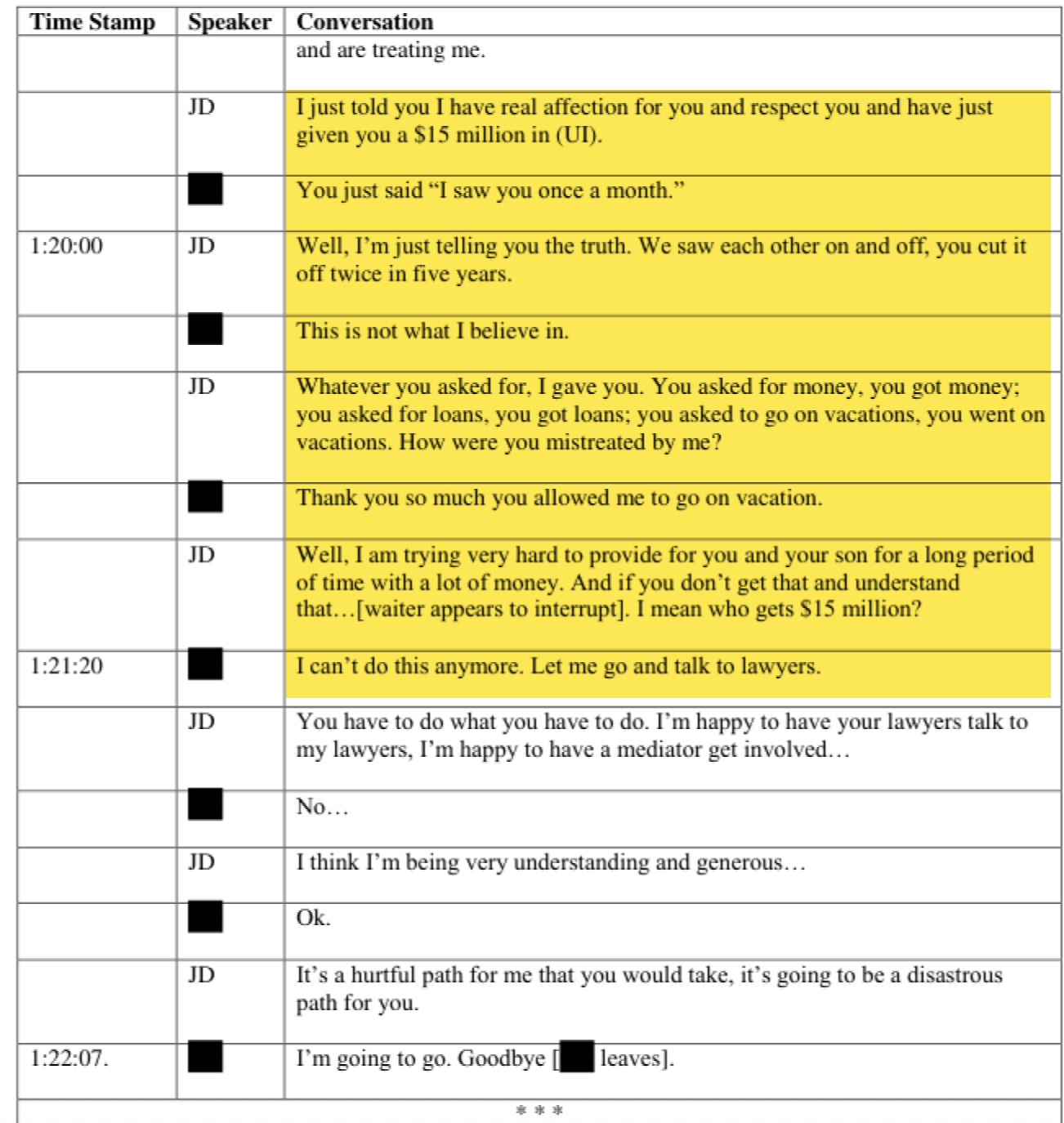
Black was both astounded and irritated that she thought a payment package of $15 million was somehow abusive and insulting. He emphasized that he was willing to negotiate it upward, but she was adamant that it had to be $100 million or nothing, an amount Black insisted he could not and would not pay.


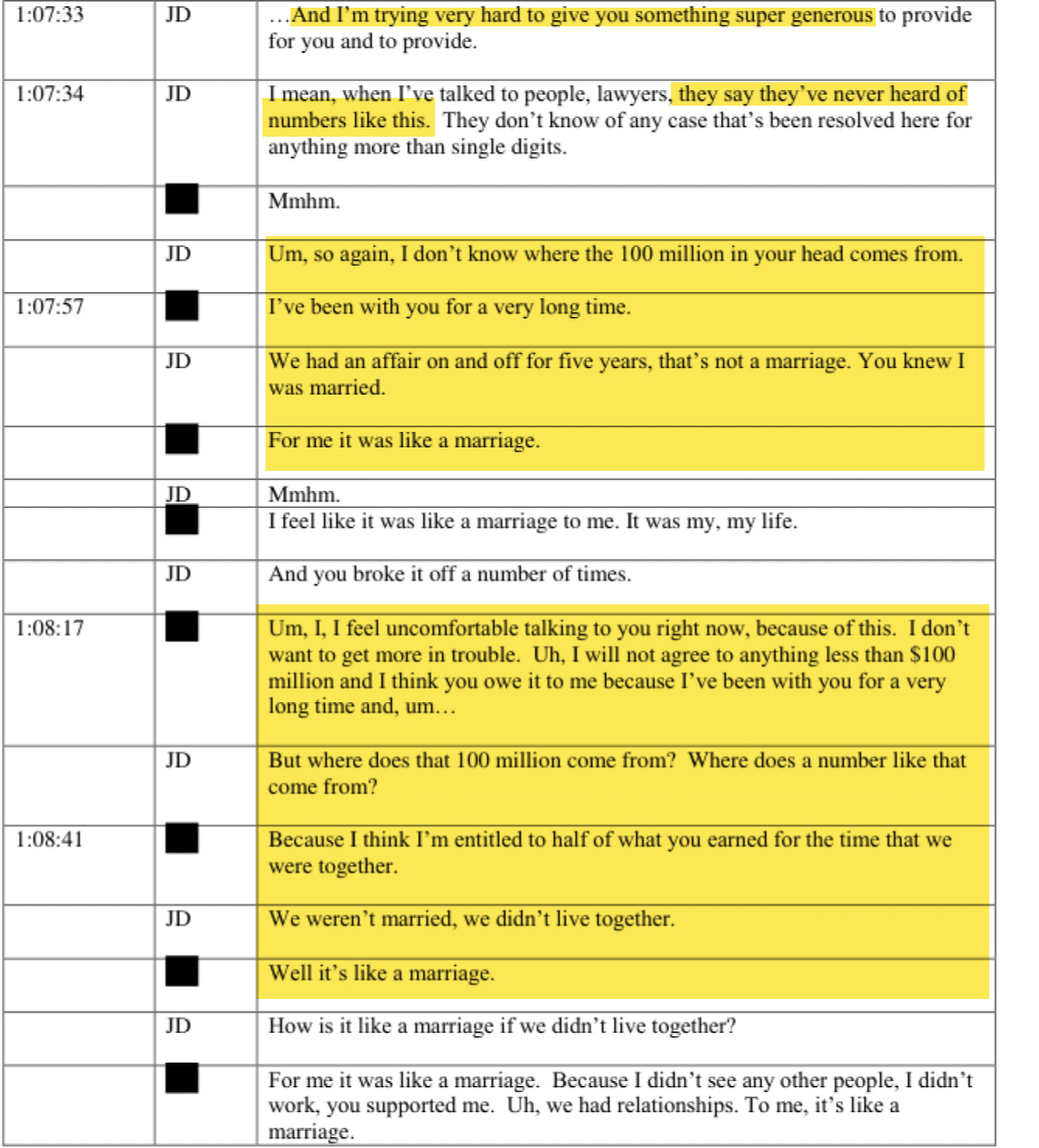
When pressed to explain where she derived that number, Ganieva argued that she considered the two to be married (even though Black was long married to another woman), thereby entitling her to half of what he earned during those years. Whenever Black pointed out that they only had sex once a month or so for five or six years in an apartment he rented for her, and that they never even lived together, she became offended and enraged and repeatedly hardened her stance.


Over and over, they went in circles for hours across multiple meetings. Many times, Black tried flattery: telling her how much he cared for her and assuring her that he considered her brilliant and beautiful. Everything he tried seemed to backfire and to solidify her $100 million blackmail price tag. (In the transcripts, “JD” refers to “John Doe,” the name the law firm used for Black; the redacted initials are for Ganieva):


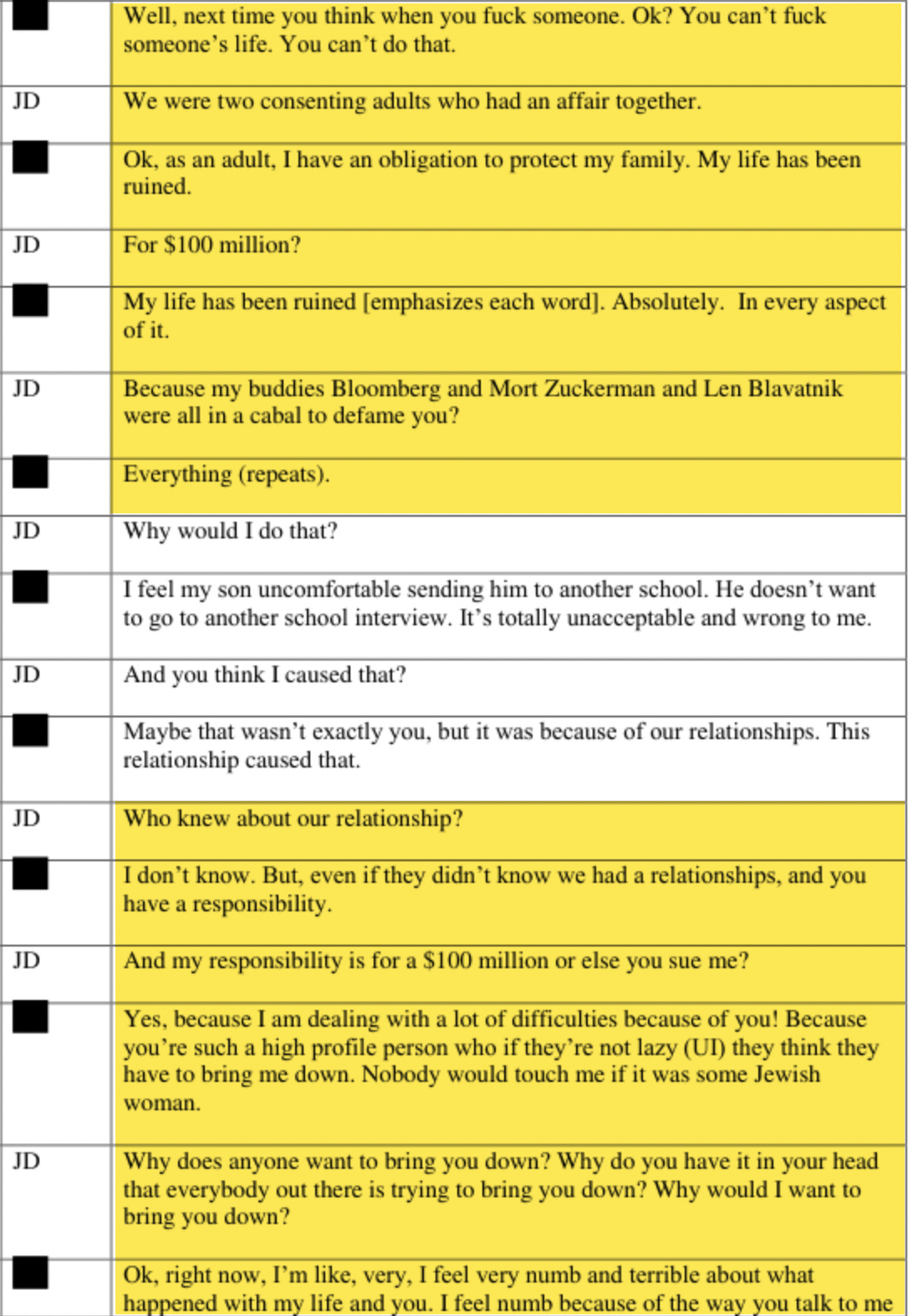
On other occasions during their meetings, Ganieva insisted that she was entitled to $100 million because Black had “ruined” her life. He invariably pointed out how much money he had given her over the years, to say nothing of the $15 million he was now offering her, and expressed bafflement at how she could see it that way.


In response, Ganieva would insist that a “cabal” of Black’s billionaire friends — led by Michael Bloomberg, Mort Zuckerman, and Len Blavatnik — had conspired with Black to ruin her reputation. Other times, she blamed Black for speaking disparagingly of her to destroy her life. Other times, she claimed that people in multiple cities — New York, London, Moscow — were monitoring and following her and trying to kill her. This is but a fraction of the exchanges they had, as he alternated between threatening her with prison and flattering her with praise, while she kept saying she did not care about the consequences and would ruin his life unless she was paid the full amount:


By their last taped meeting in October, Ganieva appeared more willing to negotiate the amount of the payment. The duo agreed to a payment package in return for her silence; it included Black’s payments to her of $100,000 per month for the next 12 years (or $1.2 million per year for 12 years), as well as other benefits that exceeded a value of $5 million. They signed a contract formalizing what they called a “non-disclosure agreement,” and he made the payments to her for several years on time. The ultimate total value to be paid was $21 million.


Unfortunately for Black, these hours of misery, and the many millions paid to her, were all for naught. In March, 2021, Ganieva — despite Black’s paying the required amounts — took to Twitter to publicly accuse Black of “raping and assaulting” her, and further claimed that he “trafficked” her to Epstein in Miami without her consent, to force her to have sex with Epstein.


As part of these public accusations, Ganieva spilled all the beans on the years-long affair the two had: exactly what Black had paid her millions of dollars to keep quiet. When Black denied her accusations, she sued him for both defamation and assault. Her case was ultimately dismissed, and she sacrificed all the remaining millions she was to receive in an attempt to destroy his life.


Meanwhile, in 2021, Black was forced out of the hedge fund that made him a billionaire and which he had co-founded, Apollo Global Management, as a result of extensive public disclosures about his close ties to Epstein, who, two years earlier, had been arrested, became a notorious household name, and then died in prison. As a result of all that, and the disclosures from his mistress, Black — just like his ex-mistress — came to believe he was the victim of a “cabal.” He sued his co-founder at Apollo, the billionaire Josh Harris, as well as Ganieva and a leading P.R. firm on RICO charges, alleging that they all conspired to destroy his reputation and drive him out of Apollo. Black’s RICO case was dismissed.


Black’s fear that these disclosures would permanently destroy his reputation and standing in society proved to be prescient. An independent law firm was retained by Apollo to investigate his relationship with Epstein. Despite the report’s conclusion that Black had done nothing illegal, he has been forced off multiple boards that he spent tens of millions of dollars to obtain, including the highly prestigious post of Chair of the Museum of Modern Art, which he received after compiling one of the world’s largest and most expensive collections, only to lose that position due to Epstein associations.


So destroyed is Leon Black’s reputation from these disclosures that a business relationship between Apollo and the company Lifetouch — an 80-year-old company that captures photos of young school children — resulted in many school districts this week cancelling photo shoots involving this company, even though the company never appeared once in the Epstein files. But any remote association with Black — once a pillar of global high society — is now deemed so toxic that it can contaminate anything, no matter how removed from Epstein.


None of this definitively proves anything like a global blackmail ring overseen by Epstein and/or intelligence agencies. But it does leave little doubt that Epstein was not only very aware of the valuable leverage such sexual secrets gave him, but also that he used it when he needed to, including with Leon Black. Epstein witnessed up close how many millions Black was willing to pay to prevent public disclosure in a desperate attempt to preserve his reputation and marriage.


In October, The New York Times published a long examination of what was known at the time about the years-long relationship between Black and Epstein. In 2016, Black seemingly wanted to stop paying Epstein the tens of millions each year he had been paying him. But Epstein was having none of it.


Far from speaking to Black as if Epstein were an employee or paid advisor, he spoke to the billionaire in threatening, menacing, highly demanding, and insulting terms:


Jeffrey Epstein was furious. For years, he had relied on the billionaire Leon Black as his primary source of income, advising him on everything from taxes to his world-class art collection. But by 2016, Mr. Black seemed to be reluctant to keep paying him tens of millions of dollars a year.

So Mr. Epstein threw a tantrum.

One of Mr. Black’s other financial advisers had created “a really dangerous mess,” Mr. Epstein wrote in an email to Mr. Black. Another was “a waste of money and space.” He even attacked Mr. Black’s children as “retarded” for supposedly making a mess of his estate.

The typo-strewn tirade was one of dozens of previously unreported emails reviewed by The New York Times in which Mr. Epstein hectored Mr. Black, at times demanding tens of millions of dollars beyond the $150 million he had already been paid.

The pressure campaign appeared to work. Mr. Black, who for decades was one of the richest and highest-profile figures on Wall Street, continued to fork over tens of millions of dollars in fees and loans, albeit less than Mr. Epstein had been seeking.


The mind-bogglingly massive size of Black’s payments to Epstein over the years for “tax advice” made no rational sense. Billionaires like Black are not exactly known for easily or willingly parting with money that they do not have to pay. They cling to money, which is how many become billionaires in the first place.


As the Times article put it, Black’s explanation for these payments to Epstein “puzzled many on Wall Street, who have asked why one of the country’s richest men would pay Mr. Epstein, a college dropout, so much more than what prestigious law firms would charge for similar services.”


Beyond Black’s payments to Epstein himself, he also “wired hundreds of thousands of dollars to at least three women who were associated with Mr. Epstein.” And all of this led to Epstein speaking to Black not the way one would speak to one’s most valuable client or to one’s boss, but rather spoke to him in terms of non-negotiable ultimatums, notably similar to the tone used by Black’s mistress-turned-blackmailer:


Email from Jeffrey Epstein to Leon Black, dated November 2, 2015.


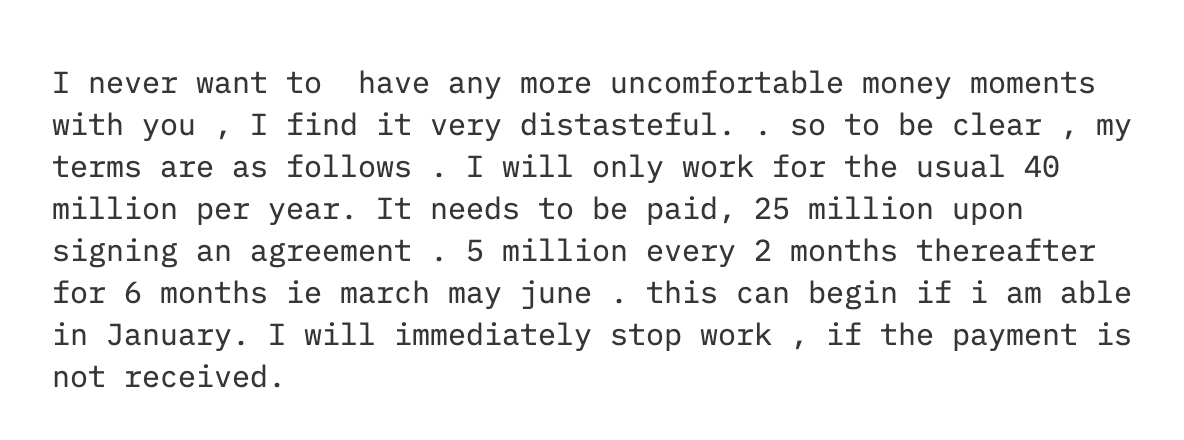
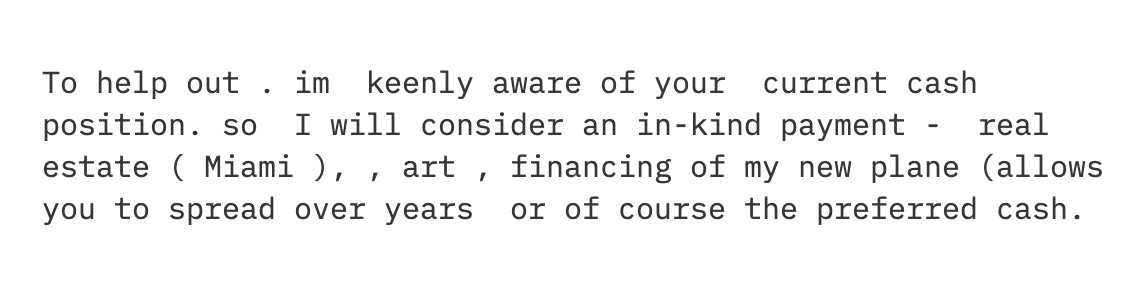
When Black did not relent, Epstein’s demands only grew more aggressive. In one email, he told Black: “I think you should pay the 25 [million] that you did not for this year. For next year it's the same 40 [million] as always, paid 20 [million] in jan and 20 [million] in july, and then we are done.” At one point, Epstein responded to Black’s complaints about a cash crunch (a grievance Black also tried using with his mistress) with offers to take payment from Black in the form of real estate, art, or financing for Epstein’s plane:


Email from Jeffrey Epstein to Leon Black, dated March 16, 2016.


With whatever motives, Black succumbed to Epstein’s pressure and kept paying him massive sums, including $20 million at the start of 2017, and then another $8 million just a few months later, in April.


Epstein had access to virtually every part of Black’s life, as he had with Wexner before that. He was in possession of all sorts of private information about their intimate lives, which would and could have destroyed them if he disclosed it, as evidenced by the reputational destruction each has suffered just from the limited disclosures about their relationship with Epstein, to say nothing of whatever else Epstein knew.


Leon Black was most definitely the target of extreme and aggressive blackmail and extortion over his sex life in at least one instance we know of, and Epstein was at the center of that, directing him. While Wall Street may have been baffled that Wexner and Black paid such sums to Epstein over the years, including after Black wanted to cut him off, it is quite easy to understand why they did so. That is particularly so as Epstein became angrier and more threatening, and as he began reminding Black of all the threats from which Epstein had long protected him. Epstein watched those exact tactics work for Black’s mistress.


The DOJ continues to insist it has no evidence of Epstein using his access to the most embarrassing parts of the private and sexual lives of the world’s richest and most powerful people for blackmail purposes. But we know for certain that blackmail was used in this world, and that Epstein was not only well aware of highly valuable secrets but was also paid enormous, seemingly irrational sums by billionaires whose lives he knew intimately.

Read full Article
post photo preview
Amazon's Ring and Google's Nest Unwittingly Reveal the Severity of the U.S. Surveillance State
Just a decade after a global backlash was triggered by Snowden reporting on mass domestic surveillance, the state-corporate dragnet is stronger and more invasive than ever.

That the U.S. Surveillance State is rapidly growing to the point of ubiquity has been demonstrated over the past week by seemingly benign events. While the picture that emerges is grim, to put it mildly, at least Americans are again confronted with crystal clarity over how severe this has become.


The latest round of valid panic over privacy began during the Super Bowl held on Sunday. During the game, Amazon ran a commercial for its Ring camera security system. The ad manipulatively exploited people’s love of dogs to induce them to ignore the consequences of what Amazon was touting. It seems that trick did not work.


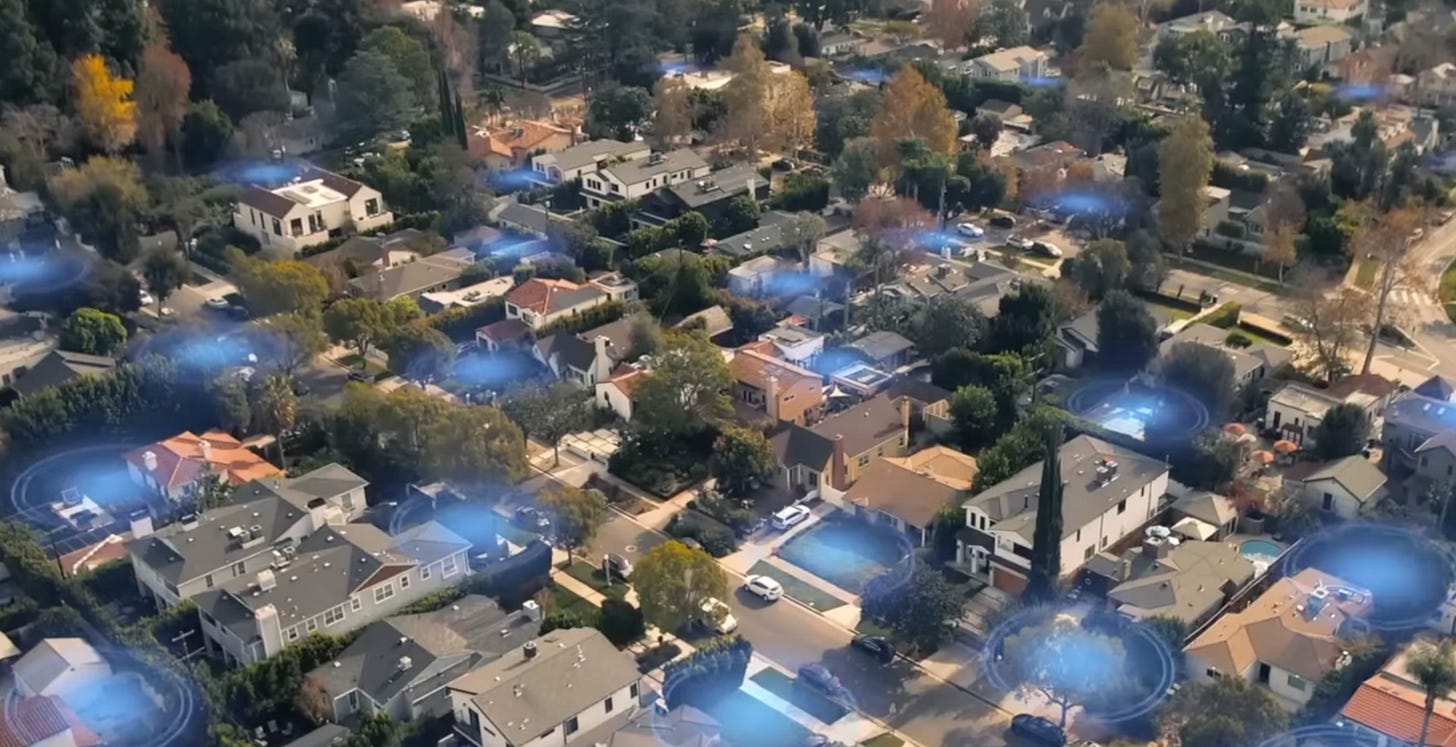
The ad highlighted what the company calls its “Search Party” feature, whereby one can upload a picture, for example, of a lost dog. Doing so will activate multiple other Amazon Ring cameras in the neighborhood, which will, in turn, use AI programs to scan all dogs, it seems, and identify the one that is lost. The 30-second commercial was full of heart-tugging scenes of young children and elderly people being reunited with their lost dogs.


But the graphic Amazon used seems to have unwittingly depicted how invasive this technology can be. That this capability now exists in a product that has long been pitched as nothing more than a simple tool for homeowners to monitor their own homes created, it seems, an unavoidable contract between public understanding of Ring and what Amazon was now boasting it could do.


Amazon’s Super Bowl ad for Ring and its “Search Party” feature.


Many people were not just surprised but quite shocked and alarmed to learn that what they thought was merely their own personal security system now has the ability to link with countless other Ring cameras to form a neighborhood-wide (or city-wide, or state-wide) surveillance dragnet. That Amazon emphasized that this feature is available (for now) only to those who “opt-in” did not assuage concerns.


Numerous media outlets sounded the alarm. The online privacy group Electronic Frontier Foundation (EFF) condemned Ring’s program as previewing “a world where biometric identification could be unleashed from consumer devices to identify, track, and locate anything — human, pet, and otherwise.”


Many private citizens who previously used Ring also reacted negatively. “Viral videos online show people removing or destroying their cameras over privacy concerns,” reported USA Today. The backlash became so severe that, just days later, Amazon — seeking to assuage public anger — announced the termination of a partnership between Ring and Flock Safety, a police surveillance tech company (while Flock is unrelated to Search Party, public backlash made it impossible, at least for now, for Amazon to send Ring’s user data to a police surveillance firm).


The Amazon ad seems to have triggered a long-overdue spotlight on how the combination of ubiquitous cameras, AI, and rapidly advancing facial recognition software will render the term “privacy” little more than a quaint concept from the past. As EFF put it, Ring’s program “could already run afoul of biometric privacy laws in some states, which require explicit, informed consent from individuals before a company can just run face recognition on someone.”


Those concerns escalated just a few days later in the context of the Tucson disappearance of Nancy Guthrie, mother of long-time TODAY Show host Savannah Guthrie. At the home where she lives, Nancy Guthrie used Google’s Nest camera for security, a product similar to Amazon’s Ring.


Guthrie, however, did not pay Google for a subscription for those cameras, instead solely using the cameras for real-time monitoring. As CBS News explained, “with a free Google Nest plan, the video should have been deleted within 3 to 6 hours — long after Guthrie was reported missing.” Even professional privacy advocates have understood that customers who use Nest without a subscription will not have their cameras connected to Google’s data servers, meaning that no recordings will be stored or available for any period beyond a few hours.


For that reason, Pima County Sheriff Chris Nanos announced early on “that there was no video available in part because Guthrie didn’t have an active subscription to the company.” Many people, for obvious reasons, prefer to avoid permanently storing comprehensive daily video reports with Google of when they leave and return to their own home, or who visits them at their home, when, and for how long.


Despite all this, FBI investigators on the case were somehow magically able to “recover” this video from Guthrie’s camera many days later. FBI Director Kash Patel was essentially forced to admit this when he released still images of what appears to be the masked perpetrator who broke into Guthrie’s home. (The Google user agreement, which few users read, does protect the company by stating that images may be stored even in the absence of a subscription.)


While the “discovery” of footage from this home camera by Google engineers is obviously of great value to the Guthrie family and law enforcement agents searching for Guthrie, it raises obvious yet serious questions about why Google, contrary to common understanding, was storing the video footage of unsubscribed users. A former NSA data researcher and CEO of a cybersecurity firm, Patrick Johnson, told CBS: “There's kind of this old saying that data is never deleted, it's just renamed.” 


Image obtained through Nancy Guthrie’s unsubscribed Google Nest camera and released by the FBI.


It is rather remarkable that Americans are being led, more or less willingly, into a state-corporate, Panopticon-like domestic surveillance state with relatively little resistance, though the widespread reaction to Amazon’s Ring ad is encouraging. Much of that muted reaction may be due to a lack of realization about the severity of the evolving privacy threat. Beyond that, privacy and other core rights can seem abstract and less of a priority than more material concerns, at least until they are gone.


It is always the case that there are benefits available from relinquishing core civil liberties: allowing infringements on free speech may reduce false claims and hateful ideas; allowing searches and seizures without warrants will likely help the police catch more criminals, and do so more quickly; giving up privacy may, in fact, enhance security.


But the core premise of the West generally, and the U.S. in particular, is that those trade-offs are never worthwhile. Americans still all learn and are taught to admire the iconic (if not apocryphal) 1775 words of Patrick Henry, which came to define the core ethos of the Revolutionary War and American Founding: “Give me liberty or give me death.” It is hard to express in more definitive terms on which side of that liberty-versus-security trade-off the U.S. was intended to fall.


These recent events emerge in a broader context of this new Silicon Valley-driven destruction of individual privacy. Palantir’s federal contracts for domestic surveillance and domestic data management continue to expand rapidly, with more and more intrusive data about Americans consolidated under the control of this one sinister corporation.


Facial recognition technology — now fully in use for an array of purposes from Customs and Border Protection at airports to ICE’s patrolling of American streets — means that fully tracking one’s movements in public spaces is easier than ever, and is becoming easier by the day. It was only three years ago that we interviewed New York Timesreporter Kashmir Hill about her new book, “Your Face Belongs to Us.” The warnings she issued about the dangers of this proliferating technology have not only come true with startling speed but also appear already beyond what even she envisioned.


On top of all this are advances in AI. Its effects on privacy cannot yet be quantified, but they will not be good. I have tried most AI programs simply to remain abreast of how they function.


After just a few weeks, I had to stop my use of Google’s Gemini because it was compiling not just segregated data about me, but also a wide array of information to form what could reasonably be described as a dossier on my life, including information I had not wittingly provided it. It would answer questions I asked it with creepy, unrelated references to the far-too-complete picture it had managed to create of many aspects of my life (at one point, it commented, somewhat judgmentally or out of feigned “concern,” about the late hours I was keeping while working, a topic I never raised).


Many of these unnerving developments have happened without much public notice because we are often distracted by what appear to be more immediate and proximate events in the news cycle. The lack of sufficient attention to these privacy dangers over the last couple of years, including at times from me, should not obscure how consequential they are.


All of this is particularly remarkable, and particularly disconcerting, since we are barely more than a decade removed from the disclosures about mass domestic surveillance enabled by the courageous whistleblower Edward Snowden. Although most of our reporting focused on state surveillance, one of the first stories featured the joint state-corporate spying framework built in conjunction with the U.S. security state and Silicon Valley giants.


The Snowden stories sparked years of anger, attempts at reform, changes in diplomatic relations, and even genuine (albeit forced) improvements in Big Tech’s user privacy. But the calculation of the U.S. security state and Big Tech was that at some point, attention to privacy concerns would disperse and then virtually evaporate, enabling the state-corporate surveillance state to march on without much notice or resistance. At least as of now, the calculation seems to have been vindicated.

Read full Article
See More
Available on mobile and TV devices
google store google store app store app store
google store google store app tv store app tv store amazon store amazon store roku store roku store
Powered by Locals