Glenn Greenwald
Politics • Culture • Writing
Glenn Takes Your Questions On Gaza, USAID, and More
System Update #403
February 10, 2025
post photo preview

The following is an abridged transcript from System Update’s most recent episode. You can watch the full episode on Rumble or listen to it in podcast form on Apple, Spotify, or any other major podcast provider.

System Update is an independent show free to all viewers and listeners, but that wouldn’t be possible without our loyal supporters. To keep the show free for everyone, please consider joining our Locals, where we host our members-only aftershow, publish exclusive articles, release these transcripts, and so much more!

The questions below were sent by our Locals supporters. If you would like to send your question, you can join our Locals community.

AD_4nXdytfYqB1TUvFNsQ6YLQlMcvhosTVI36UzDSR5I_pzsYk1_1dbfjo_3ID3oVi3Rw0D2t1qp7D2836FS2-XhJckOSThPfPcMljkroi8O6rtpEsiwzdje1nfp7t_1ShyauBjB4I8TWhvmOE_bVtPVGhs?key=qBkuFFxQZuIxxjmAsNr4GjW9

I've always believed that, unlike in the past, when journalists spoke in a monologue – they spoke on a kind of mountaintop, they issued their copy, people read it, and nobody had any outlet against it – the most important innovation of digital era journalism is that it has completely reversed: now all the time, if you write something, you are certain to hear many different directions criticisms and questions and critiques and challenges to everything that you've written. That's been part of what I've loved and, maybe because my journalism career was born in the internet age where that was already the case, to me, it's an obligation of journalism. If you're trying to have an impact on the public discourse, you have to not just open and disseminate it but answer and be accountable. 

The interactive Aftershow that we created every Tuesday and Thursday was designed to do that on Locals, where our community of subscribers is. We take questions or respond to feedback and critiques and hear suggestions for future shows. It was incredibly constructive. The problem that we have found – and we've been announcing that we're trying to retool this aftershow – is that every Tuesday and Thursday night we would end the show on Rumble and it would typically take 20, 25 minutes for us to set up the Locals show, it is in a different part of the studio, it has a different format, we have to wind down the Rumble stream and then have to boot up the Locals stream. A lot of people understandably don't want to wait around for dead air waiting for that Locals show. 

As many of you know, the Aftershow is available only for members of our Locals community, which is a really important part of the independent journalism that we do here. It's actually what enables us to do the independent journalism here. So, if you want to support our journalism and be part of the Locals community, you can just click the join button right below the video player on the Rumble page and it will take you directly to that community. 

What we decided to do is instead of these aftershows that have this big-time interval, every Friday, we're going to have what we are calling a Mailbag. I know that's an incredibly creative term. Nobody else has ever described this type of show that way before. But essentially what we want to do is elevate the questions, the comments, the critiques and the challenges from the aftershow, where only members hear it, to the live Rumble show and use Friday night, assuming that there's no major breaking news event that prevents it, and that way we can have a kind of back and forth. Other Rumble features are coming to enable it to be even more interactive, including a call-in feature where you can call in live and we can have a conversation. 

We've always gotten some amazingly provocative, interesting and entertaining questions from our viewers. Just as a note, the only people who will be able to submit questions or comments for Friday Mailbag are members of our Locals community.  

AD_4nXcrVB7o5PW-DV3vCw0BQ1Ue0Hc0gMnhpyV-CniicT4eV-dhRMigc47Ojn6dnC1eMgH0RNhMaCphDJgiRFJGOcVd73w8nmtKCP-3P4jZ6wrkKqDtF4oup8NkhmKXT_W-wBf_9Hfzpn3O1xqbtIr05w?key=qBkuFFxQZuIxxjmAsNr4GjW9

Here is video question number one in our debut Mailbag on Friday's evening System Update on Rumble and it is from Kevin Kotwas: 

So, I know that you speak a lot about the dangers of tech censorship and the importance of a free, open internet. But my question is whether or not we could truly have a free and open internet when all of these platforms are owned and centrally controlled by tech billionaires and exist within the top-down model of capitalism. I think, you know, the fact that this kind of decentralized blockchain, whatever platform doesn't exist yet, but isn't that sort of a cop-out? And shouldn't we start building these alternative systems that are, so we don't have to rely on the whims of billionaires for free speech? 

You know, that's a really great question. It's actually at the center of so many of the things that we cover. For those of you who aren't familiar with the terminology, what he's essentially saying is that one of the reasons why censorship on the internet has been such a problem is that you have these very identifiable figureheads who make all the decisions, who kind of sit there with the permit and delete buttons right on their desk. Mark Zuckerberg gets to decide what is and isn't permissible on Instagram, Facebook, and WhatsApp, and Google, on YouTube and all of their platforms and pre-Elon on that Twitter regime and now Elon himself on Twitter. And what the argument is saying is that even if you get somebody who is vehemently dedicated to the concept of free speech and opposed to online censorship, somebody like Elon Musk said he was, somebody like Rumble and its CEO, Chris Pavlovski, definitely are, but I have to say, even Jack Dorsey – I know he gets a lot of criticism, rightfully so, for the censorship Twitter did but he was never somebody who believed in internet censorship. If you listen to the reasons he says Twitter ended up censoring so much, you'll find that it's not because he was a believer in that. Quite the contrary. And the problem is that as long as you have an identifiable central decision maker, you're always going to be able to bring pressure to bear on these people. The government can threaten them, the government can put pressure on them, media outlets can try and shame them, “Oh, if you don't censor this, there's going to be blood on your hands.” But what you also often have is a workforce that these companies rely on and have recruited from Stanford and other colleges that have become pretty left-wing in terms of culture wars and believe in censorship and so, you get these internal pressures as well from your own work force saying we can't allow this kind of content. And so even the most stalwart free speech defenders like Elon ended up picking a war in Brazil that I think did a lot of good was really important he refused to censor a bunch of unjust censorship demands coming from this tyrannical judge, but then Brazil booted X, banned X from Brazil, which is a huge market, and Elon Musk had to retreat and now, he is censoring in accordance with those demands. Obviously, in China and India, all these company platforms do the same. Rumble has been an exception in that it has decided it would rather lose access to big markets, including Brazil and France than censor but at the end of the day, that is an ideal because you want these media outlets in every part of the world. 

One of the people who has advocated most the solution that's embedded in the question is the idea that we can't have any more centralized social media where there's a company or one person who sits at the helm and has the ability to censor or not censor because as long as that's the case, there will always be major vulnerability points to induce internet censorship. People like Jack Dorsey have very vocally argued that the only way out of that, no matter how well-intentioned the executives are, is through what Kevin, in that question asked, which is a kind of blockchain technology that decentralizes these social media outlets. So, in a sense, and I'm not an expert on this, technologically, but everybody has their own protocol of the social media outlet, and they can interact with one another. There was a site, Mastodon, you might remember, that liberals tried to flee when Elon bought Twitter and ended up realizing that didn't work. And there are other social media companies that don't rely on this centralized censorship, that do rely on these protocols. The problem right now is that these kinds of protocols, these kinds of blockchain sites are far too difficult to use. They're far too confusing. If you don't know a lot of computer code if you don't have an in-depth understanding of how protocols of blockchain work, it's just not user-friendly. And as long as it's not user-friendly, it's a huge entry into using them. And what we're seeing is that social media outlets to be meaningful and influential rely on scale. You need huge numbers of people on there. Otherwise, what's being said there makes no impact. 

But that can easily happen. I remember very well when the Snowden reporting happened, when Edward Snowden first started contacting me and was demanding that we use very highly sophisticated forms of encryption because he obviously felt unsafe, for good reason, talking to us about the stuff that he had taken unless we had the most military-grade encryption. But at the time, almost nobody, certainly media,, had that kind of encryption because it was extremely technologically complex to use. If you weren't well-versed in code, it would be very hard to do it. Snowden took hours and hours walking me through it. And now just six, seven, eight years later, that encryption is everywhere. It's very user-friendly. You don't need to do anything in order to have your communication encrypted. 

So, I do think there's validity to the view that as long as we have centralized social media where there's an executive or a set of executives and officials at the top, it's always going to be a vulnerability point to force internet censorship. Rumble is trying to prove that you can have a company that doesn't succumb to that but again, they've thus far been inaccessible to multiple key outlets. And you don't want that. You want Rumble and its free speech values to be in those countries. Blockchain may be the only solution. The problem is right now, and I think in the foreseeable future, it's unlikely to be sufficiently user-friendly to permit people on a very large scale to be able to actually use it. But it's a great question. It's an important development to watch out for. I hope those technologies get more user-friendly for precisely the reason that the questioner said. 


All right, let's go to question 2, from one of our longtime Locals members, Alan Smith. 

Greetings to the show's host. I'm sure it's been a long day for you, so I'll confine my questions to human subordinance. Glenn, I was wondering if there have been any developments in your ongoing feud with that Brazilian judge, and have you game down strategy in the event that you're tortured? Having Michael Tracy on is good practice and suggests that you have a high pain threshold but I recommend adopting the chunk method, just start talking, confess to everything and try to filibuster. 

Now, on a more serious note, more serious than your imminent torture, last week you seemed to suggest that you're younger than me. What you kind of understood at the time is that I am among the most accredited disinformation experts in the world. And I know what you're thinking. You're thinking that's just a made-up title that I've arbitrarily bestowed on myself, but we're not talking about that. The important thing to remember is that, aside from the obvious prestige this title affords me, it also enables me to issue disinformation warnings. 

So, let me address a couple of things. The serious question is about what my current condition is, my current status here in Brazil given the fact that I have been extremely critical of the most tyrannical official, I'd argue, in the democratic world, which is the Supreme Court Judge Alexander de Moraes, who was the one who had that war with Elon Musk, is the one who ordered X banned from all of Brazil, has put critics of his in prison, ordered searches and seizure of them, put political opponents in a form of lawfare and abuse of the justice system that makes what the Democratic Party did look tame by comparison. And there are a lot of people in prison and there are a lot of people exiled for having done that because he threatened to imprison them or has imprisoned them. And it's a really repressive environment. 

It isn't that I have just been a vocal critic of his. It's also that six months or so ago I got my hands on a massive archive that came right from his chambers. We've talked about this before. We were able to report; I partnered on purpose with the largest newspaper in Brazil, Folha de São Paulo, where we published on the front page more than a dozen articles showing all kinds of improprieties and irregularities and how his chambers were conducted. And in response, as you can imagine, he did not appreciate that, he opened a criminal inquiry. There were all kinds of threats emanating from Brasilia. But I've had this before. I obviously have this with the Snowden file and with Wikileaks and with the first reporting that we did in Brazil about Lula da Silva and the corruption force. As I always say, if you want to go into journalism and you want to actually do a good job with it, you're going to get threatened. You're going to get attacked. If you're not, it's a sign you're not bothering anybody in power. 

That said, I do think the questioner raised an important point, which is that I've known Michael Tracey for many years now. I've had many different kinds of interactions with him. I've had endless debates with him where he insists upon a certain myopic view or a more ample and substantive view and will pursue it endlessly until the end of time. You have to hang up on him, and even if you do, he'll call you 20 minutes later and continue or write you a long email about it. We've had Michael here in the studio. So, it is true that all those dealings with Michael Tracey have made me, I think, extremely well prepared to endure whatever forms of torture or other horrific suffering governments might actually try to impose as a result of their anger toward their critics. 

So, this is something that gives me a lot of hope. I think one of the things that's important – two things that are important actually – is and I've talked a lot about this with Julian Assange over the years and with Edward Snowden over the years, I talked about it with Daniel Ellsberg and Noam Chomsky, is that if you're going to try to do something that you know is dangerous, you're going to take on a power center, there's nothing that undermines the courageousness of it or the nobility of it if you start planning how to protect yourself against the worst consequences. You don't want to sacrifice the work; you don't want to run away and retreat. There's nothing noble about that. But if you devise strategies to try to minimize your vulnerability and minimize their ability to attack you, I think that's very wise. One of the tactics we've used in the Snowden story, with Wikileaks, with the first reporting we did in Brazil, is we just partner with large newspapers and commandeer them and get them on our side. It's obviously a lot more difficult for the government to try to prosecute you if you're publishing the leaked or classified documents that incriminate them and you're just doing it on your own website and they could say, you're just a blogger, you're an information broker, you're at theft. The things Obama administration officials tried to do with us with the Snowden story to justify our surveillance and imprisonment. But if you're partnering with The Guardian, The Washington Post, The New York Times, Globo and Folha – with Snowden, we partnered with media outlets around the world – then it becomes much more difficult. Then, it basically would mean that they have to put not only you but the editors in Folha and the journalists in Folha in that same criminal process as well. 

It doesn't always work out that way. Julian Assange partnered with the New York Times, The Guardian and El Pais to publish that 2010 classified information, and yet, still the Trump administration found a way to only prosecute Julian Assange and not those other newspapers. Even though the Obama administration has said there's no way to prosecute Julian Assange without also prosecuting the newspapers with whom he worked and who published the same information. When I was indicted in Brazil in 2020, I was the only one indicted, even though I was working with the largest newspaper in the country. 

So, it's not a guarantee, but it's a strategy that you can take. And look, at the end of the day, you have a lot of different options in life, and I don't think some are better than others. I think there are times in your life when you don't want to pursue a risky career project because you're just not at the point in your life when that's your priority or you're ready for it. But in general, especially in journalism, I think if you're somebody who believes in journalism, if you want to go into journalism for the right reasons – to take on power centers – if you're not prepared for and expecting these kinds of retaliations, and it goes back to what we're talking about with establishment centers of power earlier than that is simply not the right profession for you. Thanks for that question. 


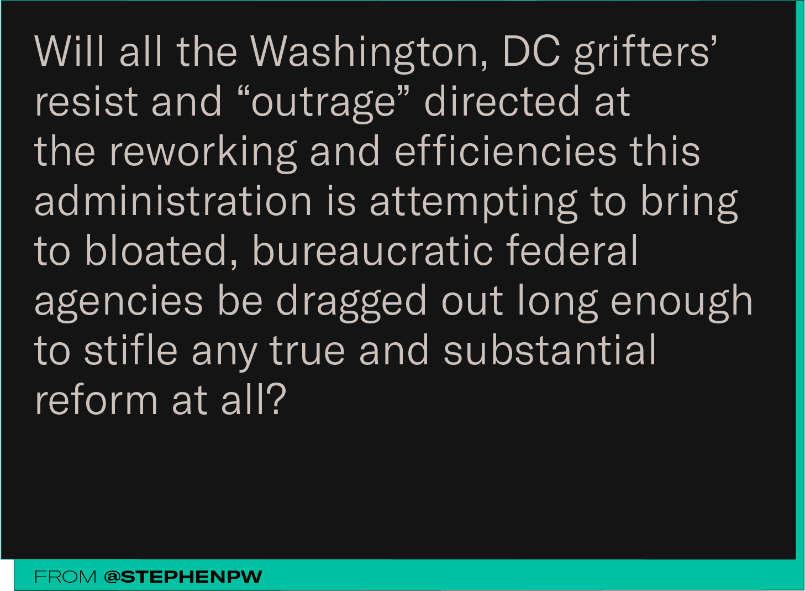
Here are some text questions. That’s what we've been doing on the Aftershow for a long time. This is from @stephenpw:
A screenshot of a computerAI-generated content may be incorrect.

It's, I think, something that is hard to say. You know, I was thinking today about the fact that I remember in the ‘80s when Ronald Reagan ran, he ran on a platform of abolishing three major cabinet positions, including the Department of Education, I believe the Department of Health and Human Services and maybe the Department of Interior. I'll check on those last two. It doesn't really matter; I don't remember for sure, but definitely the Department of Education. 

Reagan was an incredibly popular president. He won in 1984 with a massive landslide. He campaigned on it and people voted for it and he just never did it because the institutional inertia in Washington was too great to effectuate changes that radical. And I think one of the things that Democrats are looking at and feeling almost jealous about and resentful toward is that their leaders have often run on platforms and when they get into office, they make all kinds of excuses why those things are impossible to do. 

The reality is that we're not supposed to have parts of our government that operate unto themselves free of democratic accountability. Like USAID saying, “How dare you White House that got elected come in interfering in our operations and trying to find out what we're doing? We have the right to exist separately.” Why? the government funds you!

And so, I think one of the things that Elon Musk is doing, I think one of the things that a lot of people who helped prepare Donald Trump for what would happen if he won and you've got to give those people credit independently of the merits. They were not playing around; they were extremely serious about doing the things they said they were going to do. They had plans for it, they had executive orders written, they had all kinds of powers that their lawyers told them they could exercise, they're not playing around, which is what you would want in a president who campaigns on dismantling a massive institution of the deep state, administrative state. You don't want them making a few symbolic gestures toward it and then just letting it stand as is. This is, I think, something that is commendable, independent of your views of these agencies, because Donald Trump ran on a platform of doing this, the people of the United States democratically ratified it, and now he's going about doing it. 

These agencies are not going away lightly. This is now the third question when we're talking about the kind of instinct and incentive of establishment institutions. They don't just give up lightly because somebody is at their gate knocking on the door or even going in. This is a staple of American imperialistic foreign policy since the end of World War II. You think these people, these military-industrial complex people are just going to give all this up lightly? But right now, Donald Trump and Elon Musk and his team are steamrolling over opposition. The Democrats are still completely befuddled by what happened in the 2024 election, even more so by what they stand for. Nobody cares about the corporate media anymore. So, they're not a bulwark to anything, and every day they just keep rolling over these agencies. 

I don't want to be too rosy-eyed about it; we'll see what ends up replacing them, we'll see what people who are doing this actually intend with these agencies but these agencies, USAID and others like them, have been these behemoths that have run our country and run our foreign policy and run much of the world and they are completely impervious to democratic elections. Nobody has any idea of what they're doing. They purposely keep it that way. They're sinister, they interfere in other countries, other countries hate them, they have kicked them out, they've expelled them, they have a massive budget, and they do what they want with it. And so, to watch them being targeted and to watch all of this transparency, selective, though it may be emerging, I've always believed that this was the value of Donald Trump, no matter all my disagreements of various policy positions of his. 

We played you this video before where Seymour Hersh, the legendary journalist, said that he was always been associated with the left, has said that “You can vote Democrat, you can vote Republican for decades and the foreign policy establishment continues as is. Nothing can ever change and it's disastrous and corrupted.” Donald Trump, he said, is the only one with the capacity to be what he called a circuit breaker. And my former intercept colleague Jeremy Scahill, who's clearly on the left, went on Breaking News and said that he doubted that and I think that's exactly right. I think Donald Trump is a circuit breaker. And circuit breakers are a blunt instrument. They just turn all the lights off. But sometimes when the system is flowing, and nobody can stop it because it's too big and has been going on for too long and it's creating too many destructive results and results that we don't even know, you need a circuit breaker. You need to break it and then say, okay, what is this? What has it been and how do we rebuild it? And I'm not saying there are no dangers from it. I'm not saying there are no valid questions about Elon Musk's role or the role of people he's hiring to do these things but I don't think you can deny that having people rampage through these unaccountable industrial administrative state and deep state agencies in Washington is so long overdue, and I'm thrilled to see it. 


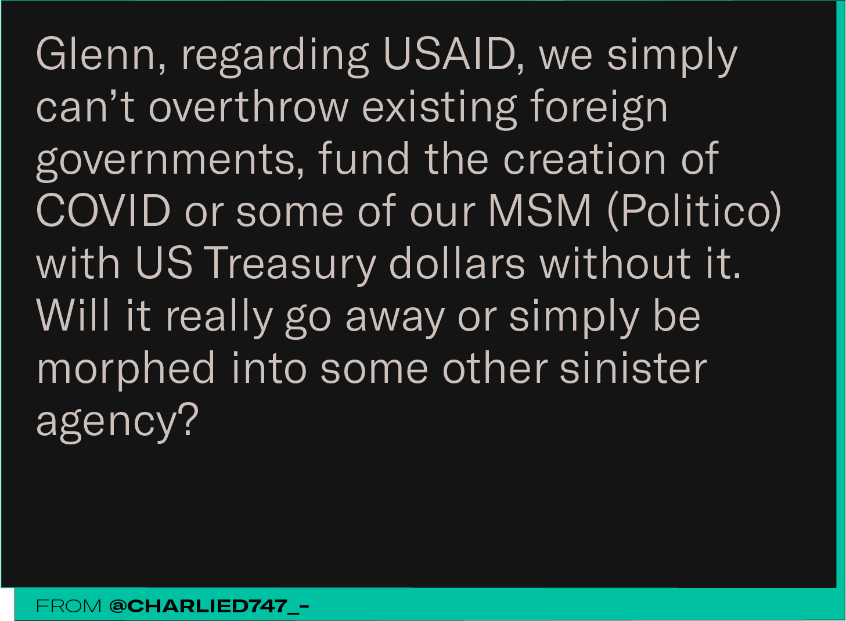
This is from @charlie747_- 
AD_4nXc55xpC2VejTri68o3QqhzaDjQ0Zi52686QBxIXCSnrF0lWLl4RNxvs2x0JQZONBTBwZM74RXMr02RrCOcw9cyMGlHrFJA555Hyc-PZjuFu1uBEbvGooIDveAe9Ls56G3ELkeAjoSt2gpnEkLtVMpw?key=qBkuFFxQZuIxxjmAsNr4GjW9

Well, let me just say that USAID was created in 1961. We had by Mike Benz on the show, he explained and I think in a very cohesive and accurate way, the reason they needed USAID, they already had a CIA, they already had a State Department. Why do you need a USAID to carry out the same foreign policies? It's because the CIA and the State Department can't go into places and say, “Hi, I'm from the U.S. government, I'm from the State Department, I'm an arm of the CIA and I'm here to involve myself in your internal activities.” USAID was a way of pretending “Oh no, we're not the CIA, we're not the State Department, we're just here to help, we want to fund your nice programs, we’re going to get involved in your civic society, we want to help people.” The reality is that that was the goal. The U.S. government did not fund USAID in these massive numbers to go around helping people because we're really nice, we were concerned for people. Sometimes they did end up helping people because one way to get soft power in a country is by going in and saying, “Oh look, we're saving your babies. Don't you love us instead of China?” 

Massive amounts of this budget, though, were about subverting elections, overthrowing elections, manipulating the outcome of elections to get the leaders that we wanted sowing discord and division, trying to transform other societies into ours and our vision of left-wing culture war ideology, because we thought that that would make these countries more amenable to our it's just a completely unnecessary part of the federal government, very, very sinister and creates a lot of anti-American rage, even though it's called USAID. Who could be against an aid agency that just wants to help? And finally, that narrative is being destroyed because transparency is what brings the truth to everything. 


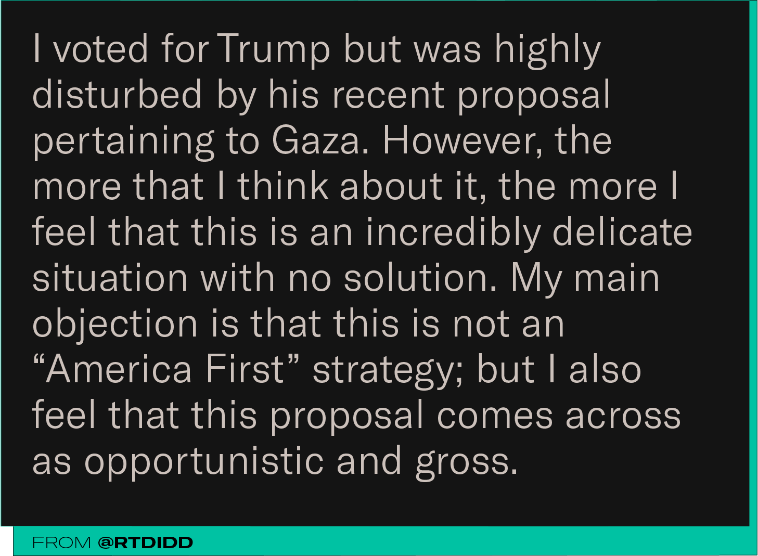
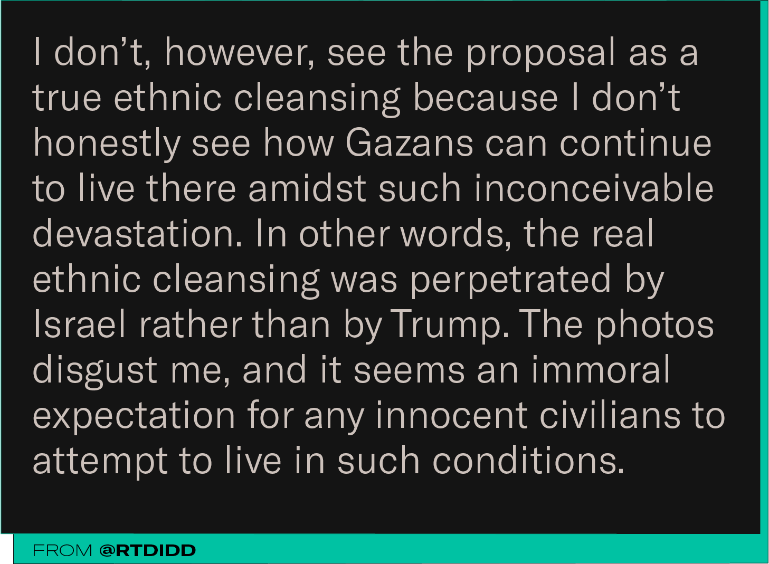
Last question from @RTDidd:
AD_4nXeM55yz0OoOxJgxHBqvKXVC84VxOO7mBRE6YRuHVAeE22MmbhjOR8pmU0FZbkjEhPRSnnzNWp2NTD8_YVtkHH0i7NT-0feT9snsS-hx1HmXgbjH7V6X1S5-zjh7pZc2b4Q2-RghXy7yM_XLvhFk0g?key=qBkuFFxQZuIxxjmAsNr4GjW9


AD_4nXd3l495-7-op8WJdxE9JzF2Y6Mca21hv-fwx7iCqlElMkhSSigH6z1O1_t0FoEtWu6NnqvacKLAqpEWDQLP5cxm5u0JMYJNSHoobnbEEspu4T1MWDnCoTGVpl0150Ao-l7qxTCxjwdgl15TJ2AjBg?key=qBkuFFxQZuIxxjmAsNr4GjW9


AD_4nXdKD3G1nQ67aXFiqQ_4E3ONtXIr_ycpIcjQdNUqAi6K49HEzckounr1YDcmGjgnCg4wRTEPbhRdogoCZl76Lu4kER4gOJp9mPEn_KxBwdDEOCy7AtJnzhKA5-NRZGhyHJ_u1q4Rcsn7ICuf-cGRgA?key=qBkuFFxQZuIxxjmAsNr4GjW9


Lots of good points there.  I absolutely agree with the point that the real ethnic cleansing came before Trump. But this is perfect bipartisan foreign policy. Joe Biden oversees the destruction of Gaza for 15 months by giving Israel the arms and enemies and money to destroy it all with no limitations and then Trump comes in and says, “Oh look, Netanyahu and Biden destroyed all of Gaza; I have to do something about it.”

It is absolutely true and we've been saying this for many years now – not just in the last couple of weeks – that Gaza has been completely destroyed and made uninhabitable. The civilian infrastructure of Gaza was obliterated on purpose – water, sewage, buildings, the health care system, and the educational system. There's nothing there. And I wouldn't even say it's such a malicious idea that, hey, look, these people can't stay there while they're renovating. I mean, I don't know if you've ever renovated the homes, you live in. It's horrific. And there the structure is not collapsed. It's just that there's so much going on that on some level, for your safety, sometimes even you have to leave the house. And here I don't even like that comparison, I just want to make the point but it is a much vaster scale. 

The problem is twofold. One is that you can rebuild Gaza without moving out 1.8 million Gazans. You rebuild this area, you move the people temporarily out, you move them back in, all within Gaza. Trump is giving the Israelis what they've always wanted, which is the cleansing ethnically of Gaza from all Arabs. But the other problem is you have to leave it to the Palestinians to decide what they want. You can't decide for them what's best. “Oh. it's better for them to just leave and not sit in the rubble.” Let them decide that right now, they're all saying “We just survive 15 months because we don't want to leave this land. This is sacred land to us. This is our land. We will fight to the death to preserve it.” 

So, if I were making a decision and somebody were saying to me, hey, you can live in this rubble that Israel just obliterated for 15 months, or you can move somewhere where there's at least some semblance of civilian life, my choice might be different than the people of Gaza who have strong religious and cultural and political reasons that probably has got reinforced over the last 15 months about why they will never, ever leave.

The other problem is, it's not just these neutral countries suggesting it to them. It's the United States and Israel. He sat next to Netanyahu. Everyone in Palestine and everyone in the world knows that the people who destroyed Gaza are the two countries sitting there, the United States and Israel. And they're the last two that people in Gaza are going to trust to move out. 

The solution to the Middle East is have the United States stop paying for Israel's military, and all of its wars and protect them diplomatically and everything they do, because then they will have an incentive to place limits on their behavior and to try to find a way to get along with their neighbors and then at the same time give the Palestinians some degree of sovereignty and dignity the way everyone else in this world would demand. I don't think there's another group of people on the planet that would tolerate and withstand a foreign military, especially the ones that kicked him out of their original homeland, putting them through humiliating checkpoints, killing them whenever they feel like it, flattening their society, cutting off food, going on for decades, who wouldn't fight back. 

There's a famous film in in Hollywood made in 1984 called Red Dawn, about how the Russians invaded and occupied the United States and all the heroic Americans, not the military, civilians, took up arms and engaged in terrorist attacks against the Russians to drive them out. That's everyone's right. Everybody, every population would use violence if foreign militaries were occupying the land. So, the solution is to solve the root of the problem. 

I do agree with people, and I think, you know, I heard this critique and I'm willing to even give it a little bit of validity that, especially in the first day when I heard this, I overreacted to it rather than caveating in the fact that it could be a negotiating ploy, which I think in part it might have been. Nonetheless, I think the very idea of even musing about ethnic cleansing – and that is what it is if you're talking about the forceful transfer of a population of a certain ethnicity out of a land, that, by definition, is ethnic cleansing and if that's not, nothing is – while he was sitting next to the smirking leader of the country that actually destroyed it. Think about the imagery that is sent around that region of the world. The unrest that can create in that region, the anti-American rage that it can create, the impossibility of normalizing relations in the Middle East while Donald Trump and Benjamin Netanyahu are sitting there talking about turning Gaza into some sort of American-owned or American-Israeli partnership real estate project when the whole point of that conflict is that the people there feel thousands of years of very deep religious, cultural and now identity-based connection to the land. 


All right. This is a great exercise. I really love this. The questions were great tonight. We'll continue to grow, get better, get more diverse and everything. That's what we're hoping. 
 

community logo
Join the Glenn Greenwald Community
To read more articles like this, sign up and join my community today
5
What else you may like…
Videos
Podcasts
Posts
Articles
Lindsey Graham: Senator from Tel Aviv

New video: Glenn discusses Sen. Lindsey Graham's (R-SC) extreme devotion to Israel.

00:18:06
The NYT Performs Loyal Stenography—Masquerading as Journalism—to Protect AOC

The New York Times dutifully protected AOC after her disastrous interview flop at the Munich Security Conference, watch Glenn's reaction here:

00:31:25
AOC Makes Her Big Foreign Policy Debut, Falls Flat on Her Face
00:23:22
Listen to this Article: Reflecting New U.S. Control of TikTok's Censorship, Our Report Criticizing Zelensky Was Deleted

For years, U.S. officials and their media allies accused Russia, China and Iran of tyranny for demanding censorship as a condition for Big Tech access. Now, the U.S. is doing the same to TikTok. Listen below.

Listen to this Article: Reflecting New U.S. Control of TikTok's Censorship, Our Report Criticizing Zelensky Was Deleted
Good news about your Locals membership and our move to Substack

Dear Locals members:

We have good and exciting news about your Locals membership. It concerns your ability to easily convert your Locals membership to SYSTEM UPDATE into a Substack subscription for our new page, with no additional cost or work required.

As most of you know, on February 6, we announced the end of our SYSTEM UPDATE program on Rumble, or at least an end to the format we’ve used for the last 3 years: as a live, nightly news program aired exclusively on Rumble.

With the end of our show, we also announced that we were very excited to be moving back to Substack as the base for our journalism. Such a move, we explained, would enable us not only to continue to produce the kind of in-depth video segments, interviews, and reports you’ve grown accustomed to on SYSTEM UPDATE, but would also far better enable me to devote substantial time to long-form investigations and written articles. Our ability at Subtack to combine all those forms of journalism will enable (indeed, already is enabling) us to ...

Super article, one of his best. Excellently persuasive. Thanks Glenn!

I am going to pick a quotation that has a pivotal focus for the reading:

”(oil is often cited as the reason, but the U.S. is a net exporter of oil, and multiple oil-rich countries in that region are perfectly eager to sell the U.S. as much oil as it wants to buy)”

There is another argument that states that it is to prevent Iran from selling oil to China. So then there is the question, that if Iran only agreed to not sell oil to China, would we still be on the brink of a new war with Iran?

There is also the question of how much money does it cost simply to transport all that military hardware to that region in order to “persuade” Iran and then if Trump decides to return all that military hardware back to home base how much is that cost in addition to the departure journey?

https://open.substack.com/pub/greenwald/p/the-us-is-on-the-brink-of-a-major?r=onv0m&utm_medium=ios

NEW: Message from Glenn to Locals Members About Substack, System Update, and Subscriptions

Hello Locals members:

I wanted to make sure you are updated on what I regard as the exciting changes we announced on Friday night’s program, as well as the status of your current membership.

As most of you likely know, we announced on our Friday night show that that SYSTEM UPDATE episode would be the last one under the show’s current format (if you would like to watch it, you can do so here). As I explained when announcing these changes, producing and hosting a nightly video-based show has been exhilarating and fulfilling, but it also at times has been a bit draining and, most importantly, an impediment to doing other types of work that have always formed the core of my journalism: namely, longer-form written articles and deep investigations.

We have produced three full years of SYSTEM UPDATE episodes on Rumble (our premiere show was December 10, 2022). And while we will continue to produce video content similar to the kinds of segments that composed the show, they won’t be airing live every night at 7:00 p.m. Eastern, but instead will be posted periodically throughout the week (as we have been doing over the last couple of months both on Rumble and on our YouTube channel here).

To enlarge the scope of my work, I am returning to Substack as the central hub for my journalism, which is where I was prior to launching SYSTEM UPDATE on Rumble. In addition to long-form articles, Substack enables a wide array of community-based features, including shorter-form written items that can be posted throughout the day to stimulate conversation among members, a page for guest writers, and new podcast and video features. You can find our redesigned Substack here; it is launching with new content on Monday.

For our current Locals subscribers, you can continue to stay at Locals or move to Substack, whichever you prefer. For any video content and long-form articles that we publish for paying Substack members, we will cross-post them here on Locals (for members only), meaning that your Locals subscription will continue to give you full access to our journalism. 

When I was last at Substack, we published some articles without a paywall in order to ensure the widest possible reach. My expectation is that we will do something similar, though there will be a substantial amount of exclusive content solely for our subscribers. 

We are working on other options to convert your Locals membership into a Substack membership, depending on your preference. But either way, your Locals membership will continue to provide full access to the articles and videos we will publish on both platforms.

Although I will miss producing SYSTEM UPDATE on a (more or less) nightly basis, I really believe that these changes will enable the expansion of my journalism, both in terms of quality and reach. We are very grateful to our Locals members who have played such a vital role over the last three years in supporting our work, and we hope to continue to provide you with true independent journalism into the future.

— Glenn Greenwald   

Read full Article
post photo preview
The Epstein Files: The Blackmail of Billionaire Leon Black and Epstein's Role in It
Black's downfall — despite paying tens of millions in extortion demands — illustrates how potent and valuable intimate secrets are in Epstein's world of oligarchs and billionaires.

One of the towering questions hovering over the Epstein saga was whether the illicit sexual activities of the world’s most powerful people were used as blackmail by Epstein or by intelligence agencies with whom (or for whom) he worked. The Trump administration now insists that no such blackmail occurred.


Top law enforcement officials in the Trump administration — such as Attorney General Pam Bondi, FBI Director Kash Patel, and former FBI Deputy Director Dan Bongino — spent years vehemently denouncing the Biden administration for hiding Epstein’s “client list,” as well as concealing details about Epstein’s global blackmail operations. Yet last June, these exact same officials suddenly announced, in the words of their joint DOJ-FBI statement, that their “exhaustive review” found no “client list” nor any “credible evidence … that Epstein blackmailed prominent individuals as part of his actions.” They also assured the public that they were certain, beyond any doubt, that Epstein killed himself.


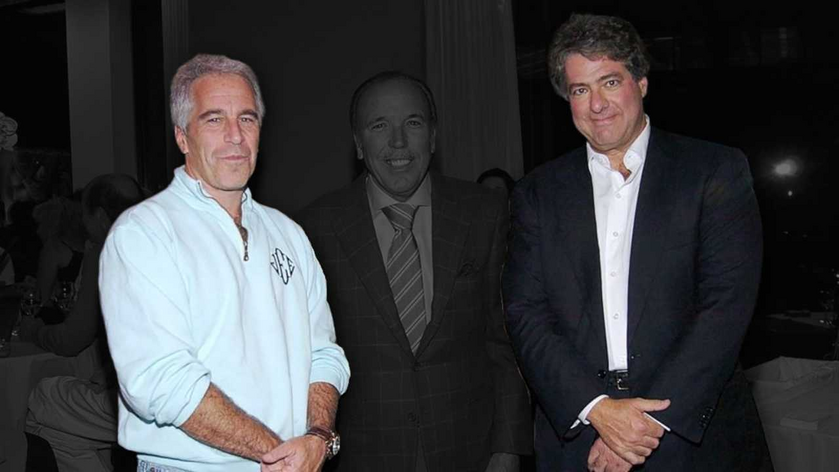
There are still many files that remain heavily and inexplicably redacted. But, from the files that have been made public, we know one thing for certain. One of Epstein’s two key benefactors — the hedge fund billionaire Leon Black, who paid Epstein at least $158 million from 2012 through 2017 — was aggressively blackmailed over his sexual conduct. (Epstein’s second most-important benefactor was the billionaire Les Wexner, a major pro-Israel donor who cut off ties in 2008 after Epstein repaid Wexner $100 million for money Wexner alleged Epstein had stolen from him.)


Despite that $100 million repayment in 2008 to Wexner, Epstein had accumulated so much wealth through his involvement with Wexner that it barely made a dent. He was able to successfully “pilfer” such a mind-boggling amount of money because he had been given virtually unconstrained access to, and power over, every aspect of Wexner’s life. Wexner even gave Epstein power of attorney and had him oversee his children’s trusts. And Epstein, several years later, created a similar role with Leon Black, one of the richest hedge fund billionaires of his generation.


Epstein’s 2008 conviction and imprisonment due to his guilty plea on a charge of “soliciting a minor for prostitution” began mildly hindering his access to the world’s billionaires. It was at this time that he lost Wexner as his font of wealth due to Wexner’s belief that Epstein stole from him.


But Epstein’s world was salvaged, and ultimately thrived more than ever, as a result of the seemingly full-scale dependence that Leon Black developed on Epstein. As he did with Wexner, Epstein insinuated himself into every aspect of the billionaire’s life — financial, political, and personal — and, in doing so, obtained innate, immense power over Black.


The recently released Epstein files depict the blackmail and extortion schemes to which Black was subjected. One of the most vicious and protracted arose out of a six-year affair he carried on with a young Russian model, who then threatened in 2015 to expose everything to Black’s wife and family, and “ruin his life,” unless he paid her $100 million. But Epstein himself also implicitly, if not overtly, threatened Black in order to extract millions more in payments after Black, in 2016, sought to terminate their relationship.


While the sordid matter of Black’s affair has been previously reported — essentially because the woman, Guzel Ganieva, went public and sued Black, accusing him of “rape and assault,” even after he paid her more than $9 million out of a $21 million deal he made with her to stay silent — the newly released emails provide very vivid and invasive details about how desperately Black worked to avoid public disclosure of his sex life. The broad outlines of these events were laid out in a Bloomberg report on Sunday, but the text of emails provide a crucial look into how these blackmail schemes in Epstein World operated.


Epstein was central to all of this. That is why the emails describing all of this in detail are now publicly available: because they were all sent by Black or his lawyers to Epstein, and are thus now part of the Epstein Files.


Once Ganieva began blackmailing and extorting Black with her demands for $100 million — which she repeatedly said was her final, non-negotiable offer — Black turned to Epstein to tell him how to navigate this. (Black’s other key advisor was Brad Karp, who was forced to resign last week as head of the powerful Paul, Weiss law firm due to his extensive involvement with Epstein).


From the start of Ganieva’s increasingly unhinged threats against Black, Epstein became a vital advisor. In 2015, Epstein drafted a script for what he thought Black should tell his mistress, and emailed that script to himself.


Epstein included an explicit threat that Black would have Russian intelligence — the Federal Security Service (FSB) — murder Ganieva, because, Epstein argued, failure to resolve this matter with an American businessman important to the Russian economy would make her an “enemy of the state” in the eyes of the Russian government. Part of Epstein’s suggested script for Black is as follows (spelling and grammatical errors maintained from the original correspondents):


you should also know that I felt it necessary to contact some friends in FSB, and I though did not give them your name. They explained to me in no uncertain terms that especially now , when Russia is trying to bring in outside investors , as you know the economy sucks, and desperately investment that a person that would attempt to blackmail a us businessman would immeditaly become in the 21 century, what they terms . vrag naroda meant in the 20th they translated it for me as the enemy of the people, and would e dealt with extremely harshly , as it threatened the economies of teh country. So i expect never ever to hear a threat from you again.


In a separate email to Karp, Black’s lawyer, Epstein instructs him to order surveillance on the woman’s whereabouts by using the services of Nardello & Co., a private spy and intelligence agency used by the world’s richest people.


Black’s utter desperation for Ganieva not to reveal their affair is viscerally apparent from the transcripts of multiple lunches he had with her throughout 2015, which he secretly tape-recorded. His law firm, Paul, Weiss, had those recordings transcribed, and those were sent to Epstein.


To describe these negotiations as torturous would be an understatement. But it is worth taking a glimpse to see how easily and casually blackmail and extortion were used in this world.


Leon Black is a man worth $13 billion, yet his life appears utterly consumed by having to deal constantly with all sorts of people (including Epstein) demanding huge sums of money from him, accompanied by threats of various kinds. Epstein was central to helping him navigate through all of this blackmail and extortion, and thus, he was obviously fully privy to all of Black’s darkest secrets.


At their first taped meeting on August 14, 2015, Black repeatedly offered his mistress a payment package of $1 million per year for the next 12 years, plus an up-front investment fund of £2 million for her to obtain a visa to live with her minor son in the UK. But Ganieva repeatedly rejected those offers, instead demanding a lump sum of no less than $100 million, threatening him over and over that she would destroy his life if he did not pay all of it.


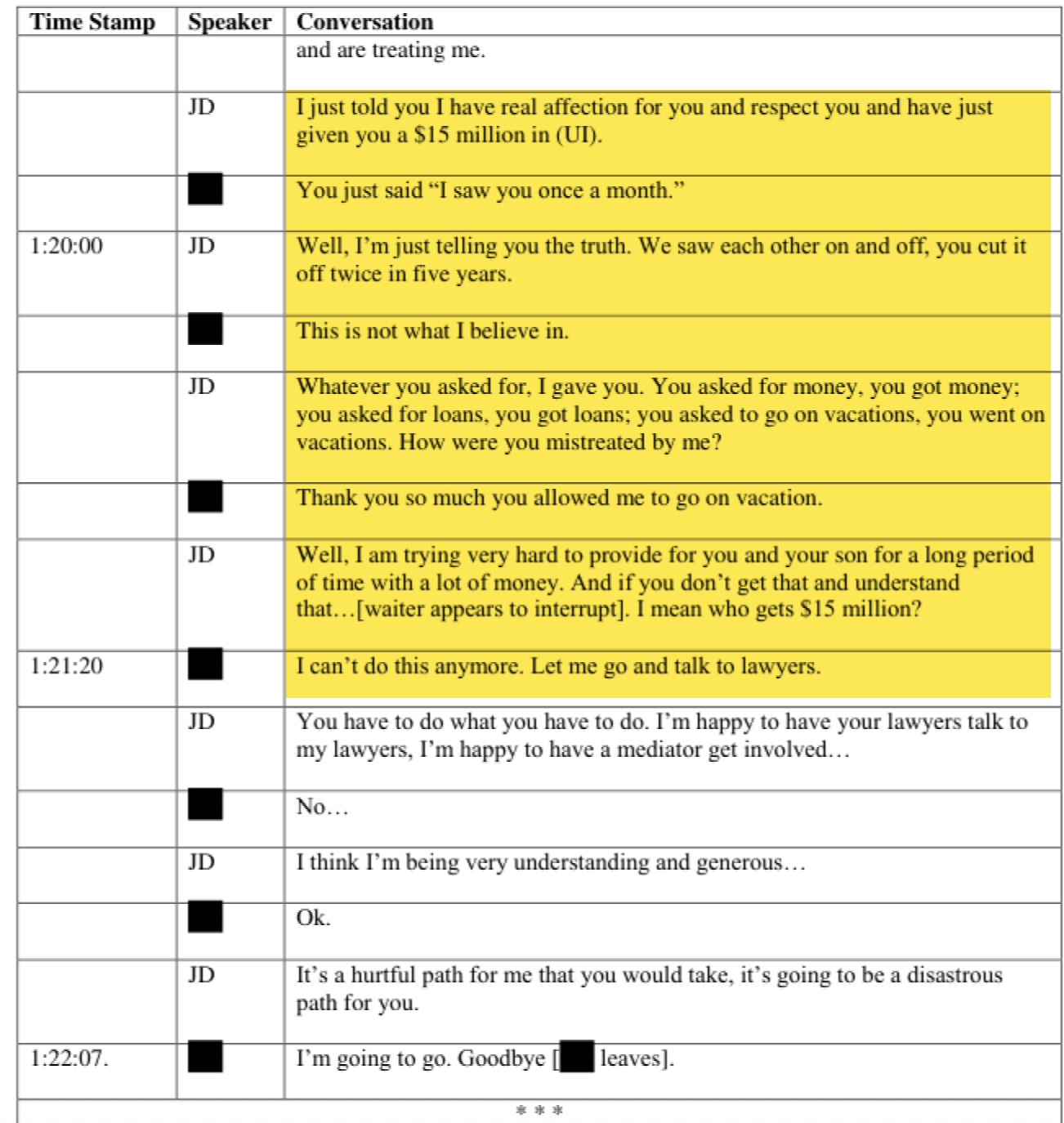
Black was both astounded and irritated that she thought a payment package of $15 million was somehow abusive and insulting. He emphasized that he was willing to negotiate it upward, but she was adamant that it had to be $100 million or nothing, an amount Black insisted he could not and would not pay.


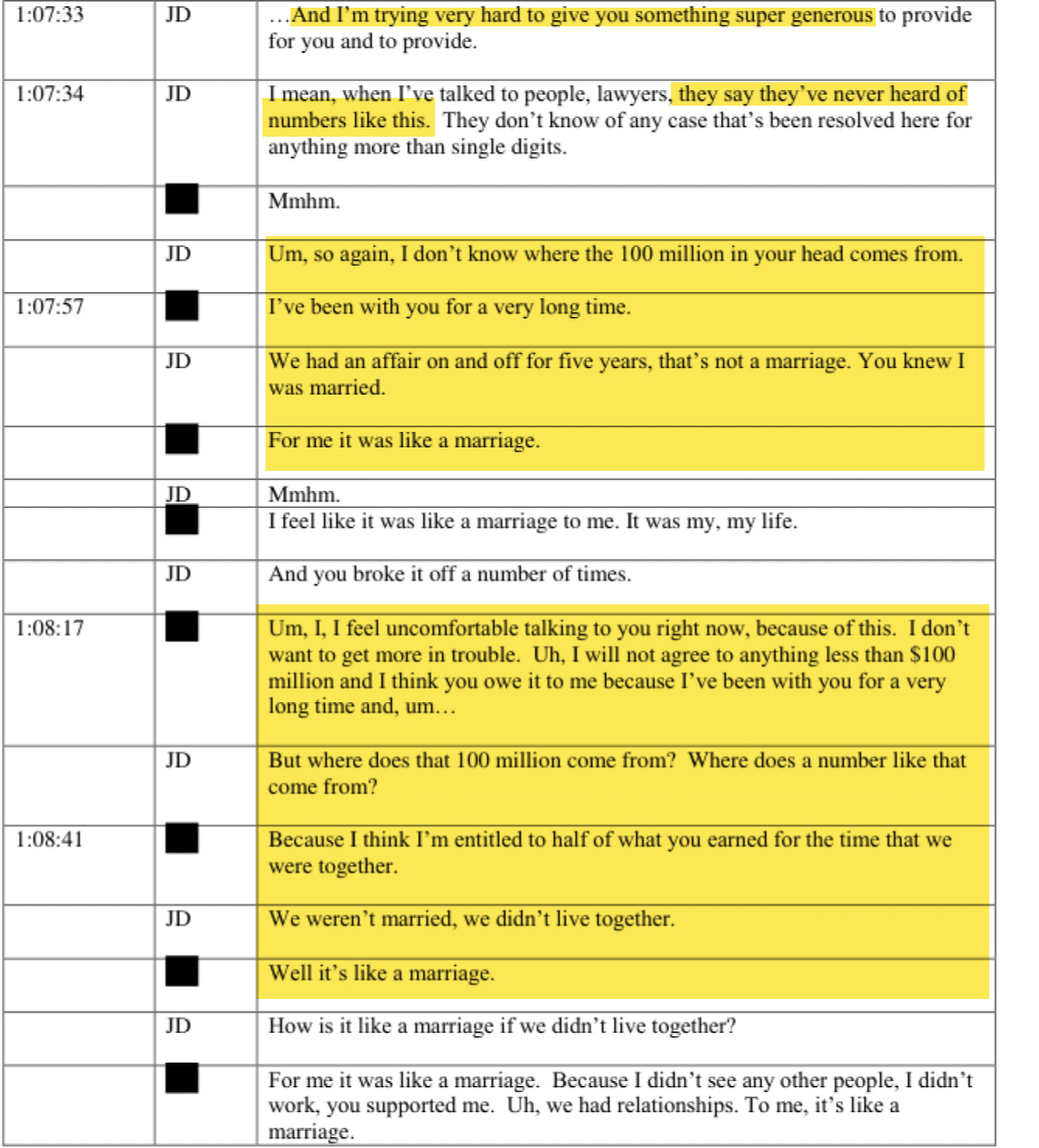
When pressed to explain where she derived that number, Ganieva argued that she considered the two to be married (even though Black was long married to another woman), thereby entitling her to half of what he earned during those years. Whenever Black pointed out that they only had sex once a month or so for five or six years in an apartment he rented for her, and that they never even lived together, she became offended and enraged and repeatedly hardened her stance.


Over and over, they went in circles for hours across multiple meetings. Many times, Black tried flattery: telling her how much he cared for her and assuring her that he considered her brilliant and beautiful. Everything he tried seemed to backfire and to solidify her $100 million blackmail price tag. (In the transcripts, “JD” refers to “John Doe,” the name the law firm used for Black; the redacted initials are for Ganieva):


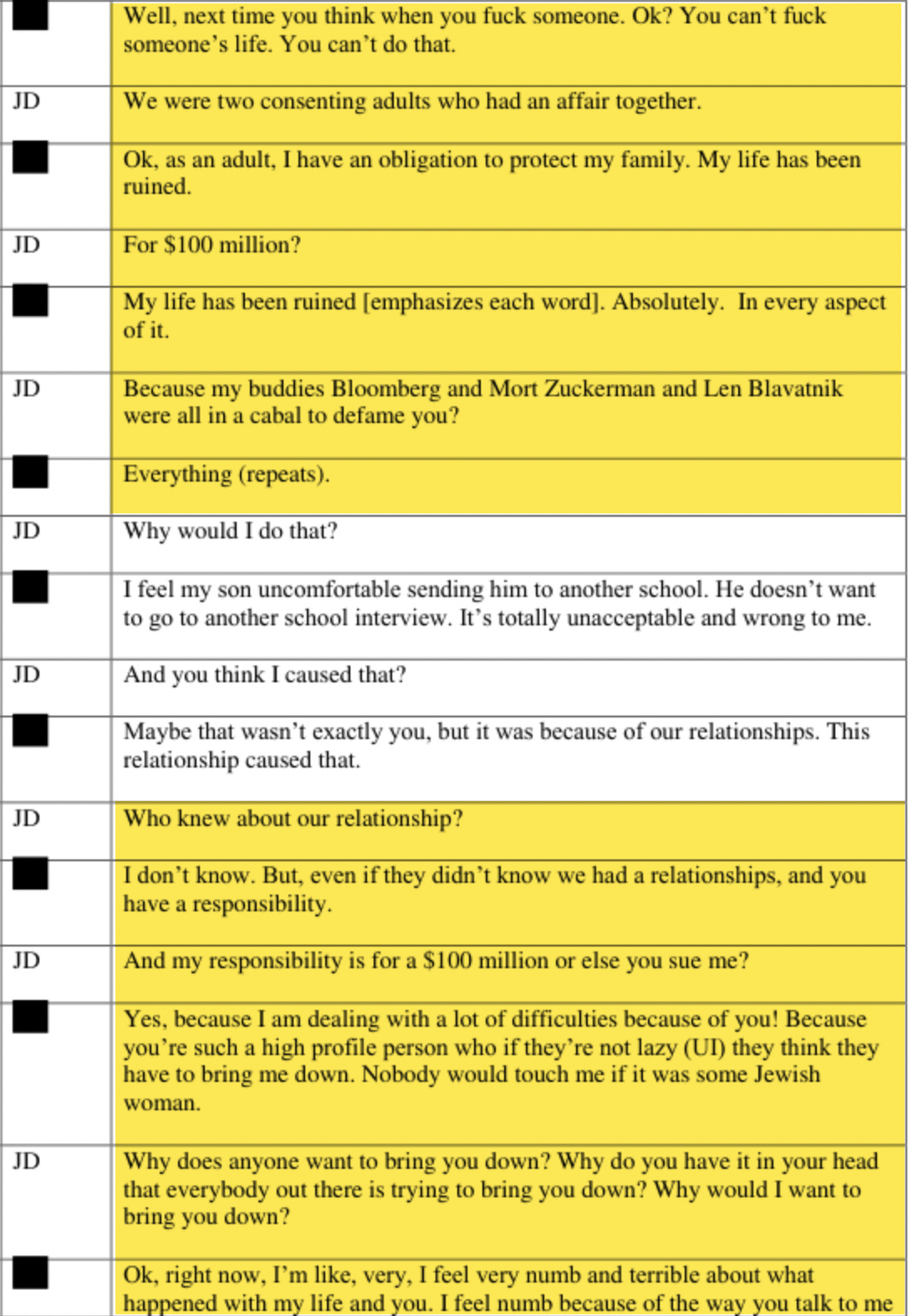
On other occasions during their meetings, Ganieva insisted that she was entitled to $100 million because Black had “ruined” her life. He invariably pointed out how much money he had given her over the years, to say nothing of the $15 million he was now offering her, and expressed bafflement at how she could see it that way.


In response, Ganieva would insist that a “cabal” of Black’s billionaire friends — led by Michael Bloomberg, Mort Zuckerman, and Len Blavatnik — had conspired with Black to ruin her reputation. Other times, she blamed Black for speaking disparagingly of her to destroy her life. Other times, she claimed that people in multiple cities — New York, London, Moscow — were monitoring and following her and trying to kill her. This is but a fraction of the exchanges they had, as he alternated between threatening her with prison and flattering her with praise, while she kept saying she did not care about the consequences and would ruin his life unless she was paid the full amount:


By their last taped meeting in October, Ganieva appeared more willing to negotiate the amount of the payment. The duo agreed to a payment package in return for her silence; it included Black’s payments to her of $100,000 per month for the next 12 years (or $1.2 million per year for 12 years), as well as other benefits that exceeded a value of $5 million. They signed a contract formalizing what they called a “non-disclosure agreement,” and he made the payments to her for several years on time. The ultimate total value to be paid was $21 million.


Unfortunately for Black, these hours of misery, and the many millions paid to her, were all for naught. In March, 2021, Ganieva — despite Black’s paying the required amounts — took to Twitter to publicly accuse Black of “raping and assaulting” her, and further claimed that he “trafficked” her to Epstein in Miami without her consent, to force her to have sex with Epstein.


As part of these public accusations, Ganieva spilled all the beans on the years-long affair the two had: exactly what Black had paid her millions of dollars to keep quiet. When Black denied her accusations, she sued him for both defamation and assault. Her case was ultimately dismissed, and she sacrificed all the remaining millions she was to receive in an attempt to destroy his life.


Meanwhile, in 2021, Black was forced out of the hedge fund that made him a billionaire and which he had co-founded, Apollo Global Management, as a result of extensive public disclosures about his close ties to Epstein, who, two years earlier, had been arrested, became a notorious household name, and then died in prison. As a result of all that, and the disclosures from his mistress, Black — just like his ex-mistress — came to believe he was the victim of a “cabal.” He sued his co-founder at Apollo, the billionaire Josh Harris, as well as Ganieva and a leading P.R. firm on RICO charges, alleging that they all conspired to destroy his reputation and drive him out of Apollo. Black’s RICO case was dismissed.


Black’s fear that these disclosures would permanently destroy his reputation and standing in society proved to be prescient. An independent law firm was retained by Apollo to investigate his relationship with Epstein. Despite the report’s conclusion that Black had done nothing illegal, he has been forced off multiple boards that he spent tens of millions of dollars to obtain, including the highly prestigious post of Chair of the Museum of Modern Art, which he received after compiling one of the world’s largest and most expensive collections, only to lose that position due to Epstein associations.


So destroyed is Leon Black’s reputation from these disclosures that a business relationship between Apollo and the company Lifetouch — an 80-year-old company that captures photos of young school children — resulted in many school districts this week cancelling photo shoots involving this company, even though the company never appeared once in the Epstein files. But any remote association with Black — once a pillar of global high society — is now deemed so toxic that it can contaminate anything, no matter how removed from Epstein.


None of this definitively proves anything like a global blackmail ring overseen by Epstein and/or intelligence agencies. But it does leave little doubt that Epstein was not only very aware of the valuable leverage such sexual secrets gave him, but also that he used it when he needed to, including with Leon Black. Epstein witnessed up close how many millions Black was willing to pay to prevent public disclosure in a desperate attempt to preserve his reputation and marriage.


In October, The New York Times published a long examination of what was known at the time about the years-long relationship between Black and Epstein. In 2016, Black seemingly wanted to stop paying Epstein the tens of millions each year he had been paying him. But Epstein was having none of it.


Far from speaking to Black as if Epstein were an employee or paid advisor, he spoke to the billionaire in threatening, menacing, highly demanding, and insulting terms:


Jeffrey Epstein was furious. For years, he had relied on the billionaire Leon Black as his primary source of income, advising him on everything from taxes to his world-class art collection. But by 2016, Mr. Black seemed to be reluctant to keep paying him tens of millions of dollars a year.

So Mr. Epstein threw a tantrum.

One of Mr. Black’s other financial advisers had created “a really dangerous mess,” Mr. Epstein wrote in an email to Mr. Black. Another was “a waste of money and space.” He even attacked Mr. Black’s children as “retarded” for supposedly making a mess of his estate.

The typo-strewn tirade was one of dozens of previously unreported emails reviewed by The New York Times in which Mr. Epstein hectored Mr. Black, at times demanding tens of millions of dollars beyond the $150 million he had already been paid.

The pressure campaign appeared to work. Mr. Black, who for decades was one of the richest and highest-profile figures on Wall Street, continued to fork over tens of millions of dollars in fees and loans, albeit less than Mr. Epstein had been seeking.


The mind-bogglingly massive size of Black’s payments to Epstein over the years for “tax advice” made no rational sense. Billionaires like Black are not exactly known for easily or willingly parting with money that they do not have to pay. They cling to money, which is how many become billionaires in the first place.


As the Times article put it, Black’s explanation for these payments to Epstein “puzzled many on Wall Street, who have asked why one of the country’s richest men would pay Mr. Epstein, a college dropout, so much more than what prestigious law firms would charge for similar services.”


Beyond Black’s payments to Epstein himself, he also “wired hundreds of thousands of dollars to at least three women who were associated with Mr. Epstein.” And all of this led to Epstein speaking to Black not the way one would speak to one’s most valuable client or to one’s boss, but rather spoke to him in terms of non-negotiable ultimatums, notably similar to the tone used by Black’s mistress-turned-blackmailer:


Email from Jeffrey Epstein to Leon Black, dated November 2, 2015.


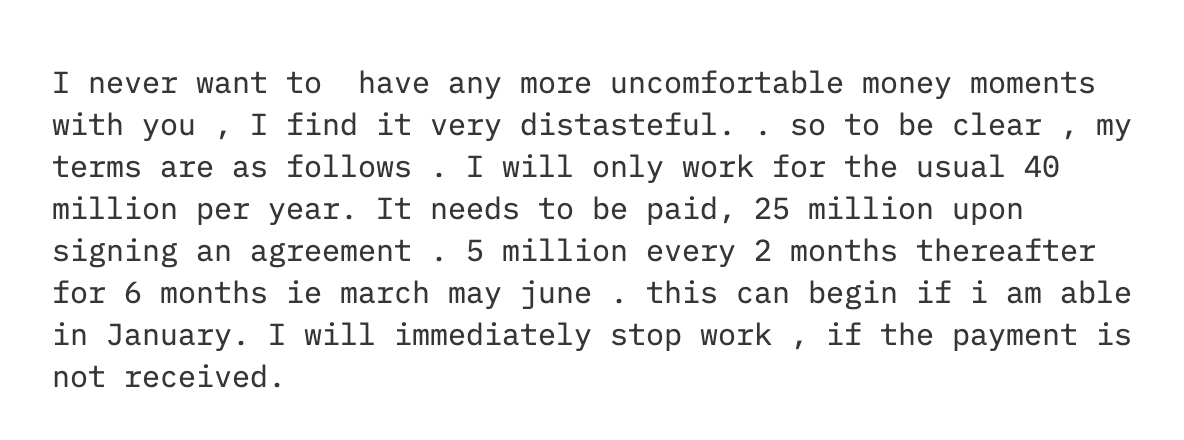
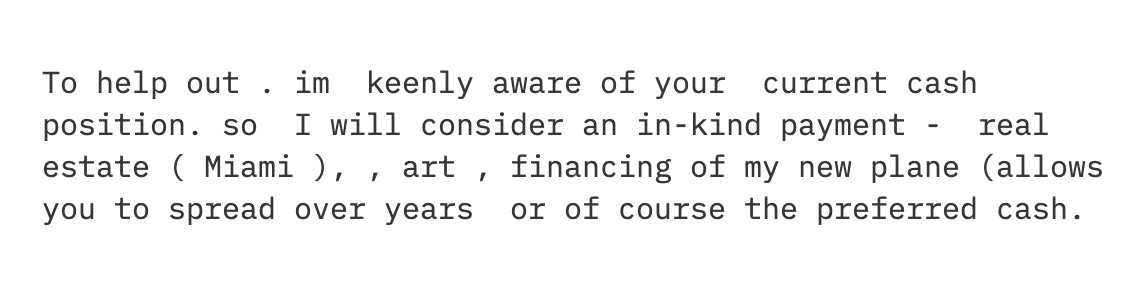
When Black did not relent, Epstein’s demands only grew more aggressive. In one email, he told Black: “I think you should pay the 25 [million] that you did not for this year. For next year it's the same 40 [million] as always, paid 20 [million] in jan and 20 [million] in july, and then we are done.” At one point, Epstein responded to Black’s complaints about a cash crunch (a grievance Black also tried using with his mistress) with offers to take payment from Black in the form of real estate, art, or financing for Epstein’s plane:


Email from Jeffrey Epstein to Leon Black, dated March 16, 2016.


With whatever motives, Black succumbed to Epstein’s pressure and kept paying him massive sums, including $20 million at the start of 2017, and then another $8 million just a few months later, in April.


Epstein had access to virtually every part of Black’s life, as he had with Wexner before that. He was in possession of all sorts of private information about their intimate lives, which would and could have destroyed them if he disclosed it, as evidenced by the reputational destruction each has suffered just from the limited disclosures about their relationship with Epstein, to say nothing of whatever else Epstein knew.


Leon Black was most definitely the target of extreme and aggressive blackmail and extortion over his sex life in at least one instance we know of, and Epstein was at the center of that, directing him. While Wall Street may have been baffled that Wexner and Black paid such sums to Epstein over the years, including after Black wanted to cut him off, it is quite easy to understand why they did so. That is particularly so as Epstein became angrier and more threatening, and as he began reminding Black of all the threats from which Epstein had long protected him. Epstein watched those exact tactics work for Black’s mistress.


The DOJ continues to insist it has no evidence of Epstein using his access to the most embarrassing parts of the private and sexual lives of the world’s richest and most powerful people for blackmail purposes. But we know for certain that blackmail was used in this world, and that Epstein was not only well aware of highly valuable secrets but was also paid enormous, seemingly irrational sums by billionaires whose lives he knew intimately.

Read full Article
post photo preview
Amazon's Ring and Google's Nest Unwittingly Reveal the Severity of the U.S. Surveillance State
Just a decade after a global backlash was triggered by Snowden reporting on mass domestic surveillance, the state-corporate dragnet is stronger and more invasive than ever.

That the U.S. Surveillance State is rapidly growing to the point of ubiquity has been demonstrated over the past week by seemingly benign events. While the picture that emerges is grim, to put it mildly, at least Americans are again confronted with crystal clarity over how severe this has become.


The latest round of valid panic over privacy began during the Super Bowl held on Sunday. During the game, Amazon ran a commercial for its Ring camera security system. The ad manipulatively exploited people’s love of dogs to induce them to ignore the consequences of what Amazon was touting. It seems that trick did not work.


The ad highlighted what the company calls its “Search Party” feature, whereby one can upload a picture, for example, of a lost dog. Doing so will activate multiple other Amazon Ring cameras in the neighborhood, which will, in turn, use AI programs to scan all dogs, it seems, and identify the one that is lost. The 30-second commercial was full of heart-tugging scenes of young children and elderly people being reunited with their lost dogs.


But the graphic Amazon used seems to have unwittingly depicted how invasive this technology can be. That this capability now exists in a product that has long been pitched as nothing more than a simple tool for homeowners to monitor their own homes created, it seems, an unavoidable contract between public understanding of Ring and what Amazon was now boasting it could do.


Amazon’s Super Bowl ad for Ring and its “Search Party” feature.


Many people were not just surprised but quite shocked and alarmed to learn that what they thought was merely their own personal security system now has the ability to link with countless other Ring cameras to form a neighborhood-wide (or city-wide, or state-wide) surveillance dragnet. That Amazon emphasized that this feature is available (for now) only to those who “opt-in” did not assuage concerns.


Numerous media outlets sounded the alarm. The online privacy group Electronic Frontier Foundation (EFF) condemned Ring’s program as previewing “a world where biometric identification could be unleashed from consumer devices to identify, track, and locate anything — human, pet, and otherwise.”


Many private citizens who previously used Ring also reacted negatively. “Viral videos online show people removing or destroying their cameras over privacy concerns,” reported USA Today. The backlash became so severe that, just days later, Amazon — seeking to assuage public anger — announced the termination of a partnership between Ring and Flock Safety, a police surveillance tech company (while Flock is unrelated to Search Party, public backlash made it impossible, at least for now, for Amazon to send Ring’s user data to a police surveillance firm).


The Amazon ad seems to have triggered a long-overdue spotlight on how the combination of ubiquitous cameras, AI, and rapidly advancing facial recognition software will render the term “privacy” little more than a quaint concept from the past. As EFF put it, Ring’s program “could already run afoul of biometric privacy laws in some states, which require explicit, informed consent from individuals before a company can just run face recognition on someone.”


Those concerns escalated just a few days later in the context of the Tucson disappearance of Nancy Guthrie, mother of long-time TODAY Show host Savannah Guthrie. At the home where she lives, Nancy Guthrie used Google’s Nest camera for security, a product similar to Amazon’s Ring.


Guthrie, however, did not pay Google for a subscription for those cameras, instead solely using the cameras for real-time monitoring. As CBS News explained, “with a free Google Nest plan, the video should have been deleted within 3 to 6 hours — long after Guthrie was reported missing.” Even professional privacy advocates have understood that customers who use Nest without a subscription will not have their cameras connected to Google’s data servers, meaning that no recordings will be stored or available for any period beyond a few hours.


For that reason, Pima County Sheriff Chris Nanos announced early on “that there was no video available in part because Guthrie didn’t have an active subscription to the company.” Many people, for obvious reasons, prefer to avoid permanently storing comprehensive daily video reports with Google of when they leave and return to their own home, or who visits them at their home, when, and for how long.


Despite all this, FBI investigators on the case were somehow magically able to “recover” this video from Guthrie’s camera many days later. FBI Director Kash Patel was essentially forced to admit this when he released still images of what appears to be the masked perpetrator who broke into Guthrie’s home. (The Google user agreement, which few users read, does protect the company by stating that images may be stored even in the absence of a subscription.)


While the “discovery” of footage from this home camera by Google engineers is obviously of great value to the Guthrie family and law enforcement agents searching for Guthrie, it raises obvious yet serious questions about why Google, contrary to common understanding, was storing the video footage of unsubscribed users. A former NSA data researcher and CEO of a cybersecurity firm, Patrick Johnson, told CBS: “There's kind of this old saying that data is never deleted, it's just renamed.” 


Image obtained through Nancy Guthrie’s unsubscribed Google Nest camera and released by the FBI.


It is rather remarkable that Americans are being led, more or less willingly, into a state-corporate, Panopticon-like domestic surveillance state with relatively little resistance, though the widespread reaction to Amazon’s Ring ad is encouraging. Much of that muted reaction may be due to a lack of realization about the severity of the evolving privacy threat. Beyond that, privacy and other core rights can seem abstract and less of a priority than more material concerns, at least until they are gone.


It is always the case that there are benefits available from relinquishing core civil liberties: allowing infringements on free speech may reduce false claims and hateful ideas; allowing searches and seizures without warrants will likely help the police catch more criminals, and do so more quickly; giving up privacy may, in fact, enhance security.


But the core premise of the West generally, and the U.S. in particular, is that those trade-offs are never worthwhile. Americans still all learn and are taught to admire the iconic (if not apocryphal) 1775 words of Patrick Henry, which came to define the core ethos of the Revolutionary War and American Founding: “Give me liberty or give me death.” It is hard to express in more definitive terms on which side of that liberty-versus-security trade-off the U.S. was intended to fall.


These recent events emerge in a broader context of this new Silicon Valley-driven destruction of individual privacy. Palantir’s federal contracts for domestic surveillance and domestic data management continue to expand rapidly, with more and more intrusive data about Americans consolidated under the control of this one sinister corporation.


Facial recognition technology — now fully in use for an array of purposes from Customs and Border Protection at airports to ICE’s patrolling of American streets — means that fully tracking one’s movements in public spaces is easier than ever, and is becoming easier by the day. It was only three years ago that we interviewed New York Timesreporter Kashmir Hill about her new book, “Your Face Belongs to Us.” The warnings she issued about the dangers of this proliferating technology have not only come true with startling speed but also appear already beyond what even she envisioned.


On top of all this are advances in AI. Its effects on privacy cannot yet be quantified, but they will not be good. I have tried most AI programs simply to remain abreast of how they function.


After just a few weeks, I had to stop my use of Google’s Gemini because it was compiling not just segregated data about me, but also a wide array of information to form what could reasonably be described as a dossier on my life, including information I had not wittingly provided it. It would answer questions I asked it with creepy, unrelated references to the far-too-complete picture it had managed to create of many aspects of my life (at one point, it commented, somewhat judgmentally or out of feigned “concern,” about the late hours I was keeping while working, a topic I never raised).


Many of these unnerving developments have happened without much public notice because we are often distracted by what appear to be more immediate and proximate events in the news cycle. The lack of sufficient attention to these privacy dangers over the last couple of years, including at times from me, should not obscure how consequential they are.


All of this is particularly remarkable, and particularly disconcerting, since we are barely more than a decade removed from the disclosures about mass domestic surveillance enabled by the courageous whistleblower Edward Snowden. Although most of our reporting focused on state surveillance, one of the first stories featured the joint state-corporate spying framework built in conjunction with the U.S. security state and Silicon Valley giants.


The Snowden stories sparked years of anger, attempts at reform, changes in diplomatic relations, and even genuine (albeit forced) improvements in Big Tech’s user privacy. But the calculation of the U.S. security state and Big Tech was that at some point, attention to privacy concerns would disperse and then virtually evaporate, enabling the state-corporate surveillance state to march on without much notice or resistance. At least as of now, the calculation seems to have been vindicated.

Read full Article
See More
Available on mobile and TV devices
google store google store app store app store
google store google store app tv store app tv store amazon store amazon store roku store roku store
Powered by Locals