The following is an abridged transcript from System Update’s most recent episode. You can watch the full episode on Rumble or listen to it in podcast form on Apple, Spotify, or any other major podcast provider.
System Update is an independent show free to all viewers and listeners, but that wouldn’t be possible without our loyal supporters. To keep the show free for everyone, please consider joining our Locals, where we host our members-only aftershow, publish exclusive articles, release these transcripts, and so much more!

Glenn Greenwald is away this week.
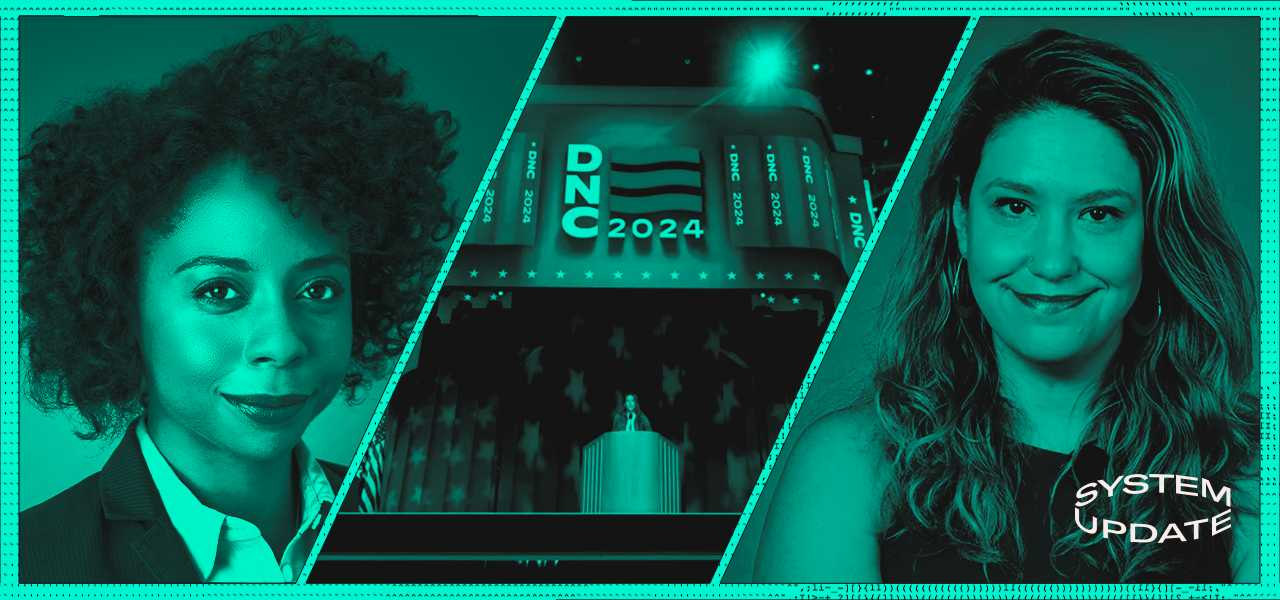
I’m Briahna Joy Gray, the guest host for this episode.
You might know me from my own podcast, “Bad Faith,” or from my previous hosting responsibilities over at The Hill’s “Rising,” less of a free speech platform than this one.
Today, I'll be walking through the implosion of the Democratic Party, the pathetic hunt for a Joe Rogan of the left, the party's instinct for corporate self-preservation over real populist reform and the media cover-up of Biden's cognitive decline.
Afterward, I'll be joined by independent left podcaster and co-host of “Useful Idiots” podcast, Katie Halper, to continue the conversation about how the DNC is continuing to try to rig elections in favor of incumbents, even as they repeatedly keep dying in office, and the likelihood that there might be more independent third-party runs in 2028, a la RFK Jr.'s 2024 attempt. Now, let's get right into it.

For a decade now, corporate Democrats have been warning that Donald Trump presents an existential threat to the Republic. During Trump's first term, much of that handwriting seemed to be hyperbolic – Trump derangement syndrome, if you will. His big legislative accomplishment was in line with the policy priorities of your typical establishment Republican: a $1.7 trillion tax cut that went overwhelmingly to the rich.
There was some good stuff too: unlike Biden, he didn't start any new wars. While he continued to fund Israel's genocide in Gaza and crack down on free speech rights of Americans who protested the said genocide, Trump did accomplish the temporary cease-fire that AOC merely claimed Kamala was “working tirelessly” to achieve.
But now that President Trump is finally following through on some of his less popular and less populist policy commitments, like the Medicaid cuts, included in his Big Beautiful Bill, which passed the House last week, or throwing markets into disarray with his erratic application of tariffs, which can be good policy.
Establishment Democrats seem almost happy to have something to justify their hatred of Trump. So, you see, the less populist Trump behaves, the more it disguises the Democrats' own failure to meet the needs of the people. Some Democrats are outright advising that the way they should respond to this alleged “existential crisis” is to simply do nothing: Just sit back and wait to benefit from the backlash.
You don't have to take my word for it: Listen to a veteran DNC advisor, James Carville, describe the strategy:
Video. James Carville, The View. February 18, 2025.
Fiddle while Rome burns, the expert says, then exploit the tragedy.
But so far, the backlash isn't coming. A new Economist/YouGov poll, out yesterday, shows that while GOP favorability is low, at negative 11%, Democrats are doing even worse, at negative 21%; 41% of Americans still view Republicans favorably, while a mere 36% of Americans view Democrats favorably.
These polls come as no surprise to those of us who consume independent media. I mean, just look around: Democrats are in the throes of a credibility crisis that arose out of Joe Biden's obvious unfitness to run for president.
They're trying to distract from their complicity and the cover-up, but going all in on the idea that it was Biden himself, his family, and his closest advisors that hid his decline from the party and the public until it was too late, not the liberal media. But it's hard to call Biden's infirmary a “cover-up” when it was out in the public for all of us to see and comment on. The president was confusing Haifa and Rafah, mixing up the president of Egypt and the president of Mexico, and even dodged culpability in the classified documents case on the basis that he didn't have the mental competence to knowingly take the files.
He even seemed to wander off at the G7 Conference a year ago, like a distracted child.
Video. Joe Biden, The Economic Times. June 14, 2024.
His mental lapses were evident as far back as the 2020 primary, during which presidential candidates Julian Castro and Cory Booker had the temerity to call him out for not remembering what he had just said at the primary debate. This clip is from way back in 2019, when Dems still could have avoided the albatross of a historically old and declining candidate around their necks. What did they do instead? Disappear both Castro and Booker, once rising stars from the ranks of up-and-coming leadership.
Video. Cory Booker, CNN. September 13, 2019.
You heard it there. The mainstream media accused anyone who noticed Biden's obvious decline of being motivated by Trump-like conservative politics. “Believe our Trump derangement syndrome, not your lying eyes,” they seem to say.
Reuters reported the story about Biden wandering off at the G7 as “lacking context.” Meanwhile, his inability to finish sentences was “contextualized” as a mere stutter.
Jake Tapper, one of the authors of the book “Original Sin,” which sheds light on the extent of Biden's mental infirmity, was himself one of the original apologists for Biden's cognitive decline. A few good mainstream pundits on MSNBC question the co-author on Tapper's own complicity.
Video. Alex Thompson, MSNBC, May 26, 2025.
That was some good questioning. And I got to say, I don't think we need medical degrees to be able to accurately observe what was going on with Joe Biden. We didn't need this new book to know the truth either. Independent media, along with the voters, knew what was been going on for years.
Biden's midterm rating was worse than any other elected president on record and, back in August 2023, polls show that 77% of Americans, including 69% of Democrats, thought Biden was too old to be president. But Democrats wouldn't listen. Or rather, they simply didn't care.
Now, as part of the media's effort to whitewash its own complicity, the same media figures who were involved in the cover-up are claiming, well, they had to defend Biden's mental competency because no one else primaried him. They were stuck with him as a candidate. This, even as the party shut down the possibility of a primary from the jump.
Contrast former DNC chair, Jamie Harrison, making that incredible claim that anyone could have primaried Biden if they wanted to, followed by Biden/Harris spokesperson turned MSNBC “journalist,” Symone Sanders, proclaiming that under no circumstances will there be a primary.
Video. Jaime Harrisson, Symone Sander, MSNBC.
“If folks wanted to primary Joe Biden, there was nobody to tell them that they couldn't?” Is he serious? The mendacity is frankly shocking. As Symone admitted, Dean Phillips and Marianne Williamson did throw their hats in the ring, as said RFK Jr., and you can hear how much respect they got for doing so reflected in Symone's smite tone and her inability to pronounce Marianne's name. Then don't forget, RFK Jr. also ran as a Democrat before the party pushed about and it's no surprise why he left the Dems.
The Democratic Party, its pundits and politicians, were simply all behind Joe Biden, no matter how ill-fated his electoral chances were from the get-go. And while they want to memory hole their role in setting Dems up to fail, I have the receipts.
Take “Pod Save America,” one of the most popular liberal podcasts in the country. These former Obama speech writers turned media moguls finally admitted that Biden wasn't fit to lead after Biden's disastrous debate with Trump. But the hindsight is 2020. Listen to how hostile they were in conversation with moderate primary candidate, Democrat Dean Phillips, when he joined their show during the primary season that wasn't.
Video. Phillips, Pod Save America. November 20, 2023.
Phillips and I do not share the same politics, but he was right. At a certain point, internal polls show that Biden could not win. According to “Original Sin,” the Jake Tapper book, Biden traded trails rather in every battleground state, and the race that tightened in states he won comfortably back in 2020. But the voters don't matter, the polls don't matter, not to Democrats. What matters to the Democratic Party elites is who they choose to top the ticket.
As Bernie Sanders’s former national press secretary in 2020, I know this all too well. In two back-to-back election cycles, the Democratic Party ignored polls that showed Bernie was more electable than Hillary Clinton and Joe Biden against Donald Trump.
Now, this is not some Monday morning quarterbacking from a disgruntled leftist. Democratic Party insider Donna Brazile admitted the primary was rigged back in 2017.
Jake Tapper and Alex Thompson admit as much in “Original Sin.” They admit it! The election was rigged. But even with all of the faux mea culpas happening around Biden's lack of mental fitness, the Democrats STILL refuse to act any differently going forward, to learn a lesson from their past mistakes. Tapper and Thompson write that Bernie was perceived to be unable to attract Black voters, but Bernie was the only candidate in 2020 who matched Biden's popularity with that group, while also outstripping the field when it came to Latino voters.
Bernie remains popular. Not only have he and Alexandria Ocasio-Cortez been turning out tens of thousands of voters across the country during their anti-oligarchy tour, including in deep red states. Bernie's recent appearance on the “Flagrant” podcast, with Andrew Schultz, had a whole room of popular podcast “Bros” clamoring for the exact “democratic socialism” establishment Dems insisted would turn off the public!
Everybody's saying it. Look, it seems obvious that left populism is the way for Democrats to push back against Trump's right populism, which unfortunately, is increasingly informed by the tech billionaires that fund his campaign rather than the working-class real populists who voted him into office. You've got to ask yourself, is pardoning reality TV stars convicted of tax fraud really improving your ability to support your family?
What about growing the military budget (and the deficit) at the same time while cutting special education funding?
What about shifting wealth from the bottom 60% of working-age households to the top income brackets?
Look, no matter what your politics are, two parties that are competing for the support of working-class Americans instead of aligning with corrupt billionaires would be a good thing! But you can't convince someone of something they're paid not to understand. Which is why Democrats are, instead of embracing popular policies like Medicare for all or a tax on billionaires, are choosing to spend millions of dollars to figure out how to, get this, speak to American men. I really wish I were kidding here.
You really can't make this stuff up. Dems are obsessed with finding the Joe Rogan of the left, but they could not be barking up a wronger tree.
Hilariously, they seem to be tapping one of their most insidious surrogates, Oliva Juliana, to “message better” on men while continuing to treat Sanders – the man who was literally endorsed by the actual Joe Rogan back in 2020 – as a pariah.
Video. James Carville, The Daily Beast. May 2025.
To be clear, Carville hasn't won an election since Bill Clinton in the ‘90s, but I digress.
The reason why Democrats’ mission to find their own Joe Rogan will fail is obvious: to be a credible interlocutor in the political space, you have to be willing to say the true thing when it's hard, even when it is critical of your party. Especially when it's critical of your party. The popular “Manosphere” podcaster, Andrew Schultz, gets it.
Video. Andrew Schultz, Flagrant. May 28, 2025.
Even on MSNBC, a guest of Ayman's show was also able to identify the core issue here.
Video. Ayman Mohyeldin, MSNBC. May 24, 2025.
See, right there at the end is a great summary of the impossibility of what Democrats think they're going to achieve. “We need an authentic voice that's going to become popular organically, and we need to control them.”
Good luck with that, Democrats. Good luck with that.
Briahna Joy Gray: Back with Katie Halper. You know her from the “Katie Halper” podcast and as co-host of “Useful Idiots” with Aaron Maté. Welcome to System Update.
Katie Halper: Thanks, Brie. Thanks for having me. Excited to be here.
Briahna Joy Gray: Katie, it's a pleasure. I can't wait to pick your brain about some of the viral clips, especially from the sort of Manosphere podcast arena that have gone viral precisely because of how well Bernie Sanders himself and his ideas have translated into his sphere, that Democrats have insisted were so right-wing and so far gone, and they spent so many years vilifying but now seem to be trying to enter into those kinds of spaces. What do you make of it?
Katie Halper: I think it's funny because, of course, Bri, not to be self-promoting, but they're searching for the – what is it? – left-wing Joe Rogan. What about Briahna Joy Gray and Katie Halper to take the mantle?
It is ironic that the same people who were throwing Bernie under the bus, smearing him, attacking him, are now saying that he has some kind of messaging that's good for the democrats. There's always this obsession with messaging over content and program, but that's kind of another issue.
I think people continue to smear Bernie Sanders but to the extent that they are praising him, they're praising him now because they know he's not going to run. So, I think they think it's safe for them to praise his ideas because they actually are either just paying lip service to it or they are afraid of Bernie's more progressive stances that challenge the status quo.
Briahna Joy Gray: Yeah. I think that really gets to the core of the issue that the Democratic Party for years has managed to try to frame themselves as somehow different than the establishment wing of the Republican Party, despite having, substantively, the same corporate donors by leaning and going all in on identity politics.
There's been a backlash against that. They're saying, okay, well, now we've got to find some other messaging prong when the whole reason why they went all in on identity politics and now we're going all in this idea that they just get the right man who's lift enough weights to say the right thing that they will also be able to compete, it's because they're allergic, their corporate base makes them allergic to actually advancing the kind of ideas that made Bernie popular in the first place acting like this guy was somehow a ball of charisma as much as I liked his sort of like a grumpy straightforward persona. He wasn't winning hearts and minds because he was a charm generator. It was because, as Joe Rogan himself said when he was endorsing Bernie Sanders back in 2020, he's a man who's been saying the same thing for the last 40 years, and he has credibility. He's trustworthy. And it's amazing to rewatch that endorsement now that the Democrats are in the middle of this incredible credibility crisis.
I want to ask you specifically about this book, “Original Sin,” by Jake Tapper and Alex Thompson. I don't know if you had seen that clip before, that super cut that Ayman put together on MSNBC of Jake Tapper doing exactly what is sort of criticized in this book, although I will say this book stays away mostly from media criticism and focuses on the idea that it was Biden in his inner circle that knew the truth and were just lying to everybody else and everybody else was sort of deceived by them, including the liberal media. What do you make of that sort of framing there? Is Jake Tapper really innocent in all of this?
Katie Halper: I mean, I joke that Jake Tapper was well-positioned to write a book about a cover-up because he participated in the cover-up. So, he does probably have some inside knowledge and real insight into it. But no, I mean, you alluded to this and the mashup that I'm in proves this. Jake Tapper was doing the exact kind of cover-up and running of interference that you and I have commented on the media doing for Joe Biden, for the DNC, for centrist Democrats, that we know that they do, they love to do. And so, it is rich seeing someone who participated in that cover-up profiting off of a book about a cover-up and he's hawking that product on his shows and on the various CNN shows that he appears on and all the appearances he's been doing. And I think at the end, once again, it's fine for people to have the eureka moments in hindsight. Somehow, it never happens in real time. And he keeps making these media appearances and talking about how he has a great humility, and his co-writer talks about the humility, which is, I guess, as close as to a mea culpa that we'll get, but that's not, I'm always so frustrated when people say humility like they always do these humble brags. I'm truly humbled by, insert whatever praise, so that's just a little pet peeve I have with that word.
But, yeah, I think that Jake Tapper, like much of the media, keeps making the same mistakes. They're warmongers for every war. I mean, the cover-up, is disgusting but another disgusting thing is that he has spread so many lies about Palestinians and has run so much interference, much like he ran so much interference for the Biden campaign, he's running so much interference for IDF and he and Dana Bash have done such a disgusting job at vilifying Palestinians, Palestinian Americans like Rashida Tlaib, but all Palestinians, and taking every single rumor and fabricating a narrative and running with it and never correcting it.
Tapper and Dana Bash pushed the mass rape Hamas narrative that has been totally debunked; they've never corrected it and, at the same time, they've ever once acknowledged the fact that there's video footage of Israeli soldiers raping a Palestinian, – what I would call hostage, what our media calls prisoner or detainee, but I think, to be consistent we should say hostage – and it's one thing to push a debunked narrative and never correct it, but at least acknowledge the fact that we do know of people who are raped by Israelis, but the fact they don't acknowledge that and that this is something that mainstream Israeli media covers shows that they really don't care about sexual violence. They don't about rape and they're happy to be doing PR for a genocidal state.
Briahna Joy Gray: Yeah, I think it's a really…
Katie Halper: Sorry, we're talking about cover-ups, but they're related.
Briahna Joy Gray: No, I think that's a really important point because there is something deeply ironic and dissonant about Jake Tapper in particular. I don't know that Alex Thompson and it could be similarly described as hypocritical, but Jake Tapper for sure, go doing the press rounds about a cover-up while still actively participating in a misinformation campaign, at least as significant as the lies about the Steele dossier or claiming that Hunter Biden's laptop was misinformation. I mean, someone else had another super cut sort of juxtaposing what he's saying now about Hunter Biden with what he said back then about Hunter Biden and framing any and every criticism of Joe Biden or just observation from people who actually love Joe Biden, that doesn't seem to be up to his best, he's not the same Joe Biden who was vice president back in 2008/2012 cycles, as somehow being Trumpy as though supporting Donald Trump, even if that were your perspective, precludes you from seeing the truth with your own eyes. And Katie, this is what's so frustrating about Democrats, and frankly, my concern with some folks on the left who seem to be taking this sort of measured praise for the enthusiasm Bernie and AOC are capturing on these anti-oligarchy tours and predicting that there's going to be real change to the Democratic Party this time, how optimistic are you that we're likely to see the Democrats learning from the lessons of the past? And if not, why aren't you optimistic?
Katie Halper: Right. Yeah, I mean, I think that, unfortunately, the Democrats would really rather lose to Trump than have someone like Bernie in power. But you're asking a slightly different question, right? You're kind of saying, well, what suggests that the Democrats will deliver anything, even with this good messaging that Bernie and AOC are bringing? And certainly, they leave a lot to be desired when it comes to Gaza, but, sure, on economic issues, Bernie, especially, is excellent.
I think that the problem is, and you've spoken a lot about this, Bri, it's great to have fresh ideas, fresh policies, fresh but also consistent. I mean, as you alluded to earlier, Bernie's been saying the same thing for decades and that is something that I think has endears him justifiably to lots of people. But the question is, will the Democratic Party actually allow for any of these policies to take hold? [audio problems]
So, there's a lot of rotating villain phenomenon, right?
So, I think that the Democrats really love to pretend that they can't get things done, that they'd love to get things done. But the truth is they just don't want to get them done. They don't want to see these things because they're as beholden to their donors as the Republicans are, they're just better on social issues often. And to the extent that they're better on social issues, they certainly are willing to sacrifice these social issues in the name of fundraising, which is why, for instance, neither Obama nor Biden codified Roe v. Wade.
Briahna Joy Gray: Yeah. I’m glad you brought up Roe v. Wade because I have more optimistic folks, left side of the aisle saying, “Oh, no, this didn't waste strategy, whatever you think of it, it's likely to work” because look at how well Joe Biden did in midterms.” And I think in retrospect, and I think some of us at the time reported that we suspected that there was not a red wave in 2022, it was not a signal that voters were actually secretly happy with Joe Biden. Polls at the time showed, as I said in my radar, that he had historically low favorability at that time. What people were coming out to vote for was not Joe Biden; it was for Roe v. Wade. It was to express their discontent with Roe being overturned and anti-abortion laws being put into effect in all the country. And a lot of red states like Kansas, bipartisan majorities came out to defend those kinds of formerly constitutional rights.
I want to ask you, though, about this particular clip where Chuck Todd, even someone who is very much an establishment pundit, seems to think and maybe even seems to hope that there will, unlike 2024, when the Democrats completely shut down a primary, that there will not just be a primary, but that there'll be independent third-party style candidates, a la RFK Jr., running in that race. Let's take a look.
Video. Chuck Todd, The Chuck Toddcast. May 27, 2025.
Briahna Joy Gray: I don't even know where to start with that, Katie. Why a military guy? Why this Bill McRaven person, who apparently is the former chancellor of the University of Texas system? And why the optimism that we're going to have someone operating outside of the two-party system, from this person who is very much an establishment pundit?
Katie Halper: Right. And who really, I think, took part in a mocking of third-party candidates that so much of the corporate media took part in. I think that it's interesting you asked about why it has to be a military figure. And I think this speaks to how much the media and our political elites are so obsessed with optics and messaging and so inattentive to substance. So, it's not about what this person's going to offer. It's not about the changes that they're going to bring to people's lives in any qualitative or meaningful way. It's about whether they can tap into people's, I don't know, like, crushes on military figures or tap into our militaristic society. It does have a bizarre obsession, I think, with optics that, again, I think is because no one who is powerful, no political or media elites actually want to see real changes. So, they just want to have kind of like different presentations that get people excited, but nobody wants to see the actual changes happen.
Briahna Joy Gray: Yes. It’s a different kind of identity politics. It's the same thing as, like, yeah, like the Joe Rogan of the left thing. It's like they think that they can find a podcaster who lifts enough weights. I guess that's why we're just disqualified Katie. We're not, we don't lift heavy…
Katie Halper: Yeah, I know. I do a lot of repetition of light weights, right?
Briahna Joy Gray: Right. It's totally vibe-based.
Now look, of course, there is a, like a substantive claim for having a veteran, but I think it also misses the mainstream pundits' missing how much we are in a sort of anti-interventionist/isolationist/anti-war moment in both parties. And that's exactly why someone like Trump, who definitely ran as an anti-interventionist and didn't start any new wars, at least in his first term, was so popular. So them saying a military guy, I mean, I think someone like Matthew Ho, who ran on the Green Party for a Senate in North Carolina some years back, could be exactly that kind of guy because he served and learned from his service exactly why we shouldn't be sending troops to fight pointless wars and ruining lives all because young kids see no other avenue to access things like healthcare and a quality education. That could be your guide, but we know Chuck Todd isn't going to throw his hat in behind a Green Party leftist, kind of Bernie-style candidate like Matthew Ho.
Katie Halper: Right. I mean, I think you're right that it would be great to have a military figure who was anti-war. I mean those are extremely powerful voices and they have a lot of credibility and, of course, more importantly they're anti-war which is something that wins votes, but also is obviously good for the planet and good for all people on the planet, except for people who work in the arms industry and people who support genocide.
But I think that it is interesting to see people again, the very same people, who, I mean, I think it was Chuck Todd who said Bernie Sanders would get “hammered and sickled,” he actually said that to him, see them act poetic about working outside of the duopoly. They acknowledge that the two-party system doesn't work, but what were they doing except for running interference for this two-party system?
Briahna Joy Gray: Yeah, absolutely. And just as the final nail in the coffin, which is perhaps a metaphor, now that I said it out loud, that's in poor taste. If we pull up the graphic, a significant number of Democrats who have quite literally died in office, a margin that would have prevented the Democrats or enabled the Democrats to block the passage of Biden's big, beautiful budget bill in the House had they stayed alive.

Now, remember, DNC vice chair David Hogg got an enormous amount of pushback simply saying you wanted to start a pack that funded challengers to incumbents, observing accurately that younger members of the party like AOC and people who are outsiders like Bernie Sanders are the ones that have managed to capture whatever energy is left in the husk of the Democrat Party. And for that, Democrat elites have rallied the ranks to literally push him out of his position at the DNC and are frankly using sort of identity politics as a lever to get him out. Even as Democrats are unable to whip sufficient votes to block win priorities, precisely because their members are so old and enfeebled that they are quite literally dying in office. What do you make of it?
Katie Halper: Yeah, I mean, of course, the final nail in the coffin was the perfect turn of phrase. But what better represents the narcissism and selfishness and moribund nature of the Democrats than the way that they are refusing to resign? Because, again, the Democrats are constantly fearmongering – and I want to be clear, I mean, Trump is something to be feared. I mean, he's not an anti-war candidate. He is terrible for many reasons. The Democrats often criticize him for the things that aren't even that bad, which is another irony. But they say he's an existential threat, he's a fascist and yet if they're so worried about this, why don't they retire so that they have a better chance of having someone from the Democratic Party who can vote against his bill? I mean literally, his bill passed because Democrats refused to resign despite having been very sick or old. It reminds me also of the way that if Kamala Harris cared so much about defeating Trump, if this was the most important election ever, then why didn't she listen to the base, which was clamoring for her to depart from Biden on several issues and most notably on Gaza. We know now from someone who worked with her, it was because she didn't want to be rude, and it's not, it's gauche to depart from your president's policies when you're the running mate.
We also know that Joe Biden said, I don't want any daylight between us, kid. And so, for Biden, his legacy, much like these Democrats who are dying in office, their legacies are more important than defeating Trump and Trumpism or helping the people that they claim to serve. For Kamala, I guess, ruffling feathers was more important– or not upsetting donors, or not being able to run around with Liz Cheney, or not incurring the wrath of AIPAC. So, it just belies the whole claim that this is something that is an existential threat.
I think that I mean we are facing existential threats. We're facing existential threats that neither party is willing to deal with, especially when it comes to climate change. But it's very hard to convince people that you're taking this seriously as an existential threat when you don't do the minimal things needed to either win an election or prevent a Republican from taking your seat in the case of people who are not resigning.
Briahna Joy Gray: Yeah, it's really hard, frankly, to see in concurrent election cycles the voting population stand up and clearly, clearly be clamoring for a legitimate, sincere populism. I mean, the outrage around inflation, cost of living, housing prices, gas prices, food prices, education prices. These are the sectors that are driving inflation and which are causing life to be so precarious for so many Americans and it's nice now that Democrats are like acknowledging that economic precarity, economic anxiety is a real thing because for I don't know like eight years after the 2015-2016 cycle they acted if you said well yeah people voted for Trump because of economic anxiety they said that oh that's just racism that's just a synonym for racism we won't take that argument so now they're finally embracing it and trying to say we're going to do a Joe Rogan sort of a situation. But again, they're not backing any of those policies. You're still getting Democrats out here arguing against baseline things like raising the minimum wage, which hasn't been raised since Bush was in office. The longest period without a minimum wage raise since it was invented in like the 1930s.
And meanwhile, Americans are struggling. So this huge lane is opening up. Meanwhile, on the right side of the aisle, I think people who voted for Donald Trump in good faith hoping that he was going to follow the sort of banded wing of his party and do real economic populism are seeing that Bannon is engaged in a battle with the other wing of the party that frankly bought the election, the tech wing, the Elon Musk's, the Marc Andreessen's, the folks who are very openly saying, “We need to do AI, we need to put the public out of business, we're going to make all of these arguments that legitimize defunding the welfare state that so many Americans, including so many American in very low-income red states in the South and elsewhere, are relying upon to survive.”
And we can do that because we literally bought this election. And I'm afraid that that tech wing, the billionaire wing, who has no alignment and interest with the working-class in this country, most of whom are frankly not even American or relatively recent transplants are going to win out and it's going to be too late for a genuine populism to actually restore a democracy that reflects people's values. What do you think?
Katie Halper: I think it's a justifiable fear. And I think what you're saying it really does ring true. Again, we've seen in the cases of the leadership of both parties, we have seen a real embrace of anti-populism, right? And one of the most frustrating things was to see people equate Bernie Sanders with Donald Trump because there's a big difference between actual populism and pseudo populism, just like there's a big difference between being anti-war and being pseudo-anti-war. And Trump is great at appealing to populist sentiments. But of course, he's not someone who cares about the working class, the middle class. He is someone who, in some ways, is more dangerous than traditional Republicans because he talks a good talk. He knows how to sound like he's a populist. He knows how to sound like he's against the status quo. But of course, in some ways, the most dangerous thing to have is someone who substantively is status quo, but performatively and stylistically is not.
Briahna Joy Gray: Yeah, it is interesting to see float things like, we’re going to do a tax on the rich, right? But then walk it back. And you can read that in a couple of different ways. You can say Donald Trump is just a bad faith actor. He never met in the first place, or you can write it as, well, he actually is the one who's got a good sense of what the wind is blowing and what the base wants. And maybe he would be happy to do a little bit. He's a billionaire himself. I wouldn't take it too far that he was willing, would be willing to do too redistributive justice to return the hard working, increased productivity of the working-classes back into their pockets the way that it was 50 years ago or so before a bunch of laws redistributed it to the very top, including Trump's own 2017 tax cuts. I won't take it too far, but there's a way you could read it that says, well, maybe Trump did get a sense that you need bread and roses. You need to get the masses a little bit to keep them on your team and that the corporate interests within his own party won't even let him do the bare minimum. And so, it's not clear to me how much there is a real war between the Steve Bannon's who seem to be more genuinely committed to working-class politics, even if it's also mixed in with sort of a nativism and some other unsavory aspects that I personally don't agree with. And this is like the raw, open, we don't need workers anymore. We're going to do AI, we're going to feed you cricket slop and you're going to like it, we don't even need humanity, we're to be on the moon types. And like my concern, I don't know how to read it, but if I had to pick, I would much rather the Steve Bannon's – I can't believe I'm saying this, but I would rather the Steve Bannon’s wing of the Republican Party went out. The problem is the Steve Banning wing of the Republican Party didn't spend half a billion dollars electing Donald Trump.
Katie Halper: Right. And I think he also doesn't appeal to certain segments, demographically speaking, who are very powerful. I mean, again, I think that it is kind of a funny thing to say, I hope that Steve Bannon wins. But of course, I do think that populists, you can work across the aisle with economic populists on certain issues, whereas there's nothing you can work with Elon Musk types about, right? They are scarier in many ways, and their policies are scarier, and there's very little overlap between the populist left and the populist right, to the extent that you can even have a populist right. But yeah, certainly I think that the Elon Musk wing is more frightening than the, I mean, they're both frightening, but yeah, I guess if. I mean, Bri, you're not someone who likes the lesser of two evils, but maybe that's the furthest I can say is that Steve Bannon is the lesser of two evils when it comes to the Bannon wing or the Elon Musk wing.
Briahna Joy Gray: Amen to that. I can't disagree, Katie. I really appreciate your willingness to talk through some of this with me. This was cathartic for me because watching all of this happen in real time has been difficult. I appreciate the opportunity to talk about it with you, talk about it here on Glenn's amazing platform, and to continue to follow the Democrats' self-destruction cycle and incredible cope over their complicity and the great Biden cover-up. Thank you, Katie.
Katie Halper: Thank you, Thanks, Bri. Thanks Glenn.