Glenn Greenwald
Politics • Culture • Writing
Biden's Reckless Words Underscore the Dangers of the U.S.'s Use of Ukraine As a Proxy War
As grave of a threat as deliberate war is, unintended escalation from miscommunication and misperception can be as bad. Biden is the perfect vessel for such risks.
November 01, 2022
post photo preview
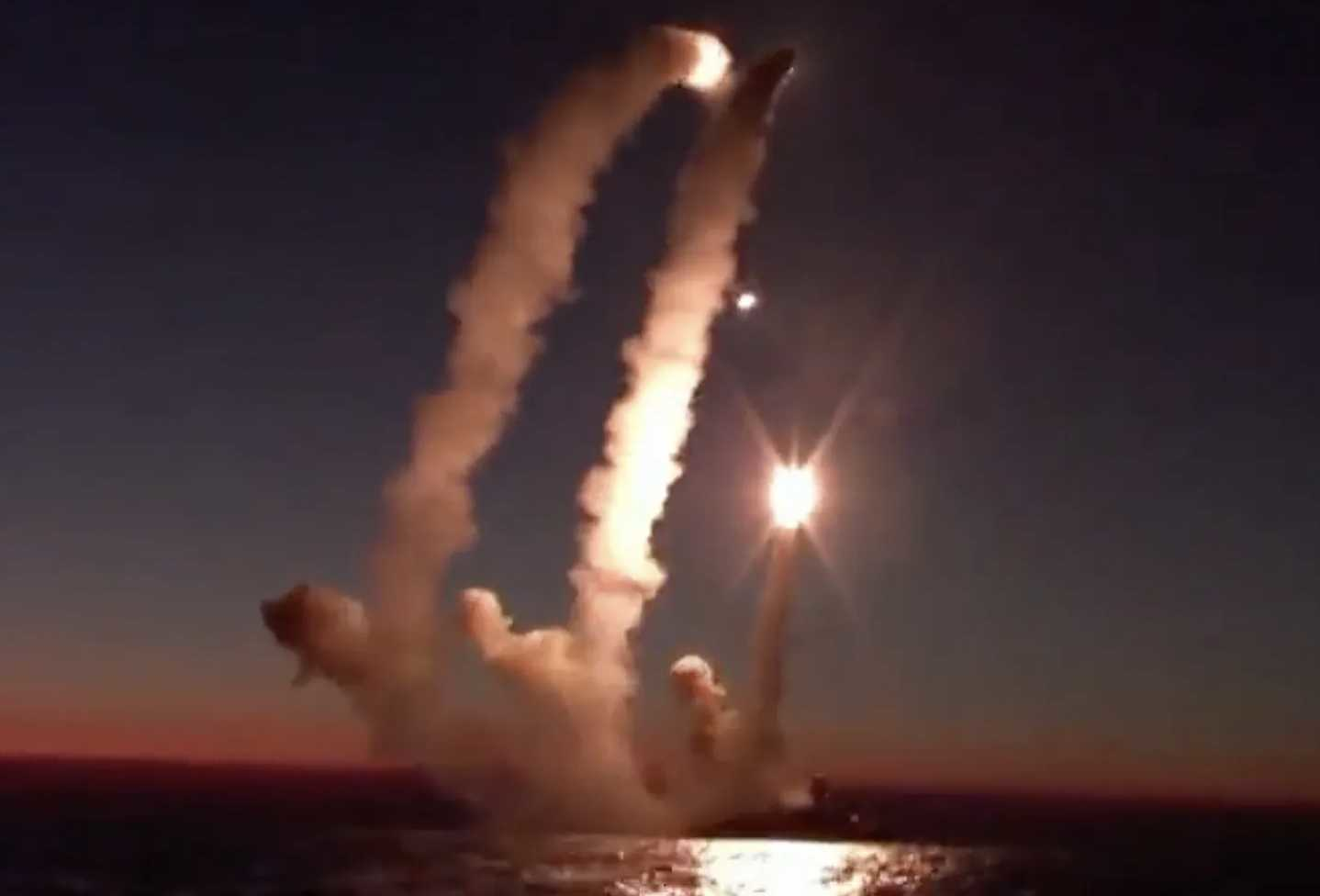
Three long-range cruise missiles are launched from a Russian submarine in the Black Sea on Saturday, striking targets near the Ukrainian border with Poland, following President Biden's apparent declaration of regime change on Saturday (Credit: 7NEWS Melbourne, Twitter)

This article was originally published on Substack on Mar. 27, 2022

The central question for Americans from the start of the war in Ukraine was what role, if any, should the U.S. government play in that war? A necessarily related question: if the U.S. is going to involve itself in this war, what objectives should drive that involvement?

Prior to the U.S.'s jumping directly into this war, those questions were never meaningfully considered. Instead, the emotions deliberately stoked by the relentless media attention to the horrors of this war — horrors which, contrary to the West's media propaganda, are common to all wars, including its own — left little to no space for public discussion of those questions. The only acceptable modes of expression in U.S. discourse were to pronounce that the Russian invasion was unjustified, and, using parlance which the 2011 version of Chris Hayes correctly dismissed as adolescent, that Putin is a “bad guy.” Those denunciation rituals, no matter how cathartic and applause-inducing, supplied no useful information about what actions the U.S. should or should not take when it came to this increasingly dangerous conflict.

That was the purpose of so severely restricting discourse to those simple moral claims: to allow policymakers in Washington free rein to do whatever they wanted in the name of stopping Putin without being questioned. Indeed, as so often happens when war breaks out, anyone questioning U.S. political leaders instantly had their patriotism and loyalty impugned (unless one was complaining that the U.S. should become more involved in the conflict than it already was, a form of pro-war "dissent” that is always permissible in American discourse).

With these discourse rules firmly implanted, those who attempted to invoke former President Obama's own arguments about a conflict between Russia and Ukraine — namely, that “Ukraine is a core Russian interest but not an American one” and therefore the U.S. should not risk confrontation with Moscow over it — were widely maligned as Kremlin assets if not agents. Others who urged the U.S. to try to avert warthrough diplomacy — by, for instance, formally vowing that NATO membership would not be offered to Ukraine and that Kyiv would remain neutral in the new Cold War pursued by the West with Moscow — faced the same set of accusations about their loyalty and patriotism.

Most taboo of all was any discussion of the heavy involvement of the U.S. in Ukrainebeginning in 2014 up to the invasion: from micro-managing Ukrainian politics, to arming its military, to placing military advisers and intelligence officers on the ground to train its soldiers how to fight (something Biden announced he was considering last November) — all of which amounted to a form of de facto NATO expansion without the formal membership. And that leaves to the side the still-unanswered yet supremely repressed question of what Undersecretary of State Victoria Nuland referred to as the Ukrainians’ "biological research facilities” so dangerous and beyond current Russian bio-research capabilities that she gravely feared they would "fall into Russian hands.”

As a result of the media's embracing of moral righteousness in lieu of debating these crucial geopolitical questions, the U.S. government has consistently and aggressively escalated its participation in this war with barely any questioning let alone opposition. U.S. officials are boastfully leading the effort to collapse the Russian economy. Along with its NATO allies, the U.S. has flooded Ukraine with billions of dollars of sophisticated weaponry, with at least some of those arms ending up in the hands of actual neo-Nazi battalions integrated into the Ukrainian government and military. It is providing surveillance technology in the form of drones and its own intelligence to enable Ukrainian targeting of Russian forces. President Biden threatened Russia with a response “in kind” if Russia were to use chemical weapons. Meanwhile, reports The New York Times, “C.I.A. officers are helping to ensure that crates of weapons are delivered into the hands of vetted Ukrainian military units."

The U.S. is, by definition, waging a proxy war against Russia, using Ukrainians as their instrument, with the goal of not ending the war but prolonging it. So obvious is this fact about U.S. objectives that even The New York Times last Sunday explicitly reportedthat the the Biden administration “seeks to help Ukraine lock Russia in a quagmire” (albeit with care not to escalate into a nuclear exchange). Indeed, even “some American officials assert that as a matter of international law, the provision of weaponry and intelligence to the Ukrainian Army has made the United States a cobelligerent,” though this is “an argument that some legal experts dispute.” Surveying all this evidence as well as discussions with his own U.S. and British sources, Niall Ferguson, writing in Bloomberg, proclaimed: “I conclude that the U.S. intends to keep this war going.” UK officials similarly told him that “the U.K.’s No. 1 option is for the conflict to be extended and thereby bleed Putin.”

In sum, the Biden administration is doing exactly that which former President Obama warned in 2016 should never be done: risking war between the world's two largest nuclear powers over Ukraine. Yet if any pathology defines the last five years of U.S. mainstream discourse, it is that any claim that undercuts the interests of U.S. liberal elites — no matter how true — is dismissed as "Russian disinformation.”

As we witnessed most vividly in the run-up to the 2020 election — when that label was unquestioningly yet falsely applied by the union of the CIA, corporate media and Big Tech to the laptop archive revealing Joe Biden's political and financial activities in Ukraine and China — any facts which establishment power centers want to demonize or suppress are reflexively labelled “Russian disinformation.” Hence, the DNC propaganda arm Media Matters now lists as “pro-Russian propaganda” the indisputable fact that the U.S. is not defending Ukraine but rather exploiting and sacrificing it to fight a proxy war with Moscow. The more true a claim is, the more likely it is to receive this designation in U.S. establishment discourse.

That there are few if any risks graver or more reckless than a direct U.S./Russia military confrontation should be too obvious to require explanation. Yet that seems to have been completely forgotten in the zeal, arousal, purpose and excitement which war always triggers. It takes little to no effort to recognize the current emergence of the dynamic about which Adam Smith so fervently warned 244 years ago in Wealth of Nations:

In great empires the people who live in the capital, and in the provinces remote from the scene of action, feel, many of them scarce any inconveniency from the war; but enjoy, at their ease, the amusement of reading in the newspapers the exploits of their own fleets and armies. To them this amusement compensates the small difference between the taxes which they pay on account of the war, and those which they had been accustomed to pay in time of peace. They are commonly dissatisfied with the return of peace, which puts an end to their amusement, and to a thousand visionary hopes of conquest and national glory, from a longer continuance of the war.

The grave dangers of the world's two largest nuclear-armed powers acting on opposite sides of a hot war extend far beyond any intention by the U.S. to deliberately engage Russia directly. Such a war, even with the U.S. waging it “only” through its proxies, severely escalates tensions, distrust, hostilities, and a climate of paranoia. That is particularly true given that — ever since Democrats decided to blame Putin for Hillary's 2016 loss — at least half of Americans have been feeding on a non-stop, toxic diet of anti-Russian hatred under the guise of “Russiagate.” As recently as 2018, 2/3 of Democrats believed that Russia hacked into voting machines and altered the 2016 vote count to help Trump win. This cultivation of extreme anti-Russian animus in Washington has been made even more dangerous by the virtual prohibition on dialogue with Russian officials, which during Russiagate was deemed inherently suspect if not criminal.

And all of those preexisting dangers are, in turn, severely exacerbated by an American president who so often is too age-addled to speak clearly or predictably. That condition is inherently dangerous, made all the more so by the fact that it leaves him vulnerable to manipulation by the Democratic Party's national security advisers who will never forget 2016 and seem more intent than ever on finally attaining vengeance against Putin, no matter the risks. Speaking to U.S. troops in Poland on Friday, a visibly exhausted and rambling President Biden — after extensive travel, time-zone hopping, protracted meetings and speeches — appeared to tell U.S. troops that they were on their way to see first-hand the resistance of Ukrainians, meaning they were headed into Ukraine:

It seems clear that this was not some planned decision to have the U.S. president casually announce his intention to send U.S. troops to fight Russians in Ukraine. This was, instead, an old man, more tired, unpredictable and incoherent than usual due to intense overseas travel, accidentally mumbling out various phrases that could be and almost certainly were highly alarming to Moscow and other countries.

But accidental or unintentional escalation — from misperception or miscommunication — is always at least as serious a danger for war as the deliberate intention to directly engage militarily. In January of this year, the Bulletin of Atomic Scientists announced that its so-called "doomsday clock” was set to 100 seconds before midnight, the metaphorical time they used to signify an extinction-level event for humanity. They warned that the prospect of a cataclysmic nuclear exchange among the U.S., Russia and/or China was dangerously possible, and specifically warned: “Ukraine remains a potential flashpoint, and Russian troop deployments to the Ukrainian border heighten day-to-day tensions.”

In 2018, when the clock was “only” at two minutes before midnight, they emphasized tensions between Russia and the U.S. as one of the primary causes: “The United States and Russia remained at odds, continuing military exercises along the borders of NATO, undermining the Intermediate-Range Nuclear Forces Treaty (INF), upgrading their nuclear arsenals, and eschewing arms control negotiations.” They urged recognition of this specific danger: “Major nuclear actors are on the cusp of a new arms race, one that will be very expensive and will increase the likelihood of accidents and misperceptions.”

That Biden's "gaffe” about U.S. troops headed into Ukraine could generate exactly this sort of "misperception” seems self-evident. So do the grave dangers from Biden's sudden yet emphatic declaration on Saturday that Putin "cannot remain in power” — the classic language of declared U.S. policy of regime change:

That clear declaration of regime change as the U.S. goal for Putin was quickly walked back by Biden's aides, who absurdly claimed he only meant that Putin cannot remain in power in Ukraine and other parts of Eastern Europe, not that he can no longer govern Russia. But this episode marked at least the third time in the past couple weeks that White House officials had to walk back Biden's comments, following his clear decree that U.S. troops would soon be back in Ukraine and his prior warning that the U.S. would use chemical weapons against Russia if they used them first.

That Biden seems to be stumbling and bumbling rather than following scripted recklessness seems likely in some of these cases but not all. The White House's vehement denial, in the wake of Biden's speech, that regime change in Russia is its goal was contradicted by Ferguson's reporting in Bloomberg last week:

Reading this carefully, I conclude that the U.S. intends to keep this war going….I have evidence from other sources to corroborate this. “The only end game now,” a senior administration official was heard to say at a private event earlier this month, “is the end of Putin regime"…..I gather that senior British figures are talking in similar terms. There is a belief that “the U.K.’s No. 1 option is for the conflict to be extended and thereby bleed Putin.” Again and again, I hear such language. It helps explain, among other things, the lack of any diplomatic effort by the U.S. to secure a cease-fire.  It also explains the readiness of President Joe Biden to call Putin a war criminal.

Whether deliberate or unintentional, these escalatory statements — particularly when combined with the U.S.’s escalatory actions — are dangerous beyond what can be described. As an Australian news outlet reported on Sunday, “Russia has launched a missile strike near Poland in what appears to be a deadly warning to the United States.” The accompanying video (see lead photo above) shows at least three long-range cruise missiles, launched from a Russian submarine in the Black Sea, precisely striking targets in western Ukraine, near to where Biden was in Poland. That missile launch, the outlet reasonably concluded, “appears to be a deadly warning to the United States.”

Whatever else is true, the U.S. and Russia are now in waters uncharted since the Cuban missile crisis. Even the savage US/USSR proxy wars of the 1980s in Latin America and Afghanistan did not entail these sorts of rapidly escalating threats. A Russian president who, validly or not, feels threatened by NATO expansion in the region and driven by questions of his legacy, on the other side of a U.S. president with a long record of hawkishness and war fever which is now hobbled by the carelessness and infirmities of old age, is a remarkably volatile combination. As former Greek finance minister Yanis Varoufakis put it on Saturday: “A U.S. President who, during an atrocious war, does not mean what he says on matters of War and Peace, and must be corrected by his hyperventilating staff, is a clear and present danger to all.”

Hovering above all of these grave dangers is the question of why? What interests does the U.S. have in Ukraine that are sufficiently vital or substantial to justify trifling with risks of this magnitude? Why did the U.S. not do more to try to diplomatically avert this horrific war, instead seemingly opting for the opposite: namely, discouraging Ukrainian President Zelensky from pursuing such talks on the alleged grounds of futility and rewarding Russian aggression, and not even exploring whether a vow of non-NATO-membership for Ukraine would suffice? How does growing U.S. involvement in this war benefit the people of the United States, particularly as they were already — before this war — weighed down by the dual burdens of pandemic-based economic depravations and rapidly escalating inflation?

These are precisely the questions that a healthy nation discusses and examines beforejumping head-first into a major war. But these were precisely the questions declared to be unpatriotic, proof of one's status as a traitor or pro-Russia propagandist, as the hallmark of being pro-Putin. These are the standard tactics used to squash dissent or questioning when war breaks out. That neocons, who perfected these smear tactics, are back in the saddle as discourse and policy leaders — due to their six-year project of ingratiating themselves back into American liberalism with performative anti-Trump agitprop — makes it inevitable that such sleazy attacks will prevail.

As a result, the U.S. now finds itself more deeply enmeshed than ever in the most dangerous war it has fought in years if not decades. It may be too late for those questions to be meaningfully examined. But given the stakes, this is as clear a case of better late than never as one will ever encounter.

community logo
Join the Glenn Greenwald Community
To read more articles like this, sign up and join my community today
1
What else you may like…
Videos
Podcasts
Posts
Articles
System Update's schedule: and my life as a "farmer"

As we have the last couple of years, we are going to take the break from Christmas until New Year off from the show, returning on Monday, January 5. We very well may have individual video segments we post to Rumble and YouTube until then, but the full show at its regular hour will resume on January 6.

In the meantime, enjoy this video we produced of my fulfillment this year of a childhood dream: to have a (very) small farm where my family can go to make communion and connection with every type of animal possible.

00:05:18
SPECIAL AFTERSHOW - SYSTEM UPDATE 500
01:07:46
Answering Your Questions About Tariffs

Many of you have been asking about the impact of Trump's tariffs, and Glenn addressed how we are covering the issue during our mail bag segment yesterday. As always, we are grateful for your thought-provoking questions! Thank you, and keep the questions coming!

00:11:10
Listen to this Article: Reflecting New U.S. Control of TikTok's Censorship, Our Report Criticizing Zelensky Was Deleted

For years, U.S. officials and their media allies accused Russia, China and Iran of tyranny for demanding censorship as a condition for Big Tech access. Now, the U.S. is doing the same to TikTok. Listen below.

Listen to this Article: Reflecting New U.S. Control of TikTok's Censorship, Our Report Criticizing Zelensky Was Deleted

“A nation that continues year after year to spend more money on military defense than on programs of social uplift is approaching spiritual death.”

Martin Luther King Jr

Happy MLK Day! & Happy Belated one to him!💖🍰🥳

I wanted to share my favorite speech of his + a Back To The Future wallpaper I made with a favorite quote of his 🚗⚡⏰🤗💖 He gave 2 very similar speeches on "traveling to the past" - I cited the one he gave on his birthday in 1954 💖🍰🥳 the first time I made this one I was really proud of it & sent it to Glenn but I forgot the Doomsday Clock 😭 but this one has it right & I used his real signature too! lol :)

The video speech "What is Your Life's Blueprint?" was given/recorded on October 26, 1967 (same year Glenn was born :) and same day that a lot of fans consider to be the real "Back to the Future" Day, based on its importance to the story :)

A little background info from Gemini (1985 is the year David was born :)

"October 26, 1985, is the central, pivotal date in the original Back to the Future film, representing the night Marty McFly travels to 1955. 

Key events occurring on or around this date include:

⚡The First Experiment: ...

Where "woke" has lead us to

Congressman Josh Hawley questions a doctor asking,

"You said science and evidence should guide medicine. Can men get pregnant?"

The doctor refuses to answer directly (on several occasions) stating that,

"I think yes-no questions like this are a political tool."

In this context, Melanie Phillips delivers a chilling diagnosis of the West's intellectual crisis:

"Ideology has replaced knowledge", she says, "and reason itself is under siege."

[1] https://x.com/EricLDaugh/status/2011485172768632969
[2] https://x.com/ImtiazMadmood/status/2013023602720018862

post photo preview
The U.S. is Not "Liberating" Anything in Venezuela (Except its Oil)

[Note: The article was originally published in Portuguese in Folha de. S.Pauloon January 5, 2026]


The United States, over the past 50 years, has fought more wars than any other country by far. In order to sell that many wars to its population and the world, one must deploy potent war propaganda, and the U.S. undoubtedly possess that.

Large parts of both the American and Western media are now convinced that the latest U.S. bombings and regime-change operation is to “liberate” the Venezuelan people from a repressive dictator. The claim that liberation is the American motive – either in Venezuela or anywhere else – is laughable. 

The U.S. did not bomb and invade Venezuela in order to “liberate” the country. It did so to dominate the country and exploit its resources. If one can credit President Donald Trump for anything when it comes to Venezuela, it is his candor about the American goal.  

When asked about U.S. interests in Venezuela, Trump did not bother with the pretense of freedom or democracy. “We're going to have to have big investments by the oil companies,” Trump said. “And the oil companies are ready to go."

This is why Trump has no interest in empowering Venezuela’s opposition leaders, whether it be Nobel Peace Prize winner Maria Corina Machado (who Trump dismissed as a “nice woman” incapable of governing) or the declared winner of the country’s last election Edmundo Gonzalez, in whom Trump has no interest. Trump instead said he prefers that Maduro’s handpicked Vice President, the hard-line socialist Decly Rodriquez, remain in power. 

Note that Trump is not demanding that Rodriguez give Venezuelans more freedom and democracy. Instead, Trump said, the only thing he demands of her is “total access. We need access to the oil and other things.”

The U.S. government in general does not oppose dictatorships, nor does it seek to bring freedom and democracy to the world’s repressed peoples. The opposite is true.

Installing and supporting dictatorships around the world has been a staple of U.S. foreign policy since the end of World War II. The U.S. has helped overthrow far more democratically elected governments than it has worked to remove dictatorships.

Indeed, American foreign policy leaders often prefer pro-American dictatorships. Especially in regions where anti-American sentiments prevail – and there are more and more regions where that is now the case – the U.S. far prefers autocrats that repress and crush the preferences of the population, rather than democratic governments that must placate and adhere to public sentiments.

The only requirement that the U.S. imposes on foreign leaders is deference to American dictators. Maduro’s sin was not autocracy; it was disobedience.


That is why many of America’s closest allies – and the regimes Trump most loves and supports – are the world’s most savage and repressive. Trump can barely contain his admiration and affection for Saudi despots, the Egyptian military junta, the royal oligarchical autocrats of the UAE and Qatar, the merciless dictators of Uganda and Rwanda.

The U.S. does not merely work with such dictatorships where they find them. The U.S. helps install them (as it did in Brazil in 1964 and dozens of other countries). Or, at the very least, the U.S. lavishes repressive regimes with multi-pronged support to maintain their grip on power in exchange for subservience.

Unlike Trump, President Barack Obama liked to pretend that his invasions and bombing campaigns were driven by a desire to bring freedom to people. Yet one need only look at the bloodbaths and repression that gripped Libya after Obama bombed its leader Muammar Gaddafi out of office, or the destruction in Syria that came from Obama’s CIA “regime change” war there, to see how fraudulent such claims are.

Despite decades of proof about U.S. intentions, many in the U.S. and throughout the democratic world are always eager to believe that the latest American bombing campaign is the good and noble one, that this one is the one that we can actually feel good about. 

Such a reaction is understandable: we want heroes and crave uplifting narratives about vanquishing tyrants and liberating people from repression. Hollywood films target such tribalistic and instinctive desires and so does western war propaganda. 

Believing that this is what is happening provides a sense of vicarious strength and purpose. One feels good believing in these happy endings. But that is not what Americans wars,  bombing campaigns and regime-change operations are designed to produce, and that it why they do not produce such outcomes.


Read full Article
post photo preview
Trump and Rubio Apply Panama Regime Change Playbook to Venezuela; Michael Tracey is Kicked-Out of Epstein Press Conference
System Update #508

The following is an abridged transcript from System Update’s most recent episode. You can watch the full episode on Rumble or listen to it in podcast form on Apple, Spotify, or any other major podcast provider.  

System Update is an independent show free to all viewers and listeners, but that wouldn’t be possible without our loyal supporters. To keep the show free for everyone, please consider joining our Locals, where we host our members-only aftershow, publish exclusive articles, release these transcripts, and so much more!


 The Trump administration proudly announced yesterday that it blew up a small speedboat out of the water near Venezuela. It claimed that – without presenting even a shred of evidence – that the boat carried 11 members of the Tren de Aragua gang, and that the boat was filled with drugs. Secretary of State Marco Rubio – whose lifelong dream has been engineering coups and regime changes in Latin American countries like Venezuela and Cuba – claimed at first that the boat was headed toward the nearby island nation of Trinidad. But after President Trump claimed that the boat was actually headed to the United States, where it intended to drop all sorts of drugs into the country, Secretary of State Rubio changed his story to align with Trump's and claimed that the boat was, in fact, headed to the United States. 

There are numerous vital issues and questions here. First, have Trump supporters not learned the lesson yet that when the U.S. Government makes assertions and claims to justify its violence, that evidence ought to be required before simply assuming that political leaders are telling the truth. Second, what is the basis, the legal or Constitutional basis, that permits Donald Trump to simply order boats in international waters to be bombed with U.S. helicopters or drones instead of, for example, interdicting the boat, if you believe there are drugs on it, to actually prove that the people are guilty before just evaporating them off the planet? And then third, and perhaps most important: is all of this – as it seems – merely a prelude to yet another U.S. regime change war, this time, one aimed at the government of oil-rich Venezuela? We'll examine all of these events and implications, including the very glaring parallels between what is being done now to what the Bush 41 administration did in 1989 when invading Panama in order to oppose its one-time ally, President Manuel Noriega, based on exactly the same claims the Trump administration is now making about Venezuela. For a political movement that claims to hate Bush/neocon foreign policy, many Trump supporters and Trump officials sure do find ways to support the wars that constitute the essence of this ideology they claim to hate. 

Then, the independent journalist and friend of the show, Michael Tracey, was physically removed from a press conference in Washington D.C. yesterday, one to which he was invited, that was convened by the so-called survivors of Jeffrey Epstein and their lawyer. Michael's apparent crime was that he did what a journalist should be doing. He asked a question that undercut the narrative of the press event and documented the lies of one of the key Epstein accusers, lies that the Epstein accuser herself admits to having told. All of this is part of Michael's now months-long journalistic crusade to debunk large parts of the Epstein melodrama – efforts that include claims he's made, with which I have sometimes disagreed, but it's undeniable that the work he's doing is journalistically valuable in every instance: we always need questioning and critical scrutiny of mob justice or emoting-driven consensus to ask whether there's really evidence to support all of the claims. And that's what Michael has been doing, and he's basically been standing alone while doing it, and he'll be here to discuss yesterday’s expulsion from this press conference as well as the broader implications of the work he's been trying to do. 


Only for Supporters
To read the rest of this article and access other paid content, you must be a supporter
Read full Article
post photo preview
Minnesota Shooting Exploited to Impose AI Mass Surveillance; Taylor Lorenz on Dark Money Group Paying Dem Influencers, and the Online Safety Act
System Update #507

The following is an abridged transcript from System Update’s most recent episode. You can watch the full episode on Rumble or listen to it in podcast form on Apple, Spotify, or any other major podcast provider.  

System Update is an independent show free to all viewers and listeners, but that wouldn’t be possible without our loyal supporters. To keep the show free for everyone, please consider joining our Locals, where we host our members-only aftershow, publish exclusive articles, release these transcripts, and so much more!


The ramifications of yesterday's Minneapolis school shooting – and the exploitations of it – continue to grow. On last night's program, we reviewed the transparently opportunistic efforts by people across the political spectrum to immediately proclaim that they knew exactly what caused this murderer to shoot people. As it turned out, the murderer was motivated by whatever party or ideology, religion, or social belief that they hate most. Always a huge coincidence and a great gift for those who claim that. 

There's an even more common and actually far more sinister manner of exploiting such shootings: namely, by immediately playing on people's anger and fear to tell them that they must submit to greater and greater forms of mass surveillance and other authoritarian powers to avoid such events in the future. As they did after the 9/11 attack, which ushered in the full-scale online surveillance system under which we all live, Fox News is back to push a comprehensive Israel-developed AI mass surveillance program in the name of stopping violent events in the future. We'll tell you all about it. 

 Then, we have a very special surprise guest for tonight. She is Taylor Lorenz, who reported for years for The New York Times and The Washington Post on internet culture, trends in online discourse, and social media platforms. She's here in part to talk about her new story that appeared in WIRED Magazine today that details a dark money program that secretly shovels money to pro-Democratic Party podcasters and content creators, including ones with large audiences, and yet they are prohibited from disclosing even to their viewership that they're being paid in this way. We'll talk about this program and its implications. And while she's here, we'll also discuss her reporting on, and warnings about new online censorship schemes that masquerade as child protection laws, namely, by requiring users to submit proof of their identity to access various sites, all in the name of protecting children, but in the process destroying the key value of online anonymity. We'll talk to her about several other related issues as well. 


There've been a lot of revelations over the last 25 years, since the 9/11 attack, of all sorts of secretive programs that were implemented in the dark that many people I think correctly view as un-American in the sense that they run a foul and constitute a direct assault on the rights, protections and guarantees that we all think define what it means to be an American. And a lot of that happened. In fact, much of it, one could say most of it, happened because of the fears and emotions that were generated quite predictably by the 9/11 attack in 2001 and also the anthrax attack, which followed along just about a month later, six weeks later. We've done an entire show on it because of its importance in escalating the fear level in the United States in the wake of 9/11, even though it's extremely mysterious – the whole thing, how it happened, how it was resolved. But the point is that the fear levels increased, the anger increased, the sadness over the victims increased and into that breach, into that highly emotional state, stepped both the government and their partners in the media, which essentially included all major media outlets at the time, to tell people they essentially have to give up their rights if they want to be safe from future terrorist attacks. 

Only for Supporters
To read the rest of this article and access other paid content, you must be a supporter
Read full Article
See More
Available on mobile and TV devices
google store google store app store app store
google store google store app tv store app tv store amazon store amazon store roku store roku store
Powered by Locals