One of the towering questions hovering over the Epstein saga was whether the illicit sexual activities of the world’s most powerful people were used as blackmail by Epstein or by intelligence agencies with whom (or for whom) he worked. The Trump administration now insists that no such blackmail occurred.
Top law enforcement officials in the Trump administration — such as Attorney General Pam Bondi, FBI Director Kash Patel, and former FBI Deputy Director Dan Bongino — spent years vehemently denouncing the Biden administration for hiding Epstein’s “client list,” as well as concealing details about Epstein’s global blackmail operations. Yet last June, these exact same officials suddenly announced, in the words of their joint DOJ-FBI statement, that their “exhaustive review” found no “client list” nor any “credible evidence … that Epstein blackmailed prominent individuals as part of his actions.” They also assured the public that they were certain, beyond any doubt, that Epstein killed himself.
There are still many files that remain heavily and inexplicably redacted. But, from the files that have been made public, we know one thing for certain. One of Epstein’s two key benefactors — the hedge fund billionaire Leon Black, who paid Epstein at least $158 million from 2012 through 2017 — was aggressively blackmailed over his sexual conduct. (Epstein’s second most-important benefactor was the billionaire Les Wexner, a major pro-Israel donor who cut off ties in 2008 after Epstein repaid Wexner $100 million for money Wexner alleged Epstein had stolen from him.)
Despite that $100 million repayment in 2008 to Wexner, Epstein had accumulated so much wealth through his involvement with Wexner that it barely made a dent. He was able to successfully “pilfer” such a mind-boggling amount of money because he had been given virtually unconstrained access to, and power over, every aspect of Wexner’s life. Wexner even gave Epstein power of attorney and had him oversee his children’s trusts. And Epstein, several years later, created a similar role with Leon Black, one of the richest hedge fund billionaires of his generation.
Epstein’s 2008 conviction and imprisonment due to his guilty plea on a charge of “soliciting a minor for prostitution” began mildly hindering his access to the world’s billionaires. It was at this time that he lost Wexner as his font of wealth due to Wexner’s belief that Epstein stole from him.
But Epstein’s world was salvaged, and ultimately thrived more than ever, as a result of the seemingly full-scale dependence that Leon Black developed on Epstein. As he did with Wexner, Epstein insinuated himself into every aspect of the billionaire’s life — financial, political, and personal — and, in doing so, obtained innate, immense power over Black.
The recently released Epstein files depict the blackmail and extortion schemes to which Black was subjected. One of the most vicious and protracted arose out of a six-year affair he carried on with a young Russian model, who then threatened in 2015 to expose everything to Black’s wife and family, and “ruin his life,” unless he paid her $100 million. But Epstein himself also implicitly, if not overtly, threatened Black in order to extract millions more in payments after Black, in 2016, sought to terminate their relationship.
While the sordid matter of Black’s affair has been previously reported — essentially because the woman, Guzel Ganieva, went public and sued Black, accusing him of “rape and assault,” even after he paid her more than $9 million out of a $21 million deal he made with her to stay silent — the newly released emails provide very vivid and invasive details about how desperately Black worked to avoid public disclosure of his sex life. The broad outlines of these events were laid out in a Bloomberg report on Sunday, but the text of emails provide a crucial look into how these blackmail schemes in Epstein World operated.
Epstein was central to all of this. That is why the emails describing all of this in detail are now publicly available: because they were all sent by Black or his lawyers to Epstein, and are thus now part of the Epstein Files.
Once Ganieva began blackmailing and extorting Black with her demands for $100 million — which she repeatedly said was her final, non-negotiable offer — Black turned to Epstein to tell him how to navigate this. (Black’s other key advisor was Brad Karp, who was forced to resign last week as head of the powerful Paul, Weiss law firm due to his extensive involvement with Epstein).
From the start of Ganieva’s increasingly unhinged threats against Black, Epstein became a vital advisor. In 2015, Epstein drafted a script for what he thought Black should tell his mistress, and emailed that script to himself.
Epstein included an explicit threat that Black would have Russian intelligence — the Federal Security Service (FSB) — murder Ganieva, because, Epstein argued, failure to resolve this matter with an American businessman important to the Russian economy would make her an “enemy of the state” in the eyes of the Russian government. Part of Epstein’s suggested script for Black is as follows (spelling and grammatical errors maintained from the original correspondents):
you should also know that I felt it necessary to contact some friends in FSB, and I though did not give them your name. They explained to me in no uncertain terms that especially now , when Russia is trying to bring in outside investors , as you know the economy sucks, and desperately investment that a person that would attempt to blackmail a us businessman would immeditaly become in the 21 century, what they terms . vrag naroda meant in the 20th they translated it for me as the enemy of the people, and would e dealt with extremely harshly , as it threatened the economies of teh country. So i expect never ever to hear a threat from you again.
In a separate email to Karp, Black’s lawyer, Epstein instructs him to order surveillance on the woman’s whereabouts by using the services of Nardello & Co., a private spy and intelligence agency used by the world’s richest people.
Black’s utter desperation for Ganieva not to reveal their affair is viscerally apparent from the transcripts of multiple lunches he had with her throughout 2015, which he secretly tape-recorded. His law firm, Paul, Weiss, had those recordings transcribed, and those were sent to Epstein.
To describe these negotiations as torturous would be an understatement. But it is worth taking a glimpse to see how easily and casually blackmail and extortion were used in this world.
Leon Black is a man worth $13 billion, yet his life appears utterly consumed by having to deal constantly with all sorts of people (including Epstein) demanding huge sums of money from him, accompanied by threats of various kinds. Epstein was central to helping him navigate through all of this blackmail and extortion, and thus, he was obviously fully privy to all of Black’s darkest secrets.
At their first taped meeting on August 14, 2015, Black repeatedly offered his mistress a payment package of $1 million per year for the next 12 years, plus an up-front investment fund of £2 million for her to obtain a visa to live with her minor son in the UK. But Ganieva repeatedly rejected those offers, instead demanding a lump sum of no less than $100 million, threatening him over and over that she would destroy his life if he did not pay all of it.
Black was both astounded and irritated that she thought a payment package of $15 million was somehow abusive and insulting. He emphasized that he was willing to negotiate it upward, but she was adamant that it had to be $100 million or nothing, an amount Black insisted he could not and would not pay.
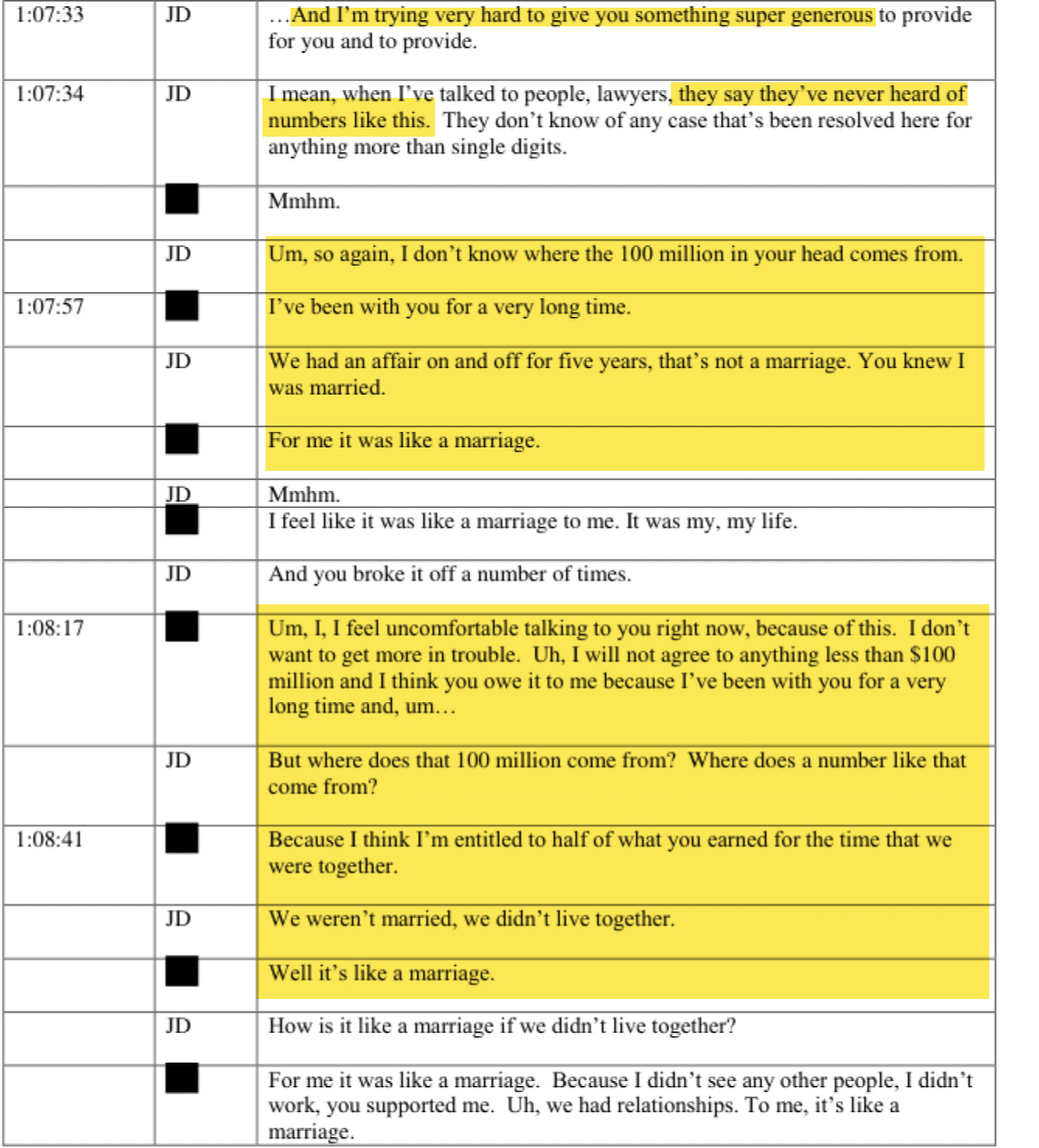
When pressed to explain where she derived that number, Ganieva argued that she considered the two to be married (even though Black was long married to another woman), thereby entitling her to half of what he earned during those years. Whenever Black pointed out that they only had sex once a month or so for five or six years in an apartment he rented for her, and that they never even lived together, she became offended and enraged and repeatedly hardened her stance.
Over and over, they went in circles for hours across multiple meetings. Many times, Black tried flattery: telling her how much he cared for her and assuring her that he considered her brilliant and beautiful. Everything he tried seemed to backfire and to solidify her $100 million blackmail price tag. (In the transcripts, “JD” refers to “John Doe,” the name the law firm used for Black; the redacted initials are for Ganieva):
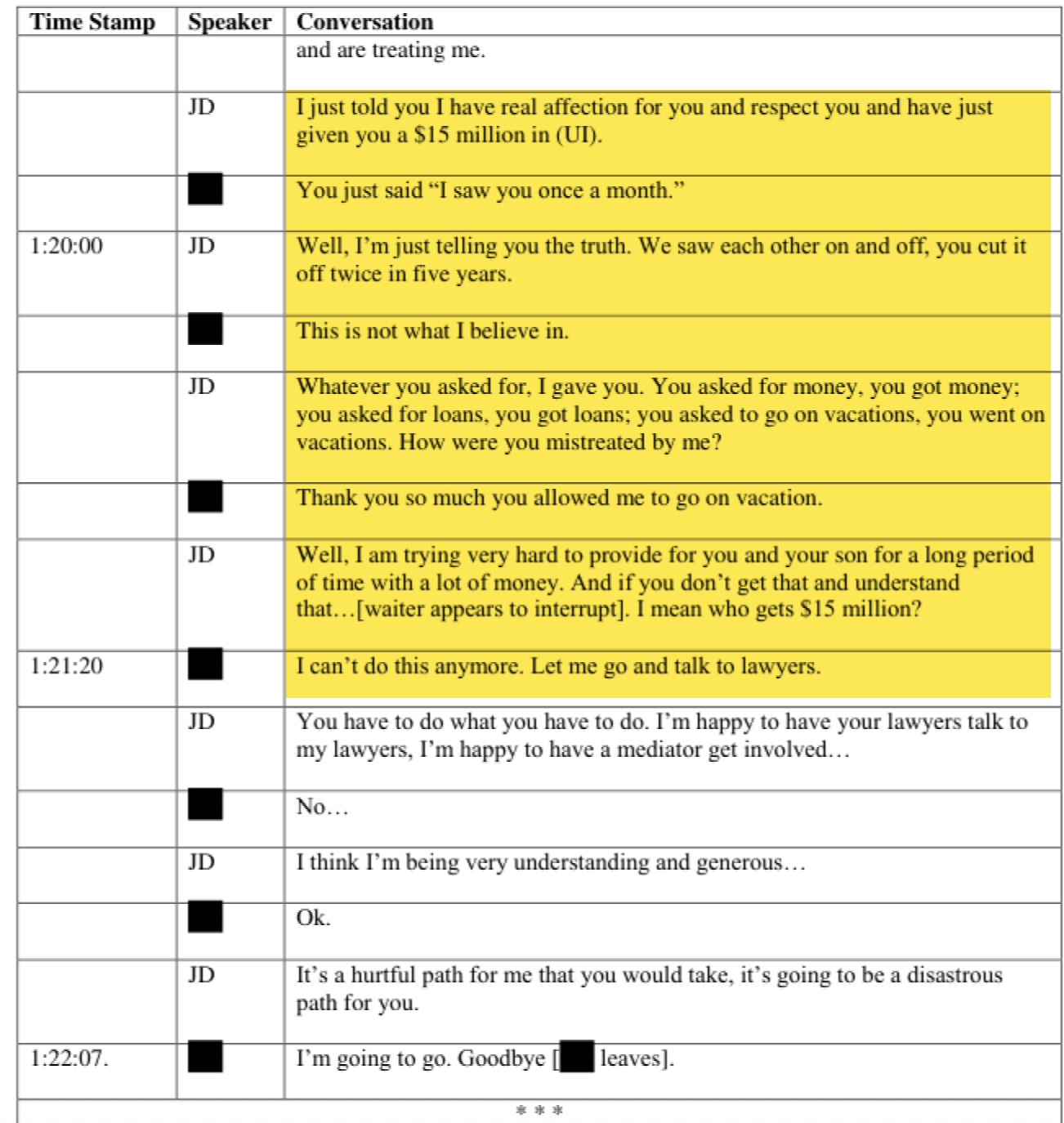
On other occasions during their meetings, Ganieva insisted that she was entitled to $100 million because Black had “ruined” her life. He invariably pointed out how much money he had given her over the years, to say nothing of the $15 million he was now offering her, and expressed bafflement at how she could see it that way.
In response, Ganieva would insist that a “cabal” of Black’s billionaire friends — led by Michael Bloomberg, Mort Zuckerman, and Len Blavatnik — had conspired with Black to ruin her reputation. Other times, she blamed Black for speaking disparagingly of her to destroy her life. Other times, she claimed that people in multiple cities — New York, London, Moscow — were monitoring and following her and trying to kill her. This is but a fraction of the exchanges they had, as he alternated between threatening her with prison and flattering her with praise, while she kept saying she did not care about the consequences and would ruin his life unless she was paid the full amount:

By their last taped meeting in October, Ganieva appeared more willing to negotiate the amount of the payment. The duo agreed to a payment package in return for her silence; it included Black’s payments to her of $100,000 per month for the next 12 years (or $1.2 million per year for 12 years), as well as other benefits that exceeded a value of $5 million. They signed a contract formalizing what they called a “non-disclosure agreement,” and he made the payments to her for several years on time. The ultimate total value to be paid was $21 million.
Unfortunately for Black, these hours of misery, and the many millions paid to her, were all for naught. In March, 2021, Ganieva — despite Black’s paying the required amounts — took to Twitter to publicly accuse Black of “raping and assaulting” her, and further claimed that he “trafficked” her to Epstein in Miami without her consent, to force her to have sex with Epstein.
As part of these public accusations, Ganieva spilled all the beans on the years-long affair the two had: exactly what Black had paid her millions of dollars to keep quiet. When Black denied her accusations, she sued him for both defamation and assault. Her case was ultimately dismissed, and she sacrificed all the remaining millions she was to receive in an attempt to destroy his life.
Meanwhile, in 2021, Black was forced out of the hedge fund that made him a billionaire and which he had co-founded, Apollo Global Management, as a result of extensive public disclosures about his close ties to Epstein, who, two years earlier, had been arrested, became a notorious household name, and then died in prison. As a result of all that, and the disclosures from his mistress, Black — just like his ex-mistress — came to believe he was the victim of a “cabal.” He sued his co-founder at Apollo, the billionaire Josh Harris, as well as Ganieva and a leading P.R. firm on RICO charges, alleging that they all conspired to destroy his reputation and drive him out of Apollo. Black’s RICO case was dismissed.
Black’s fear that these disclosures would permanently destroy his reputation and standing in society proved to be prescient. An independent law firm was retained by Apollo to investigate his relationship with Epstein. Despite the report’s conclusion that Black had done nothing illegal, he has been forced off multiple boards that he spent tens of millions of dollars to obtain, including the highly prestigious post of Chair of the Museum of Modern Art, which he received after compiling one of the world’s largest and most expensive collections, only to lose that position due to Epstein associations.
So destroyed is Leon Black’s reputation from these disclosures that a business relationship between Apollo and the company Lifetouch — an 80-year-old company that captures photos of young school children — resulted in many school districts this week cancelling photo shoots involving this company, even though the company never appeared once in the Epstein files. But any remote association with Black — once a pillar of global high society — is now deemed so toxic that it can contaminate anything, no matter how removed from Epstein.
None of this definitively proves anything like a global blackmail ring overseen by Epstein and/or intelligence agencies. But it does leave little doubt that Epstein was not only very aware of the valuable leverage such sexual secrets gave him, but also that he used it when he needed to, including with Leon Black. Epstein witnessed up close how many millions Black was willing to pay to prevent public disclosure in a desperate attempt to preserve his reputation and marriage.
In October, The New York Times published a long examination of what was known at the time about the years-long relationship between Black and Epstein. In 2016, Black seemingly wanted to stop paying Epstein the tens of millions each year he had been paying him. But Epstein was having none of it.
Far from speaking to Black as if Epstein were an employee or paid advisor, he spoke to the billionaire in threatening, menacing, highly demanding, and insulting terms:
Jeffrey Epstein was furious. For years, he had relied on the billionaire Leon Black as his primary source of income, advising him on everything from taxes to his world-class art collection. But by 2016, Mr. Black seemed to be reluctant to keep paying him tens of millions of dollars a year.
So Mr. Epstein threw a tantrum.
One of Mr. Black’s other financial advisers had created “a really dangerous mess,” Mr. Epstein wrote in an email to Mr. Black. Another was “a waste of money and space.” He even attacked Mr. Black’s children as “retarded” for supposedly making a mess of his estate.
The typo-strewn tirade was one of dozens of previously unreported emails reviewed by The New York Times in which Mr. Epstein hectored Mr. Black, at times demanding tens of millions of dollars beyond the $150 million he had already been paid.
The pressure campaign appeared to work. Mr. Black, who for decades was one of the richest and highest-profile figures on Wall Street, continued to fork over tens of millions of dollars in fees and loans, albeit less than Mr. Epstein had been seeking.
The mind-bogglingly massive size of Black’s payments to Epstein over the years for “tax advice” made no rational sense. Billionaires like Black are not exactly known for easily or willingly parting with money that they do not have to pay. They cling to money, which is how many become billionaires in the first place.
As the Times article put it, Black’s explanation for these payments to Epstein “puzzled many on Wall Street, who have asked why one of the country’s richest men would pay Mr. Epstein, a college dropout, so much more than what prestigious law firms would charge for similar services.”
Beyond Black’s payments to Epstein himself, he also “wired hundreds of thousands of dollars to at least three women who were associated with Mr. Epstein.” And all of this led to Epstein speaking to Black not the way one would speak to one’s most valuable client or to one’s boss, but rather spoke to him in terms of non-negotiable ultimatums, notably similar to the tone used by Black’s mistress-turned-blackmailer:
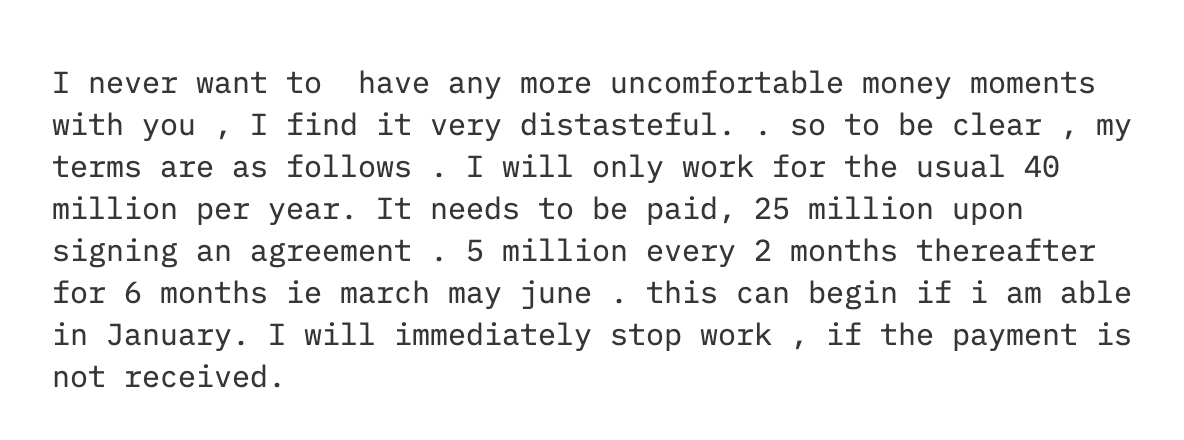
When Black did not relent, Epstein’s demands only grew more aggressive. In one email, he told Black: “I think you should pay the 25 [million] that you did not for this year. For next year it's the same 40 [million] as always, paid 20 [million] in jan and 20 [million] in july, and then we are done.” At one point, Epstein responded to Black’s complaints about a cash crunch (a grievance Black also tried using with his mistress) with offers to take payment from Black in the form of real estate, art, or financing for Epstein’s plane:
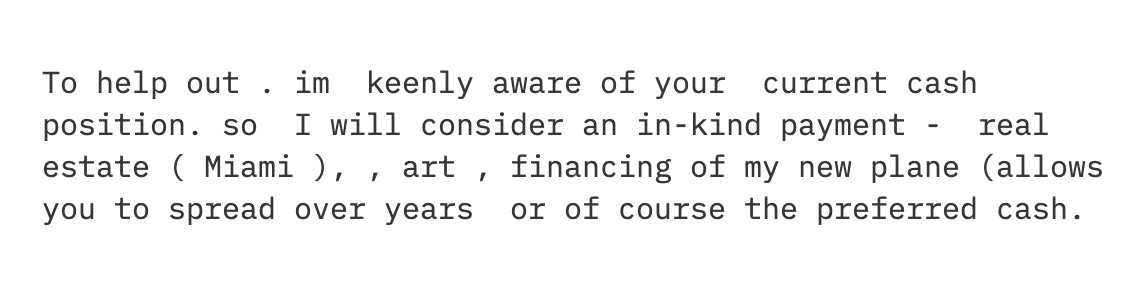
With whatever motives, Black succumbed to Epstein’s pressure and kept paying him massive sums, including $20 million at the start of 2017, and then another $8 million just a few months later, in April.
Epstein had access to virtually every part of Black’s life, as he had with Wexner before that. He was in possession of all sorts of private information about their intimate lives, which would and could have destroyed them if he disclosed it, as evidenced by the reputational destruction each has suffered just from the limited disclosures about their relationship with Epstein, to say nothing of whatever else Epstein knew.
Leon Black was most definitely the target of extreme and aggressive blackmail and extortion over his sex life in at least one instance we know of, and Epstein was at the center of that, directing him. While Wall Street may have been baffled that Wexner and Black paid such sums to Epstein over the years, including after Black wanted to cut him off, it is quite easy to understand why they did so. That is particularly so as Epstein became angrier and more threatening, and as he began reminding Black of all the threats from which Epstein had long protected him. Epstein watched those exact tactics work for Black’s mistress.
The DOJ continues to insist it has no evidence of Epstein using his access to the most embarrassing parts of the private and sexual lives of the world’s richest and most powerful people for blackmail purposes. But we know for certain that blackmail was used in this world, and that Epstein was not only well aware of highly valuable secrets but was also paid enormous, seemingly irrational sums by billionaires whose lives he knew intimately.