Israeli Prime Minister Benjamin Netanyahu has by far spent more time with President Trump than with any other world leader. Netanyahu, on Wednesday, will make his seventh visit to the U.S. since Trump’s second term began a little over a year ago, on top of the visit to Israel made by Trump in October. No other leader has visited the White House during Trump’s second term more than twice. The duo will once again meet at the White House.
The Israeli leader is traveling to Washington this time in order to impose as onerous conditions as possible on Trump’s desire to sign a deal with Iran that would avert a second U.S. attack on that country in the last eight months. “I will present to the President our positions regarding the principles of the negotiations,” Netanyahu saidbefore boarding his presidential plane this morning.
In June, Trump ordered the U.S. military to bomb several of Iran’s underground enrichment facilities in the midst of Israel’s 12-day bombing campaign. After those strikes, Trump pronounced Iran’s nuclear facilities “completely and totally obliterated.”
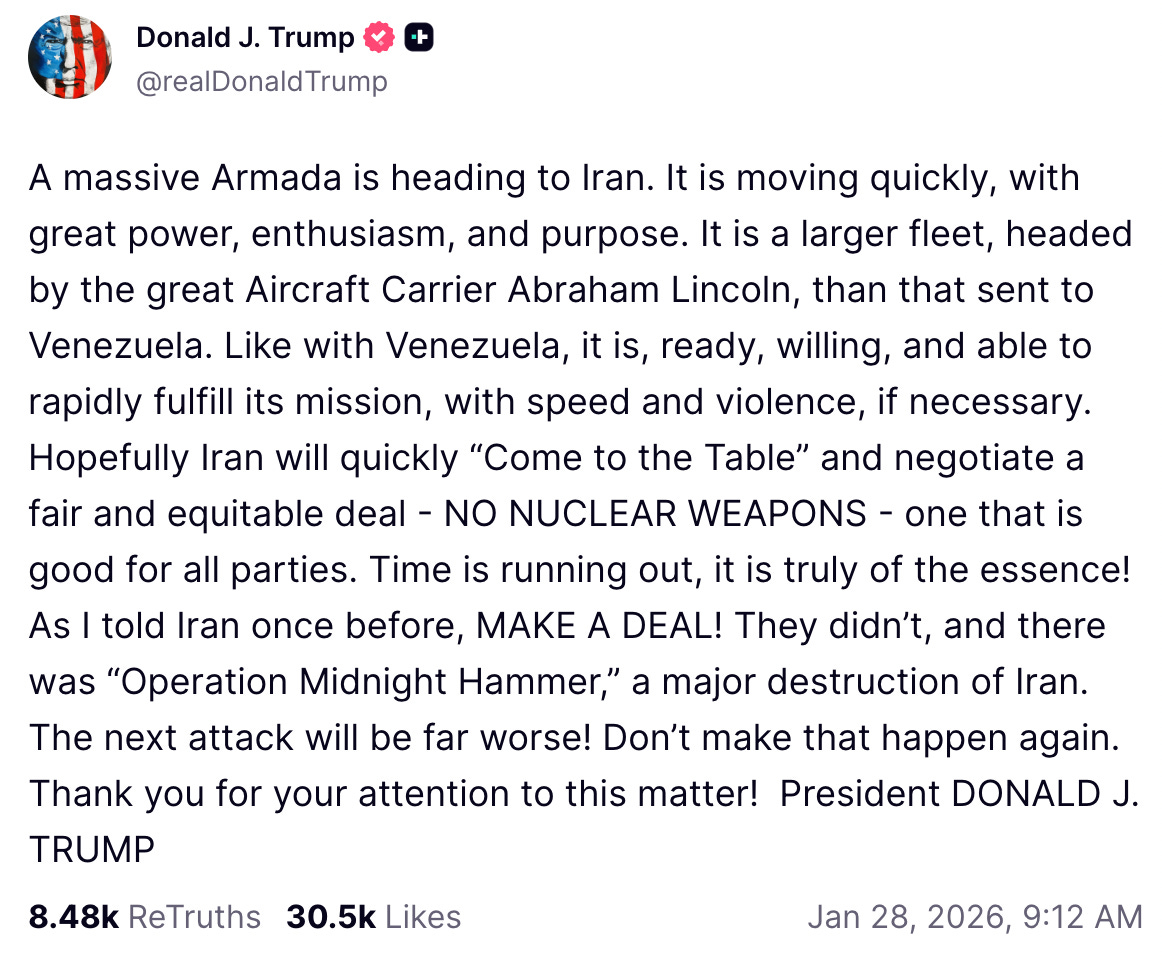
Yet over the past two months, Trump has ordered the deployment of what he called a “massive armada,” led by the aircraft carrier USS Abraham Lincoln, headed to Iran. On Truth Social, Trump emphasized that the deployment of military assets to Iran is larger than what he sent to Venezuela prior to the removal of that country’s president by the U.S. military. Trump added: “Like with Venezuela, [the U.S. armada] is ready, willing, and able to rapidly fulfill its mission, with speed and violence, if necessary.”
Indeed, Trump has explicitly and repeatedly threatened Tehran with “violence” and “very steep” consequences in the event that the two countries fail to reach a long-term agreement governing Iran’s nuclear program — the same one that Trump insisted had been “obliterated” last June.
All of that might be encouraging if not for the fact that this was the exact playbook run by Israel and the U.S. prior to their last joint bombing campaign on Iran. In the weeks leading up to Israel’s surprise attack, Trump had repeatedly assured the public, and Iran, that he believed negotiations were rapidly progressing to a deal that would render unnecessary military conflict with Iran.
And, just as now, coordinated leaks — typically laundered through Axios’ always-helpful Barak Ravid, the former IDF soldier who served in Israel’s notorious intelligence Unit 8200 — depicted a major rift between the two leaders as a result of Trump’s refusal to sanction a war with Iran. It seems clear that last year’s reports of a major “rift” were designed to lower Iran’s guard against what Trump ultimately acknowledged was a jointly planned U.S./Israel attack.
The supposed “dispute” between Washington and Tel Aviv this time rests on the scope of the deal with Iran. Israel’s fiercest loyalists in the U.S. have been demanding that Trump send the U.S. military to achieve Netanyahu’s longest and most supreme goal: having the U.S. military impose regime change on Israel’s most formidable regional enemy and replace it with a pliable puppet.
The sudden outbreak of deep concern over the human rights of Iranian protesters, from the same crowd that has cheered on every U.S. and Israeli war for decades, was quite obviously intended to provoke and even force a U.S. war to dislodge the Iranian government from power. This ritual is depressingly familiar to anyone paying even minimal attention to U.S. wars over the last several decades.
As I have long documented, feigned concern for oppressed peoples is always the tactic of choice for Washington’s neocons and warmongers. When they were trying in 2005 to force former President George W. Bush to go “from Baghdad to Tehran” on what was intended to be his regime-change crusade against Israel’s enemies, Americans were suddenly subjected to stories about the cruel and abusive treatment of Iranian gay men, as if that were a motivating factor in agitating for regime change there. (Similar concerns are rarely, if ever, expressed about the at least equally repressive behavior of friendly governments in Saudi Arabia, UAE, Egypt, Uganda — all governments which the U.S. actively supports.)
What Israel and its American supporters most fear is a U.S. deal with Iran that will only resolve the question of Iran’s nuclear program, while leaving the current government in place. But the position of the U.S. government and of President Trump has long been that the threat posed to the U.S. by Iran comes from the development of an Iranian nuclear weapon. By Trump’s own repeatedly stated views, that is the only legitimate concern of the U.S. when it comes to Iran.
But Israel has a far more ambitious agenda when it comes to that country. For that reason, Israel — as it did last June — is demanding the imposition of pre-conditions on Iran to which Israel knows Iran would and could never agree.
As the Israeli journalist Guy Azriel reported this week: “Despite the apparent lack of tangible progress in the Iran talks over the weekend and the unresolved gaps between Washington and Tehran, concern is growing in Jerusalem over the trajectory of the U.S.-led negotiations[.] … In Israel, there is mounting fear that any emerging deal could fall short of addressing the country’s core demands, not only regarding Iran’s regional terror proxies, but above all its ballistic missile program.”
In other words, Israel is demanding that the U.S. go to war with Iran even if Tehran satisfies Trump’s demands on its nuclear program. Netanyahu is insisting that Trump also require Iran to give up its ballistic missiles before any deal can be signed: something no country would ever do.
It may be rational for Israel to wish that their main regional rivals were left completely defenseless against any possible Israeli attack. President Trump himself admitted that Iran’s ballistic missiles were used to great effect to retaliate against Israel for its attack last June: “Israel got hit very hard, especially the last couple of days. Israel was hit really hard,” the President said, adding, “Those ballistic missiles, boy, they took out a lot of buildings.”
But what does that desire have to do with the United States? And why would any country, let alone Iran — which was just heavily bombed for almost two weeks last June — agree to give up conventional weapons that serve as a deterrent for future Israeli attacks?
Despite the best propaganda efforts of the Ellison-owned, Bari Weiss-led CBS News to convince Americans that Iran’s ballistic missiles somehow pose a threat to the U.S. rather than just Israel, the reality is that Iran cannot and does not pose a threat to the U.S., particularly if there is an agreement in place to ensure Iran cannot produce nuclear weapons (such an agreement had been in place that, by all accounts, provided a comprehensive inspection regime at Iranian facilities before it was nullified in 2017 by the U.S.).
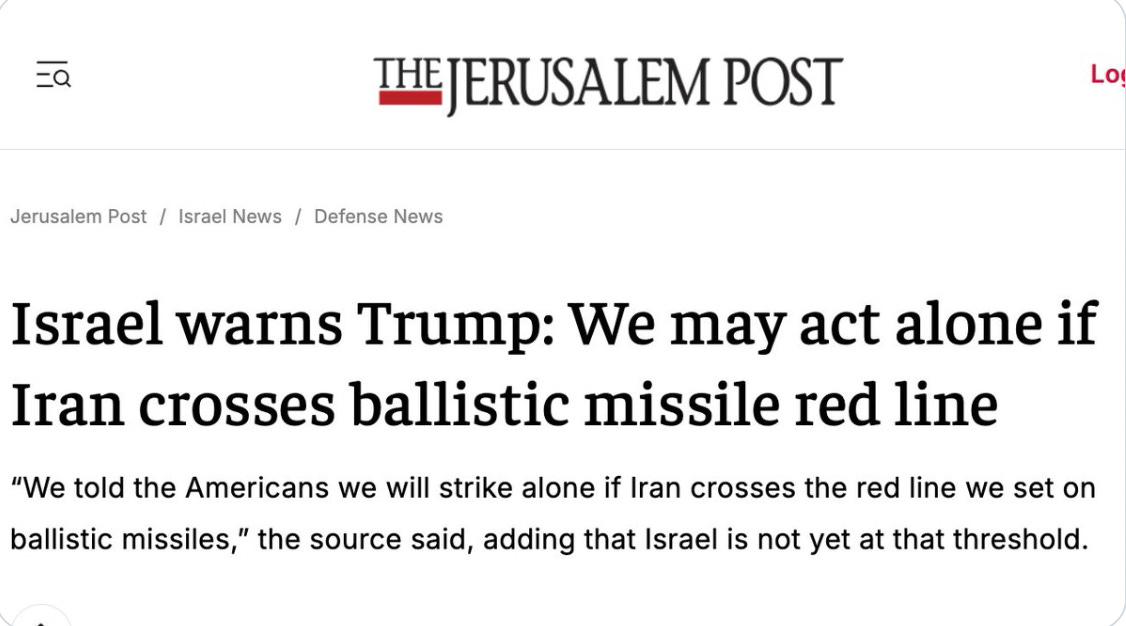
The very idea that the U.S. should even consider sending its own citizens to fight a war against Iran is the consummate example of Israel having Americans fight wars that serve Israel’s national interest but not Americans’ interests. In the days leading up to Netanyahu’s latest in a series of visits to the U.S., Israeli officials began publicly threatening that they would attack Iran on their own if Trump refused to do it for them.
If Israel actually wants war with Iran, Israel can go fight it itself. Invite their most impassioned, loudmouthed American advocates, such as Mark Levin and Sen. Lindsey Graham (R-S.C.), to join that fight. But leave the U.S. out of it.
The towering question, as always, is how much Trump is actually willing to defy not only Israel but his top Israel-centered donors and advisors, such as Miriam Adelson and Stephen Miller. The record on that front has been quite poor thus far. One once again watches to see whether the U.S. will make policy and war decisions not based on its own interests but on the interests of this one foreign country.