The following is an abridged transcript from System Update’s most recent episode. You can watch the full episode on Rumble or listen to it in podcast form on Apple, Spotify, or any other major podcast provider.
System Update is an independent show free to all viewers and listeners, but that wouldn’t be possible without our loyal supporters. To keep the show free for everyone, please consider joining our Locals, where we host our members-only aftershow, publish exclusive articles, release these transcripts, and so much more!

Once a week, we devote the show to a Q&A session. We take questions submitted throughout the week by members of our Locals community and answer as many as we can. As is typically the case, the questions tonight are wide-ranging and very provocative on a diverse range of news stories.
Our “Mailbag” is not intended to be just a sort of yes or no, but instead to give my viewpoint, my analysis, my perspective, my commentary on whatever it is that interests you. A lot of times, it ends up being topics that we might have wanted to cover anyway, that we just haven't had a chance to yet. Other times, they are topics that, on our own, we may not have covered. It's usually that kind of perfect mix that always makes me excited to do. So, let's get right into them to make sure we cover as many as possible.
The first is from @ChristianaK, and the question is very straightforward:

There's actually a second question here and let me get to it now, because it was going to be part of what I was about to say. It’s from @kevin328:
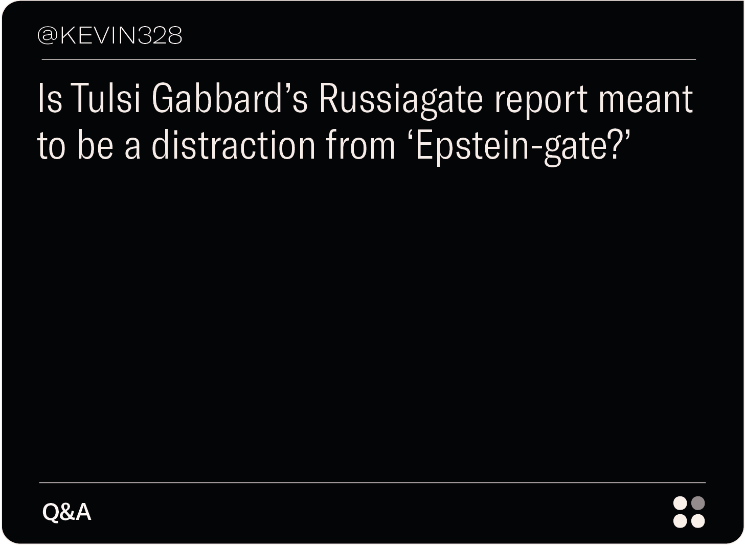
I actually think Tulsi Gabbard's revelations on their own are substantive, meritorious, important and deserve a lot of attention but I do think, at this point, anything that the Trump administration is doing is intended to feed their base that is still very confused, upset and angry, for the most part, by this increasingly bizarre posture that they've taken on the Epstein revelations, namely not to make any, led not by Pam Bondi, Kash Patel or Dan Bongino, but by Donald Trump.
Anything that they're suddenly unveiling is presumptively an attempt to distract people from that anger, that confusion and that growing suspicion about what they did with Epstein. The problem for them is the suspicions that have emerged – that I don't even think were that present before – that Donald Trump fears that his name is in the files and therefore wants to make sure they're not released, and even if his name isn't in the file in any way particularly incriminating.
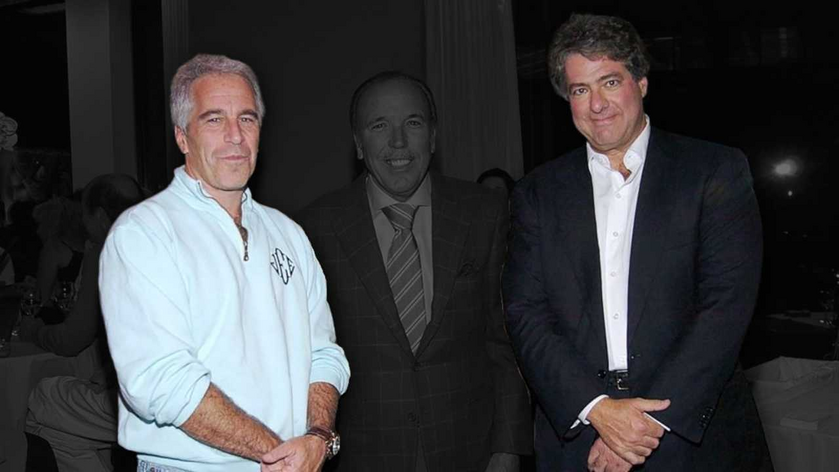
I've always thought the Epstein case has important questions to answer and I still think the Epstein case has important questions to be answered, including the ones I've outlined at length, such as whether he worked with or for any foreign or domestic intelligence agencies, and what was the source of his massive wealth, and why were these mysterious billionaires embedded in the military-industrial complex so eager on just seemingly handing him over huge amounts of wealth in exchange for services that seem very amorphous at best. I think there are a lot of unanswered questions that are important to say nothing of whether there's evidence that very powerful and important people participated in the more sinister aspects of what it was that he was doing and whether any blackmail arose from that. Of course, Donald Trump's name is going to be in some of these files for so many reasons. He was a very good friend of Jeffrey Epstein at one point. They spent a lot of time together. It seems like most or all of that time took place before the conviction of Jeffrey Epstein in 2007, which has its own very odd set of questions around why he got such an incredibly lenient deal for crimes that most people are sent to prison for a very long time.
There's actually an excellent discussion on all of this that if you haven't seen I want to recommend which is Darryl Cooper's discussion on Tucker Carlson's show about the Epstein case, Darryl spent huge amounts of time putting together the entire history of Jeffrey Epstein, where he came from, how he emerged on the scene, who his key contacts were, where his wealth came from, the questions that have arisen, the way in which they've been buried. Despite what people have tried to depict about Darryl Cooper, in large part because of his unconventional views on World War II, but more so his harsh criticism of Israel, that he's some deranged, unhinged fabulist, who doesn't understand history, he's actually one of the most scrupulous and meticulous commentators and analysts I've seen, by which I mean, he really does only very strongly-cling to facts and has no problem admitting, which he often does, that there are certain things he doesn't know, that there are holes in his understanding, holes in the information, and there's zero conspiratorial thinking or even speculative thinking in this discussion or very little. It's all just a chronicle of facts laid out in a way not just to understand the Epstein case, but the reason why it's captured so much attention about the behavior of our elite class.
So, I do think Donald Trump's name appears in these files the way The Wall Street Journal has reported it did. Trump was explicitly asked outside the White House by a reporter, just like two weeks ago: Did Pam Bondi give you a briefing in May in which she indicated to you that the Epstein files contain your name?” And to that, he explicitly said “No.” And that's exactly what The Wall Street Journal is now reporting had happened. Most journalists know that that happened. There were leaks inside the Justice Department and the White House that this is what happened. And again, I would be shocked if Donald Trump's name did not appear at some point in the Epstein files in some capacity, because of his close friendship with Jeffrey Epstein; they were in the same West Palm Beach social circles, which is a very small set of very rich people who compose that society. The U.S. attorney who ended up being appointed, who oversaw Jeffrey Epstein's sweetheart deal, ended up being appointed by Donald Trump as Secretary of Labor. He has positive feelings for Ghislaine Maxwell in that notorious interview. He said, “I wish her well,” something that Donald Trump doesn't say about most criminals, let alone ones imprisoned on charges that they trafficked underage girls.
But the climate that has been created – in large part by his closest followers, Pam Bondi, Kash Patel, Dan Bongino and his personal attorney, who is now the U.S. attorney for New Jersey, at least for a little bit longer, and some of the leading and most influential MAGA influencers – is that if your name is even remotely associated with Jeffrey Epstein, your entire life and your integrity and your character are instantly cast into doubt. One of the first times I really noticed this was when The Wall Street Journal reported on a series of contacts between people that no one knew had known Jeffrey Epstein, one of whom was Noam Chomsky. And the reason that happened was because Jeffrey Epstein had a very specific and passionate interest in academic institutions in Boston, especially the two most prestigious, Harvard and MIT. He funded various research projects. He gave $125,000, for example, to Bill Ackman's wife in order for her to have some sort of research project. And he had two or three dinners with Noam Chomsky. And Chomsky was very contemptuous of the questions in the Wall Street Journal. I guess that's what happens when you're 92. You don't take any kind of smear campaign seriously. You don't really care. And he just said, “Yeah, I had dinners with Jeffrey Epstein. He was a very well-connected and wealthy person.”
Now, oddly, Jeffrey Epstein was very close friends with the former Israeli Prime Minister Ehud Barak, who obviously knew Chomsky would have a great deal of animus towards, and Jeffrey Epstein was very connected to the Israeli government in all sorts of ways, including through his primary benefactor, the multi-billionaire Les Wexner, who handed over to Epstein billions of dollars, it seems, and assets. It is an odd person for Chomsky to know, but at the same time, if you're one of the most intellectually heralded professors and scholars in the Boston area at one of the most prestigious schools in the world, MIT, where Chomsky spent almost his entire life as a professor of linguistics, that is the kind of person that Jeffrey Epstein tried to target and befriend to make himself feel important, to make him feel intellectually relevant. And yet, you would have thought that that revelation by itself proved that Chomsky had gone to that island multiple times and had sex with underage girls and was a pedophile. So, there has been a lot of speculative guilt by association and hysteria that has surrounded this story, such that anyone whose name appears in those files is likely to have suspicion and doubt cast on them for the rest of their life, even if the connections were innocuous.
I'm sure part of what Trump wants to avoid is any indication that his name appears in those files because of that climate that will spill over him, including by many of his own followers. Then there are likely things in there that might, one of the reasons why investigations are typically kept secret, including grand jury proceedings, is because there are a lot of unverified accusations, but if they're published, they may seem like they have credibility. That was part of what we had to deal with the NSA, with the Snowden documents. A lot of the archives contain documents where they wanted to spy on certain people and they would speculate that those people might have ties to terrorist groups, or al-Qaeda, or Islamic extremism, or engage in other kinds of crimes unrelated to terrorism, but they were never charged with that. There was no evidence for it. It was just speculation about why the NSA thought they should spy on these people and had we published those documents with their names, we would have destroyed their reputations forever, based on accusations that were completely unvetted and just appeared in these documents.
Clearly, Trump panicked when he learned that his name was in there. Not only did he order no more disclosures, the investigation closed, but, out of nowhere, he began asserting that the Epstein files are all a fake, are all fabricated, or at least much of them are fabricated and claimed that they were the same kind of hoax that Obama, Hillary, Biden, Jim Comey and John Brennan manufactured for Russiagate and the Steele Dossier. All of a sudden, the Epstein files went from the most pressing and significant matter, the disclosure of which would be the key ingredient to deciphering the sinister globalist elite that runs the world, to a hoax, a bunch of fake documents that never should see the light of day.
Obviously, the only reason why Trump would suddenly concoct that excuse was because he was fearful that it would harm his reputation or the reputation of people very close to him and whom he cares about. and so he said, “No, this should never see the light of day; this is just another Democratic Party hoax that you idiots are falling for.” And that behavior obviously fuels suspicions even more, as has the subsequent reporting from The Wall Street Journal about that birthday greeting that Trump sent to Epstein, which he denies, but The Wall Street Journal reported, and then the subsequent reporting that Pam Bondi briefed him that his name appears in these documents.
So, anytime anyone thinks about the Epstein documents for even one second, that kind of loss of faith and trust in Trump is something that, once it breaks, is very difficult to put together again, and they are desperate. I mean, the day after the Epstein files, they said, “Hey, here's the Martin Luther King files.” It's like, I guess it's good to see the Martin Luther King files, kind of like the JFK files, in that these are documents that should have been released a long time ago.” There's zero reason for secrecy. It was one of the most consequential historical events of the last 70 years in the United States. We should be able to understand what our government knows about that event. But it wasn't like anybody was so eager, anyone thought that that was the key to deciphering much of anything. It was an important historical event. From all appearances, nothing particularly surprising, shocking, or informative about any of those documents that was clearly a way of saying, “Here's a new shiny toy that you can go look at and try to forget about Epstein.
The revelation by Tulsi Gabbard, especially in the time frame in which it occurred, most definitely, unfortunately, because as I said, they're consequential, is being contaminated by this perception that anything that the government is now throwing at you as disclosures are designed to distract you from the big whale that they've been covering up that they themselves made into the most pressing matter – JD Vance and Donald Trump Jr. as well – but also the idea that they want to regain your trust by showing you that they're redirecting your attention somewhere else. So, yes, unfortunately, it does have the stench of that, but at the same time, let's talk about these documents because they are extremely revealing.
I know Aaron Maté spent a good amount of time yesterday – he was one of the very, very few people who weren't a MAGA journalist or pundit, weren't a Trump supporter, who, from the very beginning, said, “This whole story seems journalistically dubious at best.” There were very few of us at the time doing that. Jimmy Dore was another person who did that. Matt Taibbi was another one. There were very, very few of us and we all got called fascists and Trump supporters and Russian agents for having questioned these sensationalistic conspiracy theories about the relationship between Donald Trump and Russia or the role Russia played in the 2016 election that never had evidence for them, that were all fueled by very familiar anonymous leaks from the CIA and the FBI and the rest of the national security state that hated Trump, to the papers to whom they always leak when they want to manipulate the public, which is The Washington Post and The New York Times, which then gave themselves Pulitzers for having done so. But of all those people, I think Aaron has the most granular, detailed knowledge of every document, of every form of testimony. It's something I haven't looked at in several years. We haven't spent a lot of time on Russiagate was basically debunked when Robert Mueller closed the investigation while arresting nobody on the core conspiracy that they criminally conspired with the Russians, saying they couldn't find any evidence for it. Of course, there's been no accountability; those very same people lied in 2020 when they said that the Hunter Biden laptop was Russian disinformation, exactly in the same way. No accountability for any of that. But I haven't spent that much time engrossed in Russian documents, like I used to do all the time when I was reporting on it. But Aaron has a very still-trap memory, especially for this particular story. So, I was very glad to let him come on and talk about it in my absence. That's one of the reasons why we asked him to guest-host last night.
So, I know he did a lot in this, but I do want to say that what was so obvious from the very beginning was that this was a very coordinated, politicized theme that emerged out of nowhere in the middle of 2016, something that the Hillary Clinton campaign, out of desperation, invented out of whole cloth. I will never forget the day when it was sort of circulating in the air. You had people like David Korn trying to insert the Steele Dossier reporting before his disclosure. “Oh, there's a document out there that everyone in Washington knows about that contains shocking revelations of Trump and Russia.” And that was all part of the effort to try to lay the foundation for this. But the Hillary Clinton campaign released this ad with this very sinister baritone, this very dark music and these very grainy photos saying, “What are Donald Trump and the Kremlin doing in secret? What is this relationship that they have?”
I was just so amazed because not only was there no evidence for it – zero, none – it never even made sense on its own terms. Why, if the Russians wanted to hack the Podesta and the DNC emails, would they have needed the assistance of the Trump campaign? How would the Trump campaign have helped in any way in that hacking? Why would they need to do that? Why would they collaborate with Trump's campaign that way? There was never really even any evidence that Putin actually wanted Trump to win that race. If anything, a lot of people assumed that Hillary was the overwhelming favorite to win, was almost certainly going to win it. No one wanted to get on her bad side, and no one thought Donald Trump could win. The idea that the Russians would go so heavy never made much sense, but even more so there was never any evidence for it that it came from Putin, that even if the Russians had been mucking around in the election, that it came from Putin, that was sort of a big master plan that had any effect on the election; there was never any evidence for this.
The intelligence community went all in because they were petrified of Trump. They hated Trump. They saw, correctly, that Hillary Clinton would be a very safe guardian and continuation of the status quo, which is what they saw in Biden and Kamala Harris as well. Trump, for whatever else is true about him, is very unpredictable. Sometimes, he will go to bat for the military-industrial complex and the intelligence community more aggressively than anyone else, as he's done many times, but he's also unpredictable and they want predictability, continuity, stability. The Democrats represented that, and Trump didn't. That was why they were so eager to destroy him, both in the campaign and then, sabotaging his presidency once he was inaugurated, and that's exactly what they proceeded to do with this fake story that ended up getting completely debunked and everybody just walked away from it as though it never happened.
What these documents reveal is what we assumed at the time, which was that the Obama administration, obviously, was desperate to help Hillary. It was the CIA under John Brennan, an extremely politicized, corrupt, and dishonest actor whom Obama first had as his national security advisor and then installed as CIA chief, that led the way in concocting evidence. They had James Clapper there, too, with a history of lying. Those are the people running the national security state. And they were open, partisan. Remember, these are the same people who ended up among the 51 intelligence officials in 2020 who lied with that letter, blaming the Russians for the Hunter Biden laptop and calling into question its authenticity right before the election because they were petrified it would help Trump win and Biden lose. Their politicized motives are beyond question.
Same with James Comey at the FBI; his hatred for Donald Trump has become legend. These were the people who took the best assessment of the U.S. Intelligence community, the analysts and the spies who were saying there's very low confidence that Russia really did anything here. We're not sure that they were the ones who did the hacking. There's no evidence that Putin even has a preference, let alone that he's pursuing some master plan to implement that preference.
Obama basically ordered Brennan and Clapper to go back and take another look, meaning to revise what their own intelligence professionals were telling them. Exactly what happened, by the way, with the Iraq war, when there were all sorts of analysts inside the CIA telling Dick Cheney and the Pentagon, Paul Wolfowitz, that they did not believe that Saddam Hussein had an active WMD program. You may remember the very bizarre story in Pat Leahy's memoir, where he says he was jogging on the street with his wife or walking on the street with this wife and these two guys who he didn't recognize came up to them as joggers and kind of whispered in Pat Lahey's ear like, hey, take a look at file number 14 in the CIA briefing that you have in the Senate.
He went and looked at it. It was filled with documents raising serious doubts about the WMD claims. And then they did it again, a few days later, and they said, “Have you taken a look at file 6?” He went there and found even more convincing evidence. He did end up voting against it but never revealed to the public that those documents were there, let alone that any of that happened, because he was too much of a coward. But he did write about it in his books.
So, there were parts of the intelligence community, the parts that were the actual professional analysts, who resisted the idea that they were weapons of obstruction. That's when they got George Tenet, the CIA director, to say, “Oh, it's a slam dunk.” They created their own intelligence teams who were ideologically driven, who would give them what they wanted. They had Colin Powell go to the U.N. and use his credibility, squander his credibility to represent that fake evidence, that fake intelligence.
This is exactly what happened here: the intelligence professionals with no real stake in the game, career intelligence officials, were saying, “There's really not much here, not very much at all, that we could actually provide you to bolster these conclusions.” And they just went back and found whatever they wanted and concluded whatever they wanted and started leaking it to The Washington Post and The New York Times and it became something that was considered not just possible, but basically proven truth.
The idea that Trump and Russia were in bed together, that Putin had blackmail leverage over Trump, became the leading narrative of the Trump campaign and the Trump presidency for the first 18 months through the Mueller investigation, drowning out all of our other politics in utter and complete fraud and hoax. We now see the actual details of what happened, which, for me, at the time, were extremely obvious, extremely visible, but the rest of the media – other than the few exceptions I named, there were a few others, some right-wing reporters were doing excellent work, Molly Hemingway and Chuck Ross doing real day-to-day reporting, a couple of others as well – but most of the media just didn't tolerate any kind of questioning of the Russiagate narrative. There was no place other than Fox News to go and question it or criticize it, not in the op-ed pages of The Wall Street Journal, or The New York Times, or The Washington Post, not in any of the other cable shows, and anyone questioning the Russiagate narrative was expelled from left liberal precincts. It became some sort of heresy to even question it when the whole thing was a scam and a fraud from the start.
I do not think there will be any accountability for this, in large part because, let's remember that that Supreme Court immunity case that liberals raised hell over and said was some kind of newly invented precedent to immunize Donald Trump to allow him to commit crimes in office, as I pointed out at the time, was neither new nor radical. But what it also did was immunize every other president besides Trump, past, present and future, from crimes they committed in office as well, as long as it's in the exercise of their Article II powers. That means Biden got immunized. It means George Bush got immunized. It means Barack Obama got immunized. It means whoever follows Trump got immunized.
Whatever else is true, clearly, everything that Barack Obama is accused of having been doing was in the exercise of his Article II powers, namely, overseeing and directing the intelligence agency. Even if he did it corruptly, even if he did it criminally, the scope of the immunity from the Supreme Court was so broad that even manipulating intelligence is not subject to criminal prosecution because that would be a violation of the separation of powers by having the judiciary punish presidents for the exercise of their Article II powers. That's what the Supreme Court decision was.
Theoretically, John Brennan or others in the intelligence community, James Clapper, people inside the Obama White House could theoretically be prosecuted, but the history of the expanded Article II powers that long predated this immunity decision that led to it, as I pointed out at the time, as they documented at great length, despite it being picked up as some brand new, radical new idea just to protect Trump, in fact, it was the logical conclusion of the expansion of executive power. The immunity provided to them makes it extremely unlikely that any of these people is going to be held criminally responsible. There are questions of Statute of Limitations, even if they could be held criminally liable, for example, for perjury, we're talking now about nine years ago, events from nine, eight, seven years ago, a lot of the Statute of Limitations have already elapsed.
But at the very least, this should be considered a nail in the coffin, not just of the fact that this was a fraud perpetrated on the American people for a long time, using the abuses of the intelligence community to do so, but that it was very deliberate, it was very knowing, it was very conscious, by the people at the highest levels of our government. It's just yet another case where the most damaging and the most extreme abrasive hoaxes happen when the intelligence community, the White House and their media partners unite to disseminate lies to the American public day after day, week after week, month after month, that they constantly reinforce.
And yeah, some of them are trying to draw this distinction between “having Russia hack the election” in terms of whether they hacked the voting systems and altered the results versus whether they hacked the election metaphorically by hacking the DNC and Podesta's emails and then changing the course of the election. But at the time, that distinction was never drawn. There was a reason they repeated over and over and over; there are montages people have made, of every major media outlet, of every major figure of politicians in the Democratic Party, over and over, obviously through a coordinated script, saying the Russians hacked our election. And the message got to the American people: 70% of Americans two years later in polling believed that Hillary Clinton was the rightful winner of the 2016 election, but that the Russians had hacked into our electoral system and changed the voting outcome.
You may recall the very notorious incident at The Intercept: a person inside the government named Reality Winner leaked to The Intercept a document and The Intercept handled it extremely carelessly. They allowed people to believe that I was the one who did it and oversaw it and, in fact, I hated this story from the beginning. I didn't even believe it should be worked on because the document was so unreliable. But they mishandled it to such an extent because they were so eager to get it published, to show the media that, despite my constant skepticism, vocal, vehement, constant skepticism about Russiagate, that they were going to join the real part of the media, and impress The Washington Post, The New York Times, and NBC News, by showing that they were willing to do a major story, bolstering the Russiagate, fraud.
The whole point of that document was a very speculative memo that had been written, suggesting that the Russians had succeeded in tests on how to tap into our electoral system to basically bolster the idea that the Russians succeeded in changing vote totals to help Donald Trump win the 2016 election. That was what the big, huge, important disclosure from Reality Winner was, that The Intercept fell lock, stock and barrel because they wanted to.
But even on the question not the weather they hacked the election in terms of the electoral system and changing vote totals, but in the metaphoric way, they're now trying to mean that they intended it to be, namely, that the Russians played a key role in that election, that it was Vladimir Putin's determination to help Trump win, that they hacked the DNC and Podesta emails to help that Kremlin goal that there was very little to no evidence for that either, and the intelligence community was extremely reluctant and dubious to endorse it, basically were forced to, when Obama ordered them to go back and make sure that they had released something before his leaving that allowed the media to believe that this was the overwhelming consensus of the intelligence committee.
That is a gigantic scandal. It's not surprising. Something I believed for a long time is exactly what happened. It seemed so obvious at the time. Probably, other than the Snowden story, maybe the big investigation we did here in Brazil in 2019 and 2020 that resulted in Lula being freed from prison, I can't recall any story, any reporting I did that generated more contempt and hatred and pushback because it was a religion to the mainstream media and the Democratic Party. And not just the partisans of the Democratic Party, but most of the liberal left part of the party, though they deny it now, bought into this Russiagate story as well. And I do think it's so refreshing anytime you get disclosures of classified documents that are concealing, not information that might harm the American public or the national security of the United States, that they're disclosed, but that will harm the reputation of people in charge because it shows corruption that they abused the secrecy powers to conceal.
Unfortunately, there is this skepticism that it's being done to distract from Epstein and partially it probably is. And there's going to be very little coverage of this because the media outlets that would cover it, that should cover it, are the ones who are the leading perpetrators of it. How can they without admitting massive guilt? They're never going to do it, they still haven't done it to this day, despite being caught lying repeatedly that the Hunter Biden laptop was Russian disinformation, a much more straightforward lie that they got caught disseminating over and over before the election. So, I don't expect this to do much.
You can see the only people who are talking about this are the people who were skeptical of the Russiagate story from the start. A lot of vindication is definitely deserved. People should claim it. It's an important story to explain to the public. But the people who really deserve accountability for this probably aren't going to get any and that's one of the major problems of our system. And until about a month ago, that's what the MAGA movement was saying was so important about the Epstein files as well, that people engaged in wrongdoing will face no accountability because these documents have been hidden. It seems like these documents are going to remain hidden, even more so because of the new determination by President Trump, for whatever his reasons, to keep them hidden and even to disparage their reliability or authenticity, even if they did get released.
All right, Columbia University and the White House announced a major new deal with the Trump Administration to restore their funding. The Trump White House cut off all research funding for Columbia, threatened to punish it in all sorts of other ways based on alleged claims that they tolerate antisemitism, that they allow Jewish students to be harassed, all those claims that the Trump administration has been making gain greater control of the curriculum at colleges, speech codes at colleges, faculty hiring at colleges. Columbia capitulated as it was clear they were going to do and they made this big announcement today.
@samsonite about that deal asked this:
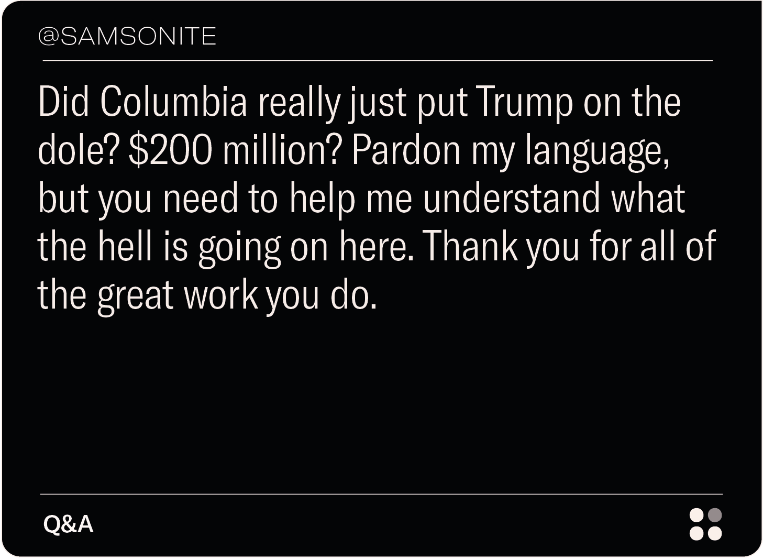
God, you must be very well-spoken, very polite if you have to apologize for “what the hell is going on here” and say, “pardon my language.” For a lot of people, that is actually very elevated language, so congratulations on that.
And then, there's a related issue that I'll get to with this next question, but the Columbia deal basically doesn't make sense on its own, because the idea is it's a deal to restore financing of the U.S. government to Colombia, even though part of the deal is that Colombia has to pay $200 million to the Trump administration, kind of as a punishment or a fee, they're accepting that they'll lose $200 million for all that naughty and bad things that they did in allowing too much criticism of Israel, and allowing protests to get out of control in the view of the Trump administration – in general, just allowing too much antisemitic thoughts and ideas and expression to the point that Jewish students are being endangered. There are also lawsuits brought by Jewish students against Columbia that Columbia is now agreeing to pay millions of dollars in order to settle.
So, congratulations to the very put-upon, marginalized and oppressed Jewish students at Columbia who are now going to get major payoffs for all the hardship and the harassment and the oppression and marginalization they had to endure from seeing protests that made them uncomfortable.
You can believe that Columbia University allowed the protest to get out of hand if you want. We've gone over this many times before. The history of student protests in this country has been an iconic part of the college experience. The protest against the Vietnam War in the ‘60s were infinitely more disruptive and radical than the protests throughout 2023, mostly into 2024, at most campuses where the resistance was largely symbolic. The campus protests at almost every school, including Columbia, were filled with Jewish students themselves, despite all the speech about how these protests were dangerous and harassing for Jewish students; huge numbers of Jews composed these protests and these encampments. We interviewed several of them to the point that every Friday night, inside the Columbia encampments, supposedly the most antisemitic one, the most dangerous one, with a history at the school of antisemitism, there were Shabbat dinners for all the protesters where Muslim, Christian and Jewish students, as part of these protests, would all get together for Shabbat dinner. They celebrated Muslim holidays and Christian holidays together.
So, there was a huge exaggeration, which there always is, of any threat anytime the government wants to seize power over our private institutions or academic institutions. There's also a lot of misconception about the funding that comes from the U.S. government to these universities. The government doesn’t fund universities and just say, here's $500 million for you to use how you want. They task these universities who can attract the greatest minds from all over the world to pay for research facilities and labs, to research cures and treatments, to research all sorts of technology, including military technology. That's where a lot of military technology comes from. It's not a charity. It's being done to keep the United States competitive. A lot of the research ends up being done in our elite universities and never before has this money come with attachments about what views can be heard on campus or what kinds of professors can teach certain things and how they have to be approved by the government.
So, two of the things that Columbia University has done that jeopardize free speech rights and academic freedom, not for foreign students and not in ways that pertain to the right to protest, it has nothing to do with the protest, it has nothing do with foreign students, it's purely about the expression of ideas, the peaceful expression of ideas in a classroom, in a student newspaper or what can be taught in schools. Part of it is that the curriculum for certain departments, obviously beginning with the Middle East Studies Department, which is the one of greatest interest to the government because that's where Israel can be criticized and discussed, now has to be subject to the review of the federal government. And on top of that, and even worse, the Trump administration demanded that Columbia adopt what Harvard has already adopted under government pressure and other universities as well, which is a radically expanded hate speech code that outlaws and bans ideas that have always been permissible to express at our leading universities under the First Amendment and the basic notions of academic freedom, but that are not outlawed.
You're not allowed, for example, to call Israel a racist endeavor, even though you're allowed to call the United States a racist endeavor, even though you're allowed call any other country a racist endeavor, just not Israel. You're not allowed to say that Jews played a role in killing Jesus, even though Christians have believed this for centuries: not allowed to say. It's not like you can say it and then other people get to debate it. That's now deemed antisemitic. You can't subject Israel to criticism that you can't prove you subject other countries equally to the exact same criticism. So, like if you criticize Israel for engaging in a genocide, but you haven't said the same thing about some faction in the Sudan that does the same things, you can be guilty of antisemitism. Even you may not talk about the Sudan because your government has no role in it, while your government funds and arms what's happening and what's being done in Gaza.
Suddenly, you have this burden of proof when you criticize Israel to show that you criticize other countries in exactly the same way. You don't have that burden to prove for any other country. You can criticize China without having to prove that you criticized other countries in the same ways. The burden is only for Israel. You're not allowed to say that certain Jewish individuals seem to have more loyalty to Israel than they do to the United States, even though it's so clearly true. People like Ben Shapiro and Bari Weiss and so many others, you are not allowed to say that anymore, not allowed to express that. If you do, you're now in violation of the expanded hate speech code. And the whole point of this is to severely chill what can be said to young people about Israel, what young people can say about Israel on college campuses, about risking punishment.
I want you to think about that for a minute. How unbelievably severe that is, how seriously grave an assault on free speech that is, not in defense of marginalized American groups, which is bad enough, but in defense of a foreign country and its interests and those who are loyal to it. Remember, the Trump movement spent a decade viciously mocking the idea that marginalized groups, minority groups and college campuses were intended to feel safe by banning ideas that make them uncomfortable. Now, that's exactly what the Trump administration required Columbia to do in exchange for having its research funding restored – and Harvard as well.
What's happening is everybody sees the same polling data that we've shown you, that huge numbers of people in the United States have dramatically revised toward the negative side, their views of Israel and the U.S. relationship to Israel. And there's panic over that among Israel and its loyalists in the United States, who are reacting to that by trying to squash and destroy any place that allows criticism of Israel. Remember, the reason why the TikTok ban passed was not because of the China issue, which never got enough votes or near enough. It only got enough votes after October 7, when enough Democrats got convinced that one of the reasons why so many young people had turned against Israel and were against the war in Gaza was because TikTok was allowing too much anti-Israel pro-Palestinian sentiment to be expressed and they wanted to either force TikTok to close because of that or to force it to be transferred to a corporation that would be much more aggressive about censoring material that the government wanted suppressed.
Right now, there's this amazing thing happening where Paramount is involved in a major merger. That's the parent company of CBS News and other networks, as well, and the idea of the merger, basically, is that Larry Ellison's son – Larry Ellison, the founder of Oracle who's worth $30, $35 billion – his son, the heir to the Ellison fortune and the Ellinson family are fanatical supporters of Israel, are buying CBS News, with “60 Minutes” being one of the examples and “60 Minutes” has been widely criticized for having broadcast a lot of reports that are very pro-Israel, but also some that were critical. And not only is he now taking control of CBS, but he's negotiating with Bari Weiss to buy her Israeli government state outlet, the Free Press, for something like $200 million. And not only will the Free Press then become part of CBS News, but she will have some sort of ombudsman role or even a correspondent role at “60 Minutes.”
So, you see this change in public opinion about Israel, and then you see the response, which is attacking all of our major institutions, imposing censorship on them, and using billionaire wealth to buy up these media outlets, and then installing within them people who are going to ensure that the content is completely pro-Israel. I hear all the time, they ask, like, “Why do you talk about Israel so much? Why are you so obsessed with Israel?” Obsessed with Israel? These are the people who are passing laws and bills and doing things every single day on behalf of Israel. The people inside government, in the largest corporations, and now in our academic institutions.
Of course, I'm going to report on it. I'm going to focus on it a lot more when our government is paying for what I think is the greatest atrocity in humanitarian crime of the 21st century, which is the genocide and mass starvation in Gaza. But beyond that, it has all kinds of repercussions here at home. And they never stop. And here's just one more example.
This is from someone called @YourLastUberDriver trying to think of what the implications of that might be. But I guess it's inspiring in the sense that if you're afraid there's a disappearance of Uber drivers, this person who asked this question will be there toward the end. They're going to be your last Uber driver. And they seem very wise, very reliable, so perhaps that's good.
@YourLastUberDriver says this:

Yes, there is bipartisan legislation designed to impose greater censorship powers over the internet, over Big Tech, which we all agreed, I thought, was a terrible thing. It has bipartisan support. It's led by Congressman Josh Gottheimer of New, who's a fanatical supporter of Israel, he's a Democrat from New Jersey, as well as Don Bacon, who is a Republican from Nebraska, who is also a fanatical Israel supporter. And it comes from the ADL, whose job is to censor American discourse on behalf of Israel.
Here's Congressman Gottheimer and Congressman Don Bacon at a George Newt conference, heralding their censorship legislation to force Big Tech to censor what they regard as antisemitic.
Video. Josh Gottheimer, Don Bacon, AD. July 24, 2025.
I want to just emphasize that last point. He's talking about his legislation and then he says what he's particularly proud of. Wow, that's something to be so proud of. You're introducing a censorship law for American citizens, and you have the approval and background of a group with a long, aggressive tradition of demanding that people be fired or censored if they become critical of Israel. Congratulations.
The Republican Congressman Bacon is a member of Congress who receives massive funding from AIPAC, needless to say, people are offended by his views. He's a public figure and he gets criticized on Twitter, and he sees it. People are calling him a Zionist, someone who's too loyal to Israel. He doesn't like it. And now he wants to enact a bill drafted by the ADL to force Big Tech to censor what he considers antisemitism. We don't think there's anti-black racism all over Twitter. Go look at Ilhan Omar's tweets and things that people say to her in response, or Jasmine Crockett. Go look at what Pete Buttigieg gets. You don't think there are all sorts of very anti-gay animus directed at him. Every single person in public life, no matter who you are, deals with that. Most of us are adults. We understand that it's actually healthier to allow free speech. I mean, if we hear things we really dislike, that are really ugly, it's in our bloodstream as Americans to kind of believe that about free speech, that yes, you get insults and all sorts of vituperative comments about things about you and who you are. But most of us don't have the impulse to go and censor that. And it's especially important to allow the public to express criticisms of political figures, elected officials in Washington, who are doing something like financing and arming a war. You're allowed to speak aggressively toward them, even if they don't like it. He's not even Jewish. Josh Gottheimer is Jewish. Congressman Bacon is not even Jewish. He's like, “I'm getting so much antisemitism in my Twitter feed.” Who cares? Stop reading it if it really bothers you. But passing a bill to force Big Tech to censor the stuff that you think is unpleasant!
Why is antisemitic speech more disturbing to you than anti-Black speech or anti-Muslim speech or anti-LGBT speech or anti-immigrant speech, which is also all over the place? My view on all of it is the same, which is that it's not the role of the government nor Big Tech to censor any of it. But this is what's happening throughout the democratic world. It's particularly happening in the EU, Canada, and, worst of all, in Brazil.
We have a First Amendment that makes it more difficult, and that's why they're trying to outsource it to Big Tech. This is exactly what I thought we were all so angry about: what the Biden administration did when they forced Big Tech to censor dissent on COVID, on the 2020 election and on Ukraine. And that's what I mean. I'm the one obsessed with Israel when you have everyday members of Congress like this standing up and introducing new bills on behalf of a foreign government that attack our free speech rights as Americans. Yeah, I'm going to talk about that a lot.
All right, here is @AntiWarism who says:
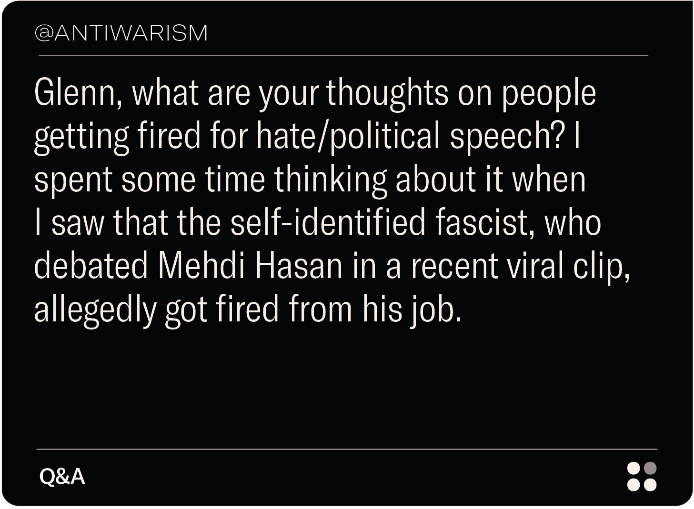
Yes, this was the idea of “cancel culture” and the objections to it. It wasn't about government attacks on free speech, which is a violation of the First Amendment. It was the ideal that if you express views that are disliked by mainstream thought, that now you get fired, you get canceled, and it happens not just to people in prominent positions, but also to people on lower-level positions.
So, here's the example. Honestly, I hate this whole format that has become popular, this Jubilee format. I can't stand how Mehdi Hassan debates. He wrote a book saying, “I'm the greatest debater” and really all he does is just filibuster and talk over people. Maybe you get out four or five words until he starts speaking over you and he thinks that's somehow an effective way of debating.
But here's the person who basically self-identified as a fascist when Mehdi accused him of being one; he then lost his job. I think it's like a 21-year-old kid, all these people at this place were quite young and here's what happened.
Video. Mehdi Hassan, Connor Estelle, Jubilee. July 30, 2025.
Can I understand why an employer would want to disassociate themselves from that person, saying that in that manner? Yes, I can understand that. But I also think that if we have this climate where people cannot say what they believe unless it's completely acceptable to power factions or mainstream forces, that even though we have a First Amendment that restricts what the government can do in theory, oftentimes, cultural repression and social ostracization are much more potent and effective tools for controlling ideas – in fact, George Orwell has wrote a preface to Animal Farm, where he basically said that although the Soviet Union has very overt forms of repression and censorship, if you criticize Stalin, the KGB shows up at your house and takes you away and sends you to a gulag, in Siberia or whatever, that actually the British form of censorship is much more effective. It's basically diluting people into thinking that they're free, but making sure they get fired, they're unemployable, they don't get heard in the media, if they express any opinions outside the very narrow range of accepted opinions. Ironically, his preface couldn't be published because it was too sensitive. It seemed like almost too pro-Russian at a time when the West was entering the Cold War. His preface was censored, but it's now available; you can go read it online. I think it's absolutely right.
There were all these examples in the Black Lives Matter movement, or Me Too, when low-level workers got fired for any kind of questioning or deviation from the right language. They had a truck driver who supposedly made the okay sign at a traffic stop, which was interpreted as a white supremacist message, and he got fired. Media outlets were doxing people for comments they were leaving to get them fired. That climate is incredibly repressive, intimidating, but after October 7, huge numbers of people in media, Hollywood and politics and journalism were fired for expressing criticism of Israel and their destruction of Gaza in academia as well. And suddenly, all the concerns about cancel culture disappeared.
So, if you're 21 years old and you basically say “I want Trump to be a king and an autocrat and that's because I'm a fascist, self-identifying as a fascist is going to fall rather shockingly on the ears of a lot of people in the United States. And if you're an employer who deals with the public and you're a private company, especially if you are in a certain community and deal with a certain group of people, it might be very harmful to your business interests to have somebody like that employed. So I understand why that could happen.
Again, if this were an isolated case, I would say: when you live in a society, you do have to kind of think about how you express yourself and what effect it has on others; if you decide you don't, then you probably are going to suffer consequences. It’s just a lesson you learn in life, living in a society; you have to accommodate, to some extent, how you're perceived.
But I also think that it can be very dangerous if it becomes too much of an automatic reaction, which, in a lot of different ways, I think it became, and a lot of the right was very opposed to these sorts of things when it was conservatives who were largely the target of it, and then, after October 7, a lot of that changed. People started applauding much more draconian forms of cancel culture like Bill Ackman, spearheading and organizing a blacklist among the most powerful law firms, Wall Street banks and hedge funds to vow never to hire undergraduate kids, 18 to 22, who sign a letter condemning Israel for their use of indiscriminate violence in Gaza, trying to make sure they're unemployable and having mass firings of people who express similar views. I noticed the disappearance of the concerns over cancel culture when that happened. And so, if you're going to be concerned with cancel culture and you don't apply it equally, it's like anything, not really a principle.
All right, last question is from @KCM71, who says this:

Let me say, I find this dynamic so fascinating that whenever the American left is faced with a nominee from the Democratic Party that they hate, they are Joe Biden or Hillary Clinton or countless senators or whomever, they're told it's your obligation to support and vote for whoever your party nominates, whether you like them or not. But the minute there's a nominee of the Democratic Party that the Democratic Party nominates who the establishment hates and the left likes, that obligation disappears.
I still believe, in 2016, had the DNC not cheated and Bernie Sanders had won the Democratic nomination, Democratic Party elites absolutely would have done everything to prevent him from being president, even if it meant electing Trump because what party leaders typically fear the most is the loss of their prerogatives within their own party. They would rather lose and keep control of the party than win if it means this shifting to some new group or some new generation.
We especially saw that when Jeremy Corbyn became the leader of the Labour Party and the vast majority of Blairites and people in the center and the center-right of that party, overwhelmingly and overtly sought to destroy him, not to get a new party leader in, but to ensure that he lost the election. They would rather have lost to Boris Johnson, had Boris Johnson become prime minister, which is what happened, than lose control of the Labour Party by winning under Jeremy Corbyn.
This is why I don't think that the Democratic establishment and elites believe they can stop Zohran at this point, in part because the alternatives are just so weak. I mean, you have Andrew Cuomo completely plagued by all sorts of scandal, just old, not really having anything to do with New York City, clearly not even wanting to be mayor; you have Eric Adams who caught red-handed taking bribes from Turkey and was only let go because he did a deal with the Trump administration to allow ICE to operate in New York City and then Curtis Sliwa, who's not a serious candidate, but are going to divide the vote enough to ensure that Zohran will win – not 100% sure anything could happen, but I think they're kind of resigned to it.
But they also are afraid, more so – you see this with Hakeem Jeffries: Zohran Mamdani won Hakeem Jeffries’ congressional district by 12 points and yet, Hakeem Jeffries, the head of the Democratic House caucus in New York, refuses to endorse Zohran Mamdani. Left-wing people to this day got angry that Bernie Sanders didn't endorse Hillary Clinton quickly enough. He went around the country campaigning for her, but they say he didn't do it enthusiastically enough.
But look at the prerogatives they take for themselves and there's never a point at which the left says, God, these people hate us so much. Like, why are we giving them our support when they so blatantly subvert and sabotage our candidates. You would think they would just have some dignity and finally leave. Jeremy Corbyn finally left the Labour Party, but only this week. He and a much younger, leftist member of parliament whose parents or grandparents were Pakistani immigrants to the U.K. – but she was born in the U.K. as her parents were third generation now, U.K. citizens – the two of them are the co-leaders of this new party in protest of the Labour Party's support for Israel and other policies as well because they concluded that there's no way within the Labour Party to actually reform. They will sabotage you if you try.
And this is something we saw with AOC, when AOC was running and won her primary, in 2018, against a very senior member of the Democratic leadership, Joe Crowley, who was really in line to become House Speaker once Nancy Pelosi left, she sounded all these radical notes. I interviewed her. I was amazed at how thoughtful she seemed to be about making sure that her primary criticisms are directed mostly at the Democratic Party, how she understood that her main job had to be to go in and change the Democratic Party and not the Republican Party, so that there were two actual parties with two different sets of views. She gets in and she understands that to play the game, to get ahead, to gain power, you have to compromise constantly, become a good Democrat. She's barely distinguishable from Nancy Pelosi at this point. Remember, AOC just voted last week to send $500 million in military aid to Israel while calling it a genocide. Even while four members of her own party, Ilhan Omar, Rashida Tlaib, Summer Lee and Al Green, all voted for Marjorie Taylor Greene's amendment to block that money from going there. AOC voted to send $500 million to Israel.
One of the things that got my attention about her in 2018 was when she said – this was at the time when the Palestinians were doing their peaceful march up to the border fence, and the Israelis started just sniping them to death – and AOC said, “It's time for the Democratic Party to stop supporting these grotesque human rights abuses by Israel.” And I thought, OK, that's interesting to me. And now, here she is just a few years later, sending $500 million to Israel while pretending to believe that Israel is engaged in a genocide.
So, there is the very real question of whether somebody who's very politically ambitious, as Zohran Mamdani is, can possibly change anything with any party system that is designed to destroy any challenge to its leadership, to its core dogma, to its donor base. And you see him making some concessions already. And while I still hope he wins given the alternatives, I mean the part of the debate alone where they said, “What's your first foreign trip going to be? And they all said, “We're going to go to the Holy Land and we're going to go right to Israel and we going to take our first trip to Israel” and he said, “I'm going to stay at home and work on the affordability issues facing the people of our city.” That alone, that kind of politics – as mayor of an American city, my job is to focus on the American people and not go pay some homage to Israel or to some other foreign country or that he understands that affordability and economic populism is the key issue, not culture war stuff, which is what he ran on in his campaign – those are the kind of things, that populist messages, that I think we need more of, both on the left and the right. But if you ask me, do I think he's going to immediately start compromising? Then my answer is probably going to be yes, because he's going to have to work with the Democratic Party infrastructure to get anything done.
I think I might have talked about this before, but I'll just tell this quick story. When my husband got elected to become an elected official and got into elected office, first as a city councilman in Rio de Janeiro, and then as a member of the Brazilian Congress, I saw this firsthand. He wanted to go and introduce packages and laws and projects to help the people of his community, the people who voted for him, and whom he felt an obligation to serve. The only reason why he was interested in politics was to try to change people's material lives for the better. And then you get there, and you hear like, “Oh, that seems like a good bill. We're not sure we can get it to the fore, though. But if you're willing to support this project of mine, it's kind of corrupt, like just about greasing the wheels, then, maybe, you'll be able to get your bill to the fore and we support you.” You're suddenly faced with this choice: do I now start compromising and becoming part of the system in the hope that I can actually get the things done that I want to get done or do I just stand on principle and say, no, I'm not going to play your game, even if it means I can never get my things to the floor? Maybe in 10 years you can use your charisma and ability to get a platform.
When you first get there, you're faced with these huge obstacles where, if you want to do anything, you have to play the game. And then, at some point, you have to consider how much are you really compromising to serve your original goals, or how much are you now compromising because you want to get on the key committees, and what are the motives that you want to get on the keys committees, is it because that's a better path to power? It's a very, very difficult road to navigate. Even if you arrive with the best of intentions, you find yourself in this corrupt, sleazy system constructed to co-opt you and to basically get you to play the game that you were running to destroy and it's very hard once you're immersed in it to see what the real principles are and what the real compromises are that are going to actually undermine what you set out to be. I think the only way to do that is by avoiding the structures that are already so fundamentally rotted and so fundamentally corrupt that they're going to contaminate you the more you attach yourself to them.
I think being part of the Democratic Party is going to guarantee that you end up on the AOC to Pelosi path. Remember, Nancy Pelosi, when she started a career from San Francisco, was considered way to the left in the Democratic Party and by the end, she had no ideology. She was just a manager, like a technocrat, supporting wars and Wall Street and finance, insider trading. That's the path that you end up on and that the system is guaranteed to lure you into. You have to be someone who just has a personality that's very combative, very willing to sacrifice your own ambition and self-interest in career pursuits to combat.
And if you ask me if that's Zohran Mamdani, I don't know him well enough to say one way or the other for sure, but it doesn't seem like that's what he is to me. Kind of like what Obama pretended to be and then wasn't. Every 10 years the Democratic Party offers a new person like this: here's the exciting one, here's a new one, here's the one who's really going to be on your side. We know you hate our party, we know you hit our dogma, our leadership, but look, we found something really new and exciting for you and it keeps people, young people and people identified as the left, on that path to identifying with the Democratic Party.
Oftentimes, the Democratic Party changes very little; usually, that's the case. Everybody likes to keep up hope. Nobody likes to be defeatist or nihilistic but wants to believe that there's something hopeful. I'm the same way. Why would I wake up and focus on these sorts of things every day unless I believe that there were prospects and hope for positive change?
I've seen positive change. You look at history, you look at current politics. It can happen. Changes in public opinion can happen. You want to believe that if you didn't believe that you would go do something else, if you thought it was all futile. But the road of being lured in by outsiders to the Democratic Party who seek to get into the Democratic Party and assume power within it is one fraught with almost nothing but disappointment, defeat and betrayal, ultimately, a draining of any belief that that continues to be the correct path. And people want to believe that. So, they keep kind of being vulnerable to that sales pitch.
Maybe Zohran will be different. It's possible. But I certainly won't be shocked sitting here six months from now or a year from now if someone comes and shows me or I see for myself all the evidence that he's basically morphing into AOC and then Nancy Pelosi, that will not shock me in the slightest.